Physics: Publication in Nature
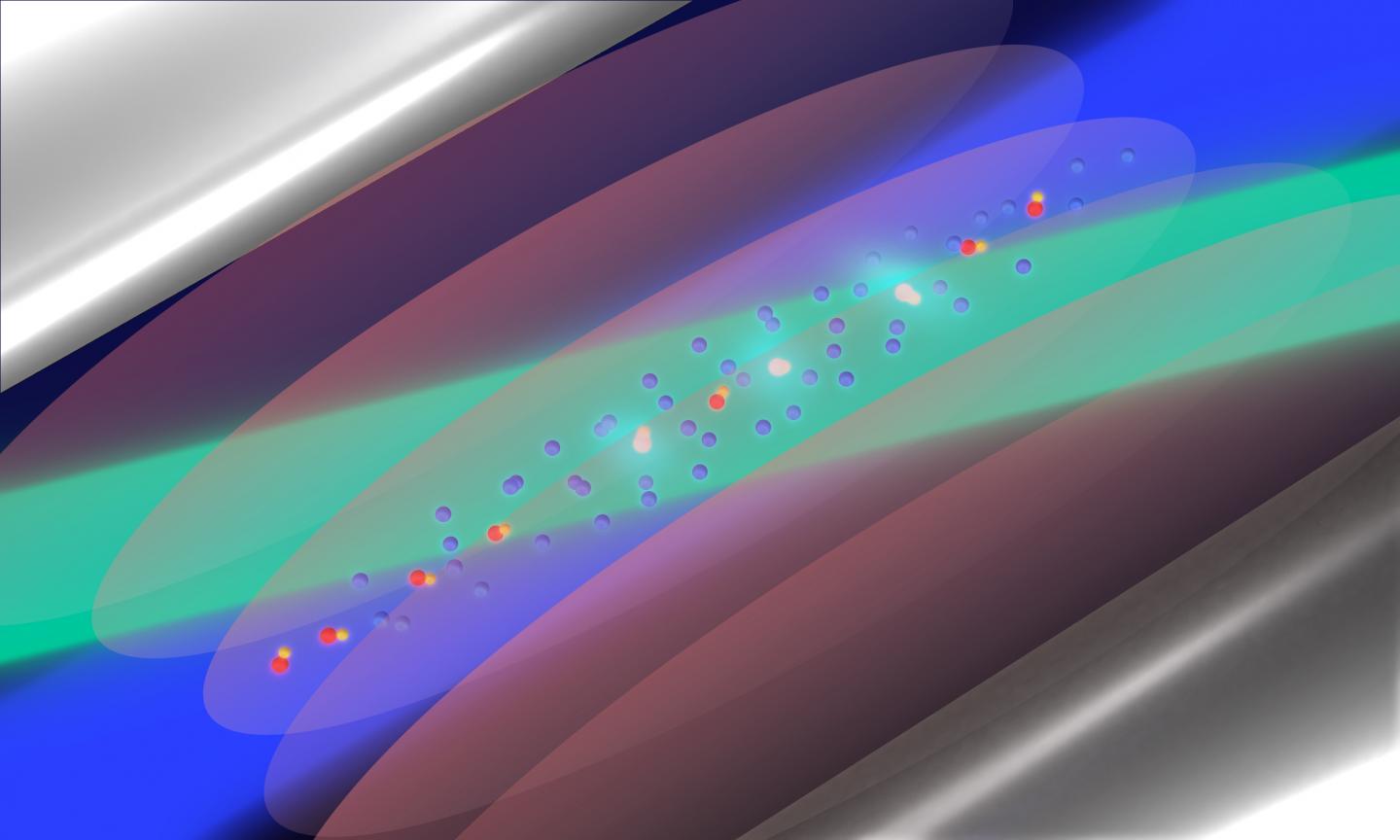
Credit: HHU / Alighanbari, Hansen, Schiller
The universe mainly consists of a novel substance and an energy form that are not yet understood. This ‘dark matter’ and ‘dark energy’ are not directly visible to the naked eye or through telescopes. Astronomers can only provide proof of their existence indirectly, based on the shape of galaxies and the dynamics of the universe. Dark matter interacts with normal matter via the gravitational force, which also determines the cosmic structures of normal, visible matter.
It is not yet known whether dark matter also interacts with itself or with normal matter via the other three fundamental forces – the electromagnetic force, the weak and the strong nuclear force – or some additional force. Even very sophisticated experiments have so far not been able to detect any such interaction. This means that if it does exist at all, it must be very weak.
In order to shed more light on this topic, scientists around the globe are carrying out various new experiments in which the action of the non-gravitational fundamental forces takes place with as little outside interference as possible and the action is then precisely measured. Any deviations from the expected effects may indicate the influence of dark matter or dark energy. Some of these experiments are being carried out using huge research machines such as those housed at CERN, the European Organization for Nuclear Research in Geneva. But laboratory-scale experiments, for example in Düsseldorf, are also feasible, if designed for maximum precision.
The team working under guidance of Prof. Stephan Schiller from the Institute of Experimental Physics at HHU has presented the findings of a precision experiment to measure the electrical force between the proton (“p”) and the deuteron (“d”) in the journal Nature. The proton is the nucleus of the hydrogen atom (H), the heavier deuteron is the nucleus of deuterium (D) and consists of a proton and a neutron bound together.
The Düsseldorf physicists study an unusual object, HD+, the ion of the partially deuterated hydrogen molecule. One of the two electrons normally contained in the electron shell is missing in this ion. Thus, HD+ consists of a proton and deuteron bound together by just one electron, which compensates for the repulsive electrical force between them.
This results in a particular distance between the proton and the deuteron, referred to as the ‘bond length’. In order to determine this distance, the HHU physicists have measured the rotation rate of the molecule with eleven digits precision using a spectroscopy technique they recently developed. The researchers used concepts that are also relevant in the field of quantum technology, such as particle traps and laser cooling.
It is extremely complicated to derive the bond length from the spectroscopy results, and thus to deduct the strength of the force exerted between the proton and the deuteron. This is because this force has quantum properties. The theory of quantum electrodynamics (QED) proposed in the 1940s must be used here. A member of the author team spent two decades to advance the complex calculations and was recently able to predict the bond length with sufficient precision.
This prediction corresponds to the measurement result. From the agreement one can deduce the maximum strength of a modification of the force between a proton and a deuteron caused by dark matter. Prof. Schiller comments: “My team has now pushed down this upper limit more than 20-fold. We have demonstrated that dark matter interacts much less with normal matter than was previously considered possible. This mysterious form of matter continues to remain undercover, at least in the lab!”
###
Original publication
S. Alighanbari, G. S. Giri, F. L. Constantin, V. I. Korobov & S. Schiller, Precise test of quantum electrodynamics and determination of fundamental constants with HD+ ions, NATURE (2020)
DOI: 10.1038/s41586-020-2261-5
Media Contact
Dr. Arne Claussen
[email protected]
Original Source
https:/
Related Journal Article
http://dx.