Primary varicella-zoster virus (VZV) reactivation, the underlying cause of herpes zoster (HZ), is typically recognized for its dermatomal rash and associated neuropathic pain. However, the emergence of systemic complications, particularly fulminant rhabdomyolysis, represents an extremely rare and life-threatening clinical sequela that remains poorly understood, especially in geriatric populations. This case report details the complex clinical course of a 63-year-old female who experienced severe, critical rhabdomyolysis following a history of lumbar herpes zoster, complicated by secondary hypothyroidism. Her condition progressed rapidly from generalized myalgia and oliguria to acute kidney injury, hepatic dysfunction, and respiratory failure, necessitating intensive multidisciplinary care to stabilize her multi-organ failure.
The patient was admitted to the emergency intensive care unit (EICU) with a six-day history of fever and generalized myalgia, coupled with a four-day history of progressive oliguria. Prior to admission, she had developed a localized painful erythematous rash over the left T12 dermatome, which was clinically diagnosed as herpes zoster and treated locally. Six days before presentation, her symptoms escalated, marked by fever, cough, and diffuse muscle soreness, which failed to respond to empirical azithromycin. Over the subsequent four days, while her fever subsided, her myalgia intensified markedly, accompanied by generalized edema and a sharp decline in urine output, leading to urine that appeared wine-colored. Serial laboratory testing revealed a rapid and alarming escalation of serum creatine kinase (CK), rising from 4,383 U/L to 32,183 U/L within 48 hours, prompting her transfer for advanced management.
Upon admission, the patient was lethargic and presented with severe facial and extremity edema, proximal muscle weakness graded at 3/5 in all four limbs, and coarse breath sounds bilaterally. Diagnostic investigations revealed a severe elevation of muscle injury markers. Serum CK reached a peak of 186,383 U/L on the day of admission, alongside markedly elevated levels of lactate dehydrogenase (LDH) at 3,807 U/L, aspartate aminotransferase (AST) at 2,070 U/L, and alanine aminotransferase (ALT) at 565 U/L. Urinalysis confirmed myoglobinuria, showing occult blood 3+, protein 2+, and markedly elevated erythrocytes. Renal function tests indicated significant distress, with a serum creatinine of 67.8 μmol/L and a blood urea nitrogen (BUN) of 8.82 mmol/L. Inflammatory markers were highly elevated, including C-reactive protein (CRP) at 147.4 mg/L, procalcitonin (PCT) at 2.98 ng/mL, and interleukin-6 (IL-6) at 398 pg/mL.
Further investigation into the systemic complications revealed evidence of acute kidney injury (AKI) and hepatic dysfunction. Thyroid function tests were critical in identifying a secondary complication; her TSH was 6.24 mIU/L (above the reference range of 0.60–4.40 mIU/L), with FT3 (1.67 pmol/L) and FT4 (8.17 pmol/L) both below their respective reference ranges. This confirmed virus-induced secondary hypothyroidism. Autoimmune panels, including myositis-specific and associated antibodies, were negative, ruling out autoimmune necrotizing myositis. Imaging, including a thigh MRI, showed subcutaneous edema and intramuscular fluid collection without focal inflammatory masses, and a muscle biopsy of the right biceps brachii provided the definitive pathological evidence. The biopsy revealed extensive myofiber necrosis, degeneration, and lysis, with marked variation in fiber size, but crucially, no inflammatory cell infiltration, confirming a pattern consistent with non-inflammatory rhabdomyolysis.
The clinical course required immediate classification as critically ill and the rapid convening of a multidisciplinary team (MDT) involving specialists in intensive care, nephrology, infectious diseases, rheumatology, and endocrinology. Due to progressive hypoxemia and decreased consciousness, the patient required emergency endotracheal intubation and mechanical ventilation. To manage the severe myoglobin toxicity and electrolyte disturbances, continuous veno-venous hemodiafiltration (CVVHDF) was initiated for nine consecutive days. This aggressive renal replacement therapy was essential for clearing myoglobin and maintaining fluid balance. Concurrently, low-dose methylprednisolone was administered to address systemic immune dysregulation, while levothyroxine replacement was started to counteract the secondary hypothyroidism and potentially improve skeletal muscle metabolic function.
The therapeutic intervention led to a substantial improvement in the patient’s clinical status. Following 12 days of comprehensive EICU management, the patient’s muscle strength recovered and generalized edema resolved. The serial monitoring of muscle injury markers demonstrated a gradual decline in CK, LDH, and AST. By hospital day 12, the serum CK had decreased significantly to 3,381 U/L, alongside reductions in LDH and AST. It is noteworthy that while the initial serum creatinine was within normal limits at admission, the severe rhabdomyolysis preceded the subsequent AKI. Following the cessation of CVVHDF on hospital day 10, a transient rebound in creatinine was observed, peaking at 359.6 μmol/L on hospital day 12, but overall, the patient showed significant recovery of multi-organ function. She was successfully weaned from mechanical ventilation and transferred to a general ward.
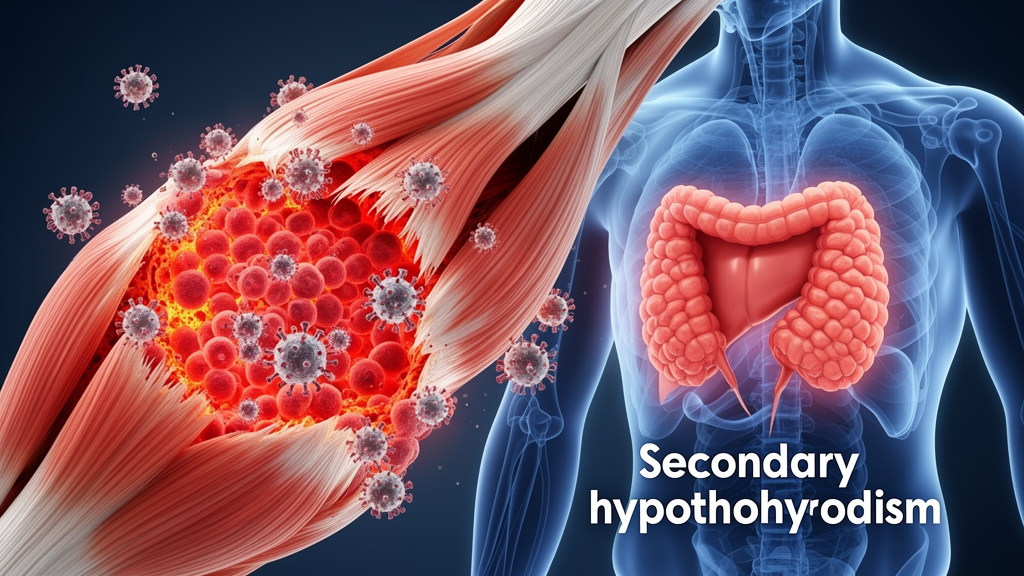
The authors propose a synergistic injury model to explain this extreme presentation. They suggest that while VZV is neurotropic, the primary muscle insult was likely driven by robust systemic immune activation, evidenced by the markedly elevated admission inflammatory biomarkers (IL-6, CRP, PCT). This cytokine-driven process—which causes sarcolemmal integrity impairment and myofiber necrosis—was then critically aggravated by concurrent secondary hypothyroidism. Hypothyroidism is known to impair skeletal-muscle mitochondrial metabolism and reduce ATP turnover, thereby lowering the threshold for muscle damage and making myofibers more susceptible to the inflammatory stress induced by VZV reactivation. This combination of cytokine-mediated stress and hypothyroid metabolic decompensation resulted in the extreme CK elevation.
This rare presentation underscores the critical need for heightened vigilance in elderly patients presenting with herpes zoster. The diagnosis can be easily missed, particularly when complicated by concurrent pneumonia or AKI, and may even present after the cutaneous lesions have resolved. The authors emphasize that clinical suspicion should prompt immediate CK screening, especially when generalized myalgia is present in an HZ patient. Furthermore, markedly elevated CK must prompt a thorough evaluation of thyroid function to identify any potentiating secondary dysfunction. Once severe rhabdomyolysis is established, timely and aggressive multidisciplinary organ support, including continuous renal replacement therapy, is paramount to improving prognosis in this severe but rare condition.
Subject of Research: Herpes zoster-induced critical rhabdomyolysis complicated by secondary hypothyroidism.
Article Title: Herpes zoster–induced critical rhabdomyolysis with secondary hypothyroidism: a case report
Article References: Lv, X., Zhang, B., Yang, W., & Lu, X. (2026). Herpes zoster–induced critical rhabdomyolysis with secondary hypothyroidism: a case report. Frontiers in Medicine, 13, Article 1969501. https://doi.org/10.3389/fmed.2026.1969501
Image Credits: AI Generated
DOI: 10.3389/fmed.2026.1969501
Keywords: Herpes Zoster, Rhabdomyolysis, Critical Care, Hypothyroidism, VZV, Acute Kidney Injury, Case Report, Systemic Inflammation, Herpes, zoster, induced, critical
News Source: Ophelia Keating. (October 27, 2026). Herpes Zoster Triggers Critical Rhabdomyolysis and Secondary Hypothyroidism in Elderly Patient. Scienmag.