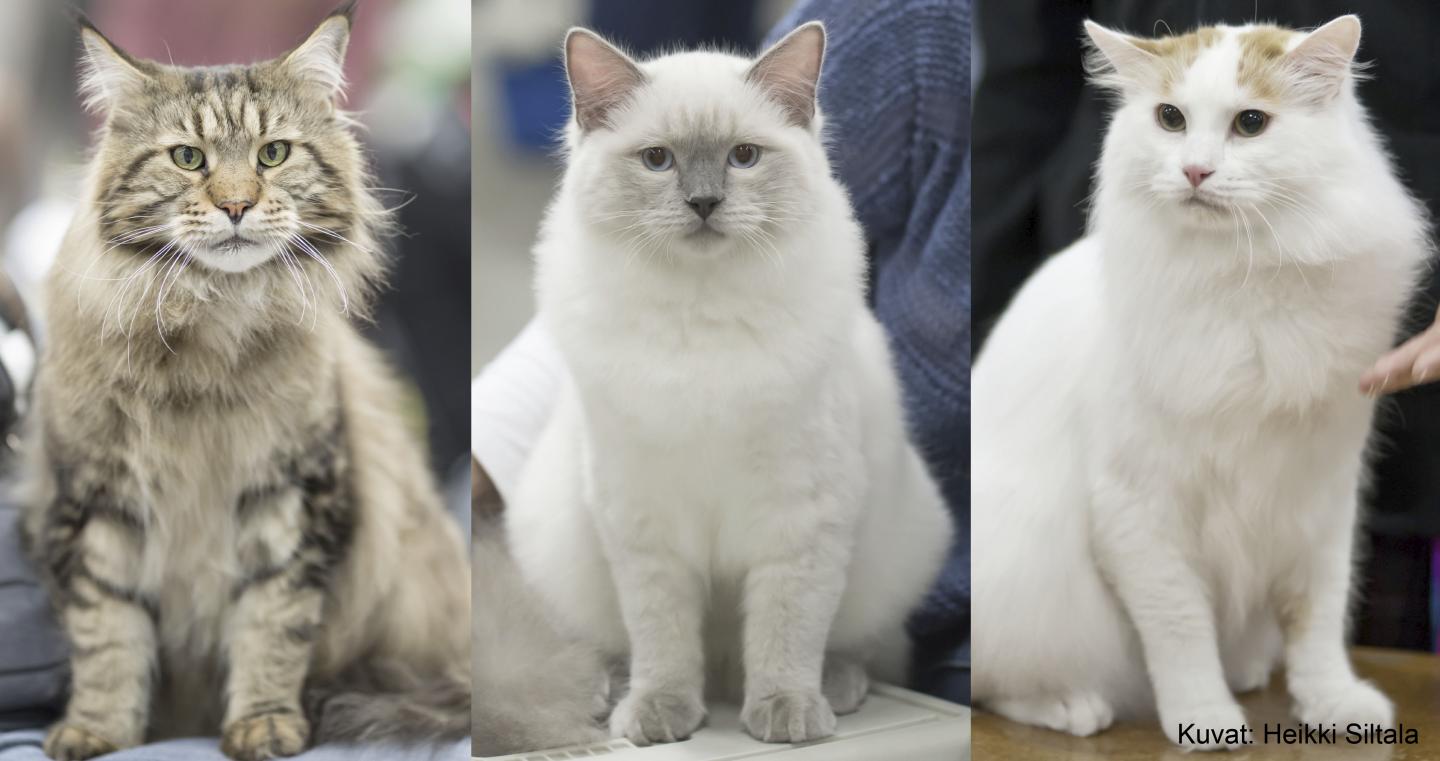
Credit: Heikki Siltala
Cat breeds differ from each other in behaviour with regard to activity, aggressiveness, shyness, sociability and stereotypical behaviour. A study conducted at the University of Helsinki discovered that behavioural traits are highly heritable. Heritability of behaviour explains differences between breeds.
Cats are our most popular pets but few studies have been conducted on their behaviour.
“Dozens of international studies have been conducted on dog breeds’ behaviour traits and heritability, whereas ours is the first study on behaviour trait heritability in cats,” says Milla Salonen (formerly Ahola), doctoral student at the University of Helsinki.
All studied traits manifested differences in behaviour between various breeds: activity level, sociability with humans, shyness, aggressiveness and stereotypical behaviour. The largest differences in behaviour were observed in activity and the smallest in stereotypical behaviour.
“Since the age of about two weeks, activity is a reasonably permanent trait, whereas stereotypical behaviour is affected by many environmental factors early on in the cat’s life as well as later. This may explain the differences observed,” says Professor Hannes Lohi, the principal investigator of the feline genetic research group.
The research group studied the heritability of behaviour traits in three different breeds: Maine Coon, Ragdoll and Turkish Van. These breeds were chosen because there was a sufficient number of questionnaire responses on them and there was also enough information on the parents of the cats.
“Furthermore, these breeds are genetically diverse. Based on prior research, the Maine Coon is related to Nordic cat breeds and landrace cats, while the Ragdoll is related to Western European and American cat breeds. The Turkish Van and Angora seem to have separated from other breeds,” says Lohi.
Approximately half of behaviour traits are inherited
The study discovered that the heritability estimate of behaviour traits varied from 0.40 to 0.50 on average. This means that little under half of the variation in behaviour traits is explained by hereditary variation. Heritability estimates are fairly similar between cat breeds regardless of genetic differences between the breeds.
There are a number of alternative explanations for behavioural differences. It is possible that behaviour has been subject to selection in the breeding of cats. It is possible that the aim has been to make some cats active and some docile. Behaviour traits can also ‘hitchhike’ with some other selected gene, such as the gene for fur or eye colour.
“On the other hand, cat breeds have been bred from local landrace populations, which they continue to genetically resemble. Consequently, the behaviour of breeds descended from cats in the same region may resemble each other due to their common history,” says Salonen.
Based on the current research, differences can be explained partly by genetic similarity and partly by preference for certain features, such as long hair.
“However, discovering the evolutionary background of differences in behaviour traits requires further studies,” says Lohi.
The study utilised feline behaviour questionnaire material on 6,000 cats collected earlier. The material consists of questionnaire responses on 40 different cat breeds. It is the world’s second largest body of material on feline behaviour.
“In March, we published a new and improved feline behaviour and personality questionnaire on the Petsofi platform with the aim of collecting responses on more than 20,000 cats. A sample size this large would allow us to conduct unique research as well as to confirm our current results, and I wish to take this opportunity to thank those cat owners who have already responded to the questionnaire,” says Lohi.
###
Media Contact
Hannes Lohi
[email protected]
Original Source
https:/
Related Journal Article
http://dx.