


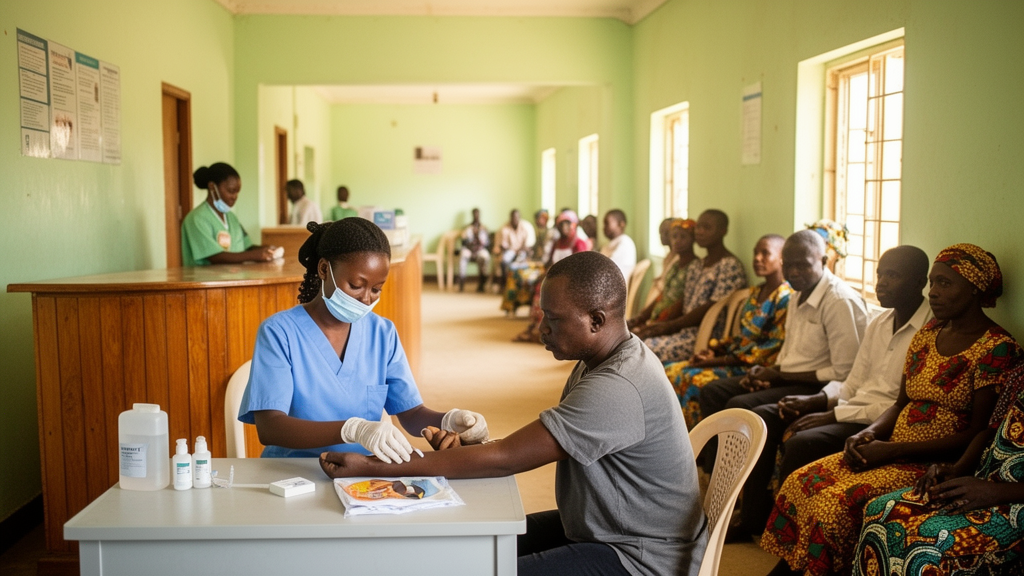
Hepatitis B virus (HBV) and hepatitis C virus (HCV) infections are common among both community residents and hospital patients in Nasarawa State, North-Central Nigeria, according to a cross-sectional study of 852 adults that used laboratory confirmation to classify infections. The overall PCR-confirmed prevalence of HBV was 12.91%, while HCV prevalence was 7.04%, with the two viruses showing different patterns across the study settings.
The study, published in BMC Infectious Diseases on 29 October 2026 as an open-access research article, was led by Awayimbo Ruth Jaggu and colleagues, with Adamu Ishaku Akyala as senior author. It recruited participants from three distinct settings in equal measure: a tertiary healthcare facility population at the Federal Medical Centre, Keffi, and two community-based populations in Akwanga and Lafia Local Government Areas, with 284 participants per setting.
Participants completed structured questionnaires covering socio-demographic characteristics, behaviours, healthcare-related exposures, and household contacts. Screening used rapid diagnostic tests, followed by enzyme-linked immunosorbent assay (ELISA) and polymerase chain reaction (PCR), which served as the reference standard for infection classification. Data were analysed with IBM SPSS Statistics version 26.0, using descriptive statistics, bivariate analysis with crude odds ratios and 95% confidence intervals, and multivariable logistic regression producing adjusted odds ratios, with statistical significance set at p < 0.05.
HBV prevalence was 11.80% in community-based populations and 15.14% in the facility-based population. The researchers report no statistically significant difference in HBV prevalence between community and facility participants (χ² = 1.86; p = 0.206), suggesting the virus circulates at similar levels in both contexts. HCV told a different story: prevalence was 5.28% in community populations but 10.56% among facility-based participants, a difference the authors report as statistically significant (χ² = 7.028; p = 0.007).
The multivariable analysis identified specific exposures independently associated with each virus. For HBV, sharing of personal hygiene items was associated with infection (adjusted odds ratio = 1.73; 95% CI: 1.06–2.70; p = 0.040), as was a history of sexually transmitted infections (AOR = 2.47; 95% CI: 1.38–4.42; p = 0.030). For HCV, a history of blood transfusion was independently associated with infection (AOR = 2.11; 95% CI: 1.04–4.31; p = 0.040).
These associations come from a cross-sectional design, which measures exposures and infections at a single point in time. The adjusted odds ratios describe statistical associations rather than demonstrated causal effects, and the study’s findings apply to the adults sampled in these three Nasarawa State settings. The authors note that data on prevalence and associated risk factors across community- and facility-based populations in Nigeria, including Nasarawa State, have remained limited, which the study was designed to address.
The higher HCV prevalence among facility-based participants coincided with the finding that blood transfusion history was independently associated with HCV infection, though the study did not test whether this or other healthcare-related exposures explain the difference between settings.
Chronic viral hepatitis due to HBV and HCV remains a significant global public health problem and a leading cause of liver-related morbidity and mortality, particularly in sub-Saharan Africa, according to the study’s background. The authors conclude that both infections remain prevalent in community- and facility-based populations in Nasarawa State, and that the identified behavioural and healthcare-related exposures highlight the need for expanded vaccination programmes, routine hepatitis screening, community education, and strengthened infection prevention and control measures.
The study was published as an early-share, peer-reviewed accepted article carrying a permanent DOI; the publishers note that this version is subject to further edits and will be replaced by the final Version of Record. The authors state that targeted, context-specific public health interventions are required to support prevention, early detection, and management of viral hepatitis, and to contribute to Nigeria’s 2030 viral hepatitis elimination goals. As a single-state cross-sectional survey of 852 adults, the findings describe the burden and associated factors in these specific populations rather than national estimates, and the reported prevalence figures should be read within that scope.
Subject of Research: Prevalence and risk factors of hepatitis B and C virus infections among community and hospital populations in Nasarawa State, Nigeria
Article Title: Burden and risk factors of hepatitis B and C virus infections among hospital and community populations in North-Central Nigeria
Article References: Jaggu, A. R., Ishaleku, D., Jaggu, A. Y., Ojji, O. I., Abdullahi, Y. Y., Manzah, G. A., Olaiya, O., & Akyala, A. I. (2026). Burden and risk factors of hepatitis B and C virus infections among hospital and community populations in North-Central Nigeria. BMC Infectious Diseases. https://doi.org/10.1186/s12879-026-14763-9
Image Credits: AI Generated
DOI: 10.1186/s12879-026-14763-9
Keywords: hepatitis B, hepatitis C, Nigeria, Nasarawa State, prevalence, cross-sectional study, risk factors, blood transfusion, public health, viral hepatitis, PCR, ELISA
News Source: Kristina Jarvis. (October 29, 2026). Hepatitis B and C remain common across community and hospital populations in Nasarawa State, Nigeria. Scienmag.



