Researchers from the University of Portsmouth are collaborating with the British Virgin Islands government to help make its inhabitants and biodiversity more resilient to the impacts of climate change.
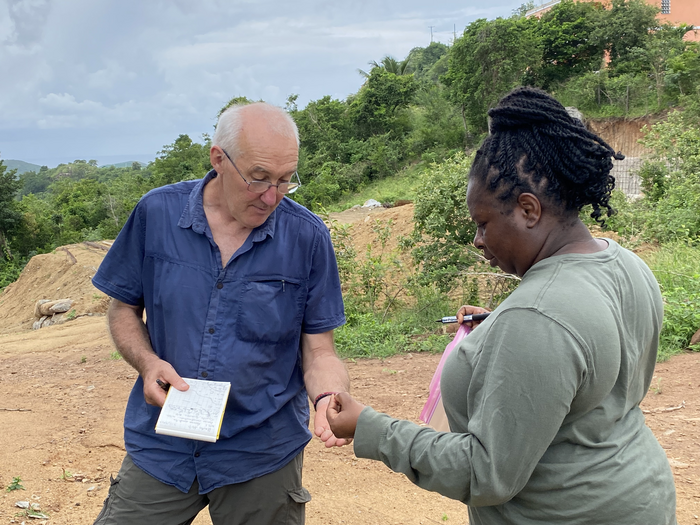
Credit: DDM/Chrystall Kanyuck-Abel
Researchers from the University of Portsmouth are collaborating with the British Virgin Islands government to help make its inhabitants and biodiversity more resilient to the impacts of climate change.
For many years, stakeholders have been missing crucial information about soil layers that would help inform hazard assessments, planning approvals, agricultural land use, environmental impact reports, future infrastructural development, and the rehabilitation of the Territory.
Working with the Department of Disaster Management (DDM) and other government agencies, the researchers are conducting a multi-purpose soil survey across the Islands.
The study will produce highly detailed and digitised maps that illustrate the characteristics of each soil type around the Islands. Implementing this new soil data into the Government’s development processes will aid in proper planning, development of new lands, reduction in disaster risk, and improved climate change adaptation measures. The outcome is that developers and other stakeholders now have a resource that will assist in building SMART, resilient and reliable infrastructure for long-term use.
The research team will also provide training in soil sampling and analysis and help establish a soils laboratory at the H. Lavity Stoutt Community College.
Acting Permanent Secretary in the Ministry of Natural Resources and Labour, Joseph Smith Abbott, said: “Detailed soil maps can improve decision making regarding a wide range of topics, including erosion prevention and mitigation, biodiversity conservation, farming and food security, building construction, and waste management.
“This kind of work that is being done today really and truly allows us to better prepare ourselves to adapt to a changing environment.”
The research is being led by Richard Teeuw, Professor of Geoinformatics and Disaster Risk Reduction at the University of Portsmouth. Professor Teeuw said: “We are already finding much more geological diversity than was previously understood.”
DDM Director Jasen Penn said details about soil composition will help improve decision making when it comes to risks like earthquakes and landslides. He also highlighted how the new soils laboratory will help improve future research in the Territory.
“This means that we as a Territory will be able to monitor change, carry out further research on our local soil, and of course, train others to continue this kind of work in the future,” he said.
The two-year £160,900 project is funded by the UK Government’s Darwin Plus (also known as The Overseas Territories Environment and Climate Fund). Throughout the project, soil sampling will continue on the four major islands in the Territory, as well as at key sites for conservation on other sister islands. Portsmouth researchers from the University’s School of the Environment, Geography and Geosciences (Dr Nick Koor, Dr Heather Rumble and Nasos Argyriou) and School of Civil Engineering and Surveying (Dr Fay Couceiro and Professor John Williams) will return to the Islands to conduct fieldwork in January and June 2023.
Partners in the soil study are the Ministry of Natural Resources and Labour; Department of Agriculture and Fisheries; Environmental Health Division; H. Lavity Stoutt Community College; Land Survey Department; National Parks Trust; and the Town and Country Planning Department.