Titanium dioxide is one of the most familiar materials in modern technology, appearing in sunscreens, paints, solar cells, gas sensors and self-cleaning surfaces, yet its usefulness depends on details that are easy to overlook: which crystal form it takes, how large its crystallites are, and how its electronic band gap responds to processing. A new study from researchers at Mangalore University in India offers a detailed, temperature-by-temperature account of how a simple heat treatment transforms sol–gel synthesized titanium dioxide nanoparticles, tracking the material from poorly crystalline anatase to nearly pure rutile and revealing how the optical band gap evolves along the way.
K. S. Swathi and K. Gopalakrishna Naik synthesized titanium dioxide nanoparticles using the sol–gel method, a low-cost wet-chemistry route in which titanium tetra(iv) isopropoxide, a common liquid precursor, is added dropwise to ethanol under constant stirring. Hydrochloric acid was used to set the pH of the solution to 1.4, ensuring that hydrolysis proceeded under acidic conditions. After two hours of stirring at room temperature, the solution was heated to 125 degrees Celsius for an hour, and the resulting gel was pre-heated at 300 degrees Celsius for two hours to drive off reaction by-products and begin crystallizing the material. The white powder was then divided into batches and calcined for two hours in a tubular furnace at temperatures ranging from 300 to 900 degrees Celsius.
The team then subjected each batch to a battery of characterization techniques, including powder X-ray diffraction, Raman spectroscopy, field-emission scanning electron microscopy, energy-dispersive X-ray spectroscopy, transmission electron microscopy, high-resolution TEM, selected area electron diffraction and UV–visible absorption spectroscopy. The X-ray diffraction results told a clear story. Samples calcined at 300 degrees Celsius showed broad, low-intensity diffraction peaks characteristic of the tetragonal anatase phase, a signature of nanoscale crystallites with a large fraction of atoms at surfaces, along with surface defects and amorphous grain boundaries. Samples calcined at 400 and 500 degrees Celsius remained purely anatase, but their diffraction peaks sharpened as crystallinity improved.
The first hint of change came at 600 degrees Celsius, where a very low-intensity peak at around 27.5 degrees in 2-theta, corresponding to the (110) lattice planes of rutile, appeared alongside the dominant anatase reflections. This marked the onset of the anatase-to-rutile transformation. By 700 degrees Celsius the diffraction patterns matched the tetragonal rutile phase, and samples calcined at 800 and 900 degrees Celsius were overwhelmingly rutile. Notably, a faint anatase (101) peak persisted even at 900 degrees Celsius, indicating that the applied temperature and two-hour duration were not sufficient to achieve complete transformation to pure rutile, a phase that in many studies only forms above 1000 degrees Celsius.
Using the Scherrer equation on the most intense diffraction peaks, the researchers estimated that crystallite size grew from about 3.39 nanometers at 300 degrees Celsius to 61.5 nanometers at 900 degrees Celsius. Microstrain and dislocation density, both indicators of crystal defects and distortion, decreased steadily with increasing calcination temperature, confirming that heat treatment suppresses surface defects and amorphous grain boundaries while allowing crystallites to grow. The relative amounts of anatase and rutile were quantified with the Spurr–Myers method, which showed that the rutile weight fraction increased monotonically between 600 and 900 degrees Celsius as enhanced atomic diffusion and grain growth drove the transformation forward.
Raman spectroscopy independently confirmed the phase evolution. Samples calcined up to 600 degrees Celsius displayed only anatase features, dominated by the intense E_g vibrational mode near 144 inverse centimeters, together with the B1g band near 397 inverse centimeters and the combined A1g plus B1g and E_g modes near 513 and 635 inverse centimeters. The 700-degree sample was a hybrid, showing both the anatase E_g band and strong rutile E_g and A1g modes, along with a multi-phonon scattering feature near 230 inverse centimeters. At 800 and 900 degrees Celsius, only rutile bands remained. The team also tracked a gradual red shift of the E_g modes with increasing temperature, attributing it to phonon softening caused by lattice expansion, anharmonic vibrational effects and partial relaxation of residual strain. The phonon confinement model, rooted in the Heisenberg uncertainty principle, explains how smaller particles broaden the phonon momentum distribution and produce asymmetric broadening of Raman bands.
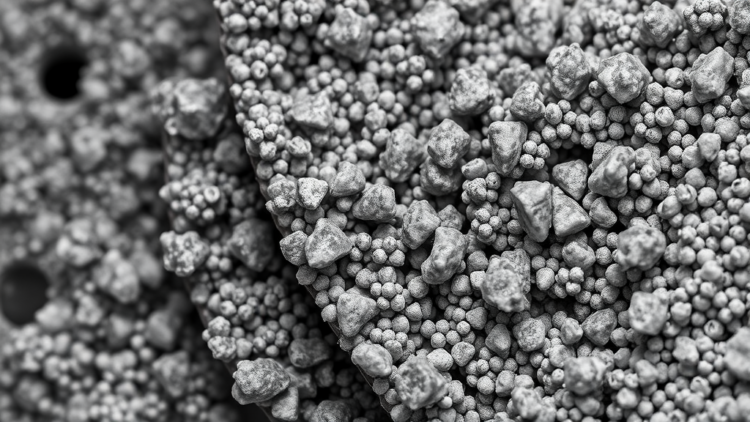
Electron microscopy added a subtle twist. Field-emission SEM images of samples calcined at 400, 600 and 800 degrees Celsius showed micrometre-sized agglomerates of fine, roughly spherical nanoparticles, with no dramatic morphological change across the temperature range. Energy-dispersive X-ray spectra confirmed the presence of only titanium and oxygen. Transmission electron microscopy, however, revealed that average particle size rose from roughly 8.6 nanometers at 400 degrees Celsius to 25.5 nanometers at 600 degrees Celsius, then unexpectedly fell to about 12 nanometers at 800 degrees Celsius before jumping to around 202 nanometers at 900 degrees Celsius. The authors attribute the dip at 800 degrees Celsius to the breaking and rearranging of titanium–oxygen bonds during the anatase-to-rutile transformation, in which distorted anatase octahedra break apart and reassemble into the denser rutile structure, collapsing loosely bound agglomerates into more compact grains.
High-resolution TEM lattice fringes and selected area electron diffraction patterns corroborated the diffraction results. The d-spacing measured at 400 and 600 degrees Celsius was about 0.35 nanometers, matching the (101) planes of anatase, while the 800-degree sample contained grains with d-spacings of both 0.35 and 0.32 nanometers, corresponding to anatase (101) and rutile (110) planes respectively. At 900 degrees Celsius the d-spacing of about 0.25 nanometers confirmed the rutile (101) plane. Inverse fast Fourier transforms of the 800-degree sample revealed structural distortion from edge dislocations, direct visual evidence of the strain involved in the phase transformation. The SAED ring patterns confirmed that all calcined samples were polycrystalline.
Optical measurements revealed perhaps the most intriguing finding. Using Tauc analysis of UV–visible absorption data, the researchers found that the nanoparticles exhibited apparent direct-transition-like band gap behavior, even though bulk anatase is classically an indirect band gap semiconductor. The direct-transition fits produced more linear absorption edges and better near-band-edge fitting than indirect models, which the authors attribute to quantum confinement, structural disorder and defect-induced localized states that modify the electronic band structure at the nanoscale. The sharp absorption edges, without pronounced tails, suggested low densities of localized defect states and improving crystallinity with temperature. The band gap decreased from about 3.51 electron volts at 300 degrees Celsius to 3.34 electron volts at 700 degrees Celsius as anatase crystallites grew, then settled at 3.33 and 3.25 electron volts for the 800 and 900-degree rutile-dominated samples, consistent with the known band gaps of the two phases.
The study’s significance lies in its integrated view of how a single processing variable, calcination temperature, simultaneously governs phase composition, crystallite size, vibrational response and optical behavior in titanium dioxide. By clarifying why nano-anatase appears to behave like a direct band gap semiconductor and by mapping the gradual, incomplete anatase-to-rutile transformation between 600 and 900 degrees Celsius, the work offers practical guidance for researchers tailoring titanium dioxide nanoparticles for photocatalysis, solar energy conversion and optoelectronic devices, where the balance between anatase and rutile often determines performance.
Subject of Research: Calcination temperature effects on the structural, vibrational and optical properties of sol–gel synthesized TiO2 nanoparticles
Article Title: Calcination effect on the properties of sol–gel synthesized TiO2 nanomaterials
Article References: Swathi, K. S., & Naik, K. G. (2026). Calcination effect on the properties of sol–gel synthesized TiO2 nanomaterials. Discover Industrial Chemistry and Materials, 1(1), Article 3. https://doi.org/10.1007/s44508-026-00003-0
Image Credits: AI Generated
DOI: 10.1007/s44508-026-00003-0
Keywords: titanium dioxide, TiO2 nanoparticles, sol–gel synthesis, calcination, anatase, rutile, phase transformation, X-ray diffraction, Raman spectroscopy, optical band gap, photocatalysis, nanomaterials
Cite Scienmag News
APA MLA Chicago
Bethany Barker. (September 22, 2026). Heat Treatment Steers Titanium Dioxide Nanoparticles from Anatase to Rutile. Scienmag. https://scienmag.com/heat-treatment-steers-titanium-dioxide-nanoparticles-from-anatase-to-rutile/
Bethany Barker. “Heat Treatment Steers Titanium Dioxide Nanoparticles from Anatase to Rutile.” Scienmag, 22 September 2026, https://scienmag.com/heat-treatment-steers-titanium-dioxide-nanoparticles-from-anatase-to-rutile/. Accessed 22 September 2026.
Bethany Barker. “Heat Treatment Steers Titanium Dioxide Nanoparticles from Anatase to Rutile.” Scienmag. September 22, 2026. https://scienmag.com/heat-treatment-steers-titanium-dioxide-nanoparticles-from-anatase-to-rutile/
Copy citation Download RIS
Tags: anataseanatase to rutile transformationcalcinationcrystal morphologycrystal structure controlelectronic properties of titanium dioxideheat treatmentlow-cost nanomaterial fabricationnanomaterialsnanomaterials in solar cellsoptical band gapoptical band gap evolutionphase transformationPhotocatalysisRaman spectroscopyrutilesol-gel synthesistemperature-dependent phase changeTiO2 nanoparticlestitanium dioxidetitanium dioxide nanoparticlesX-ray diffraction