


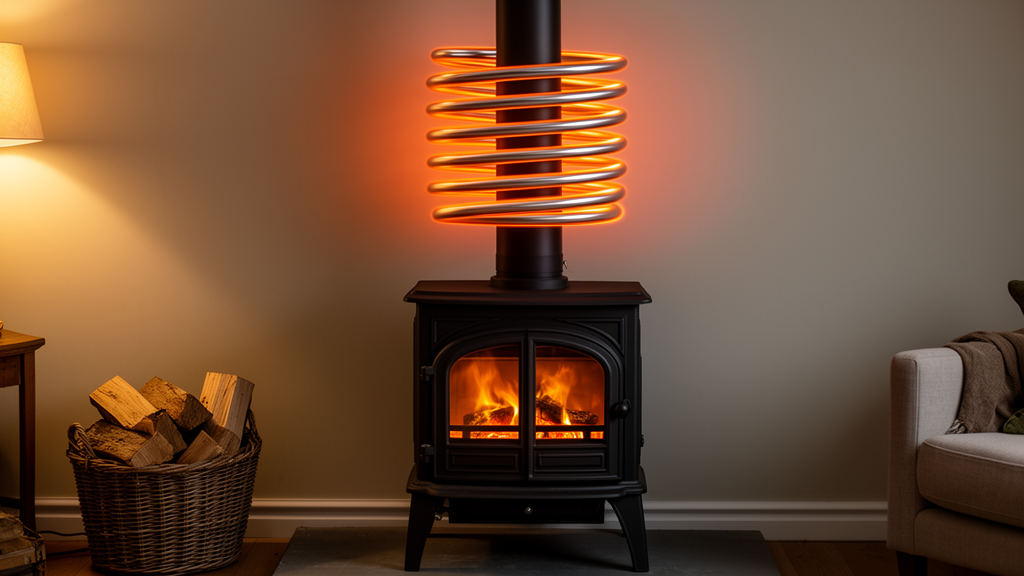
Wood-burning stoves deliver heat in waves. Because split logs burn in batches, the output of a typical stove surges when a fresh load catches fire and sags as the fuel burns out, leaving rooms alternately too warm and too cool.
The study, published in the journal Discover Energy, evaluated the effect of heat accumulation on the course of heat output of a wood-burning stove using wood logs. The motivation, the authors write, comes from the unstable nature of batch combustion, which leads to significant fluctuations in heat supply and a related decrease in thermal comfort. Their measurements were carried out in a calorimetric chamber under three operating conditions: without heat storage, and with heat storage elements around the flue gas path under two different combustion air supply modes.
The headline result is a trade-off that works in the occupant’s favor. Heat accumulation in the presented setup reduced the instantaneous heat output by roughly 15 percent during operation. Compared with the reference variant without heat storage, the average output during the combustion phase fell by approximately 14.15 percent when the combustion air supply was left open after the final fuel load, and by about 15.76 percent when it was closed. That missing energy was not lost. It was banked in the storage mass and released later, smoothing the heat output over time and extending the post-combustion heat-release phase.
The experimental apparatus was a calorimetric chamber built to the methodology of the AS/NZS 4012:2014 standard for determining power output and efficiency of domestic solid fuel burning appliances. The chamber is a thermally insulated, isolated measuring space with a wooden frame covered in OSB boards, a 120-millimeter layer of mineral wool, and an inner aluminium foil lining that limits heat accumulation in the walls. Air is drawn through the chamber by a frequency-controlled fan, and the temperature difference between inlet and outlet air is converted into instantaneous heat output using calibration curves established with electric heaters of known power input. The chamber is designed for accurate, repeatable measurements in the range from 100 watts to 20 kilowatts.
The heat source was a modern fireplace insert with a manufacturer-declared adjustable output range of 2.7 to 7 kilowatts, fueled with naturally dried beech wood cut to the manufacturer’s recommended dimensions. The fuel was characterized by elemental analysis, gravimetric moisture determination, and bomb calorimetry. Combustion was initiated with about 2 kilograms of split wood, and after a transitional refuelling the main measurements began with a standard fuel load of 1.5 kilograms, two logs of roughly 750 grams each. Refuelling was triggered not by a clock but by the carbon dioxide concentration in the flue gas, measured with an ABB AO2020 flue gas analyser: whenever the CO2 level steadily dropped below 4 percent, a new load was added. In practice, the intervals between refuelling cycles ranged from about 30 to 35 minutes, and each experiment included six refuelling cycles, a limit chosen once additional fuel no longer increased the specific heat output.
The storage elements themselves were cladding half-rings made of KZB-8, a refractory concrete classified by the manufacturer as highly accumulative, with high bulk density and dimensional stability under cyclic thermal stress. These were not custom prototypes but commercially available chimney accumulation cladding elements intended to surround a flue pipe. In this cladding arrangement the flue gas never touches the storage material directly; heat passes by convection from the gas to the metal duct, by conduction into the ceramic rings, and then by radiation and natural convection from the ring surfaces into the room. Seven rings were stacked on the vertical flue section, forming a continuous assembly about 700 millimeters tall. Surface thermocouples on every half-ring recorded a maximum temperature of approximately 185.2 degrees Celsius on the lowest ring.
The three operating variants differed only in storage and air control. Variant A ran without storage and with the air supply closed after the final load, mimicking common user practice. Variant B carried the storage rings and left the air open after the last refuelling, letting the remaining char burn out at higher intensity. Variant C combined the storage rings with a closed air supply. Each variant was represented by one complete experimental run, and the authors are explicit that the design provides a comparative assessment rather than a statistical analysis based on repeated runs; no formal uncertainty analysis was performed, although all variants shared the same calibrated chamber, fuel, batch mass, refuelling criterion, and evaluation method.
The most dramatic differences emerged in the low-output tail of the post-combustion phase. In the first 20 to 25 minutes after the final load, output fell from peaks near 9 kilowatts toward 6 kilowatts, with the storage variants running about 14 to 16 percent lower. Between roughly 25 minutes and 1 hour 20 minutes, the curves began to separate, as the storage variants declined more gradually. In the low-output region, from about 1.5 hours to 9 or 10 hours, the effect became fully evident: the stove without storage effectively stopped delivering heat after about 6 to 7 hours, while the storage variants maintained a measurable output above 100 watts for up to 9 to 10 hours. The air supply mode proved secondary, with the open-air variant lasting only slightly longer than the closed-air one.
An energy balance computed by numerically integrating the heat-output curves confirmed the mechanism. The storage variants released less heat during the combustion phase and more during the post-combustion phase, showing that part of the heat generated during burning was stored and released afterward. The benefit amounts to a few kilowatt-hours per combustion cycle, typically 2 to 3 kilowatt-hours. That is modest next to the stove’s peak output, but its significance lies in shifting energy delivery to a period when the stove would otherwise provide nothing, reducing the need for user interaction and supporting a more stable indoor temperature profile.
The authors conclude that accumulating sensible heat appears to be an effective way to stabilize the operation of local biomass heaters, making it particularly suitable for buildings with low heat demand, where a smooth supply of heat matters more than short-term high output. In modern well-insulated homes, they note, a time-varying heat supply concentrated in one location can overheat adjacent spaces, and the mismatch between instantaneous stove output and actual heat demand causes temperature fluctuations that erode comfort. Commercially available storage elements represent an additional investment typically on the order of hundreds of euros, though the study did not perform a detailed economic analysis. The researchers point to future work on optimizing the mass, heat capacity, and placement of storage elements, and on integrating them with flue gas cleaning technologies that could simultaneously cut emissions and exploit residual heat. For now, the message is concrete and simple: a stack of refractory rings around the flue pipe can turn a flickering, wave-like heat source into a steadier companion.
Subject of Research: Experimental evaluation of heat storage elements for stabilizing the heat output of wood-burning stoves
Article Title: Heat accumulation in solid materials during the combustion of solid fuels
Article References: Trač, M., Jaroch, M., Chmelář, M., Krpec, K., Kuo, J.-K., Wang, C.-C., & Ryšavý, J. (2026). Heat accumulation in solid materials during the combustion of solid fuels. Discover Energy, 6(1), Article 64. https://doi.org/10.1007/s43937-026-00184-x
Image Credits: AI Generated
DOI: 10.1007/s43937-026-00184-x
Keywords: wood-burning stoves, heat accumulation, sensible heat storage, refractory concrete, batch combustion, calorimetric chamber, thermal comfort, flue gas, biomass heating, post-combustion heat release, KZB-8, low-energy buildings
News Source: Denise Maddox. (October 30, 2026). Heat storage rings tame the wavering output of wood-burning stoves. Scienmag.



