


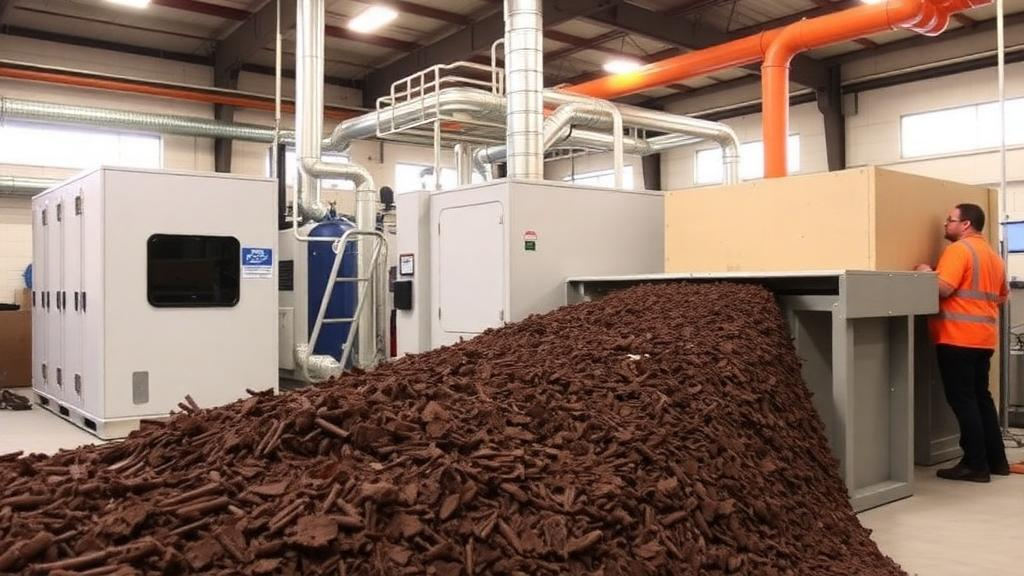
Sewage sludge is one of the least glamorous byproducts of modern life, and one of the most expensive to deal with. That step is also an energy hog: thermal drying accounts for more than half of the carbon emissions in most typical sludge treatment chains, with conventional dryers consuming roughly 800 to 1,400 kilowatt-hours per ton of sludge processed.
A study published in Cleaner Engineering and Technology now reports a detailed simulation, optimization, and full-scale trial of a heat pump assisted low-temperature belt dryer designed to shrink that energy bill.
The core idea behind the system is heat recovery. A heat pump captures the latent heat released when water evaporates from the sludge and reuses it to reheat the circulating air, rather than venting that energy to the atmosphere. Because the drying air stays below 90 degrees Celsius, the approach also suppresses the release of gaseous pollutants such as hydrogen sulfide, ammonia, and volatile organic compounds that plague high-temperature drying. The researchers built the system as a closed loop: the heat pump module generates hot air that meets specified process parameters, the air is ducted to a drying chamber where it exchanges heat with the sludge and vaporizes moisture, and the cooled, humidified air then returns to the heat pump for dehumidification and reheating before recirculating.
Inside the drying chamber, the team deployed a three-tier mesh belt structure and a secondary cutting step: sludge dried to roughly 70 percent moisture content at the end of the first belt layer is cut a second time to increase its specific surface area and improve its shaping. A key design change was the airflow arrangement. In a conventional bottom-inlet, top-return configuration, air becomes cooler and more humid as it passes through the lower sludge layers, weakening the drying driving force in the upper layer. The team instead adopted a center-return configuration with upper and lower air inlets and a middle return outlet, so the upper sludge layer receives heated supply air directly and the airflow paths through the sludge layers are shortened. According to the authors, this arrangement improves heat and moisture transfer and reduces the fan power needed to overcome airflow resistance.
To refine the chamber geometry, the researchers built a computational fluid dynamics model in which the mesh belts and sludge layers were simplified as porous media, and they quantified flow uniformity using the coefficient of variation of velocity across sampling cross-sections. Two optimizations emerged. First, airflow baffles installed at both ends of the dryer reduced local airflow velocities: the simulated airflow volume at the ends of the lower mesh belt dropped 46.43 percent, from 3,919 to 2,100 cubic meters per hour, and the upper belt dropped 31.65 percent, from 5,057 to 3,456 cubic meters per hour, with corresponding velocity reductions from 0.56 to 0.30 meters per second and from 0.79 to 0.54 meters per second. Lower local velocities are expected to reduce dust entrainment, although the authors note that dust entrainment itself was not directly quantified by particle tracking or dust concentration measurements. Second, relocating the fans from the outlet side to a central position lowered the coefficient of variation to 52.8 percent, yielding a more uniform velocity distribution across the belt layers.
The thermodynamic model, which couples heat pump performance with sludge drying kinetics, was validated against a municipal sludge drying prototype at the Liangzhu Wastewater Treatment Plant. The relative error in the moisture content of the dried sludge was about 2.28 percent, and the error in energy consumption per ton of sludge was 3.81 percent, below the 5 percent threshold the team set for design-grade accuracy. With the model trusted, the authors swept through the parameters that matter most to a heat pump drying system, several of which—cooling water flow rate, return air temperature, and air flow ratio among them—had been poorly characterized in earlier work.
Some questions resolved quickly. Adding a regenerator to recover heat at the condenser outlet lowered energy consumption only marginally, from 149.8 to 147.8 kilowatt-hours per ton, and raised the coefficient of performance by just 2.83 percent in simulation. Given that a regenerator adds equipment cost, complicates the system, and introduces pressure-drop risks, the team concluded its influence was effectively negligible and recommended omitting it. Cooling water also proved forgiving: at flow rates of 1.2 versus 4.1 kilograms per second across inlet temperatures of 35, 40, and 45 degrees Celsius, increasing the flow rate did not significantly enhance heat rejection, and even the lower flow rate met the total heat rejection requirement, with the inlet water temperature able to compensate for the reduced flow.
Refrigerant charge, by contrast, demanded real optimization. As the R134a charge increased from 6 to 15 kilograms, the high-side pressure rose, the low-side pressure fell, and heat output shifted between the system’s two condenser stages, changing the outlet air temperatures of the upper and lower drying circuits. Energy consumption per ton of sludge first decreased and then increased with charge, and outlet sludge moisture rose steadily. The simulation identified a charge range of 9 to 12 kilograms as the sweet spot that meets the target outlet moisture while keeping energy consumption relatively low.
The operating parameters told a similar story of trade-offs. Sweeping the evaporation temperature from 32.6 to 36.8 degrees Celsius at a fixed refrigerant charge of 10 kilograms, the team found that the specific moisture extraction rate of the whole system rose and then fell, peaking at 3.84 kilograms of water per kilowatt-hour at an evaporation temperature of 36 degrees Celsius, where energy consumption also reached its simulated minimum of 173.6 kilowatt-hours per ton of sludge. Notably, the maximum heat pump coefficient of performance did not occur at the same evaporation temperature as the best overall system performance, a result the authors cite as evidence that the drying side and heat pump side must be designed as an integrated whole. Lowering the return air temperature from 60 to 40 degrees Celsius raised the heat pump’s coefficient of performance and cut energy consumption, but at the cost of wetter outlet sludge—so in practice, the lowest return air temperature that still achieves the required dryness is the efficiency optimum. Adjusting the air flow ratio, the fraction of circulating gas that bypasses the dehumidifying evaporator, revealed that energy consumption per ton rises continuously as more air passes through the secondary condenser, while outlet moisture falls.
The final test came at engineering scale. Full-scale equipment built to the optimized parameters was deployed at a centralized sludge treatment facility that deep-dewaters sludge to about 70 percent moisture, dries it below 40 percent, and ships it to a waste-to-energy plant for co-incineration. During the monitored operating period in August 2025, incoming sludge moisture held steady near 70 percent while daily throughput per unit ranged from 65 to 88 tons. Discharged sludge moisture stayed consistently below 40 percent, dipping as low as 24 percent on August 12. Daily water removal ranged from 37.8 to 49.5 tons, and measured specific moisture extraction rates ran from 3.5 to 4.5 kilograms of water per kilowatt-hour, peaking at 4.5 on August 8. Stability metrics were equally encouraging: coefficients of variation for feed rate and feed moisture were 8.8 and 1.5 percent, and for discharged moisture, water removal, and SMER were 13.1, 9.6, and 9.5 percent respectively, with most key indicators below 10 percent.
The authors are careful about the limits of their claims. The optimal evaporation temperature of 36 degrees Celsius applies to the conditions they investigated and may shift with different sludge properties and operating conditions. The minimum energy consumption of 173.6 kilowatt-hours per ton came from the evaporation-temperature simulations rather than the plant trial, and the study leaves the system’s carbon footprint and operating costs for future quantitative assessment. Still, by bridging the design gap between drying kinetics and heat pump subsystems with a validated coupled model—and proving the result at full scale—the work offers municipal operators a concrete, measured pathway toward drying sludge with a fraction of the energy their current dryers demand.
Subject of Research: Simulation, optimization, and engineering-scale validation of a heat pump assisted low-temperature belt dryer for energy-efficient municipal sludge drying
Article Title: An energy-efficient approach to sludge drying: Simulation and optimization of a heat pump assisted low-temperature belt dryer
Article References: Wang, Z., Xiao, B., Bi, Y., Cao, F., Song, Y., Du, R., Liu, Y., Zhen, J., & Li, J. (2026). An energy-efficient approach to sludge drying: Simulation and optimization of a heat pump assisted low-temperature belt dryer. Cleaner Engineering and Technology, 35, Article 101337. https://doi.org/10.1016/j.clet.2026.101337
Image Credits: AI Generated
DOI: 10.1016/j.clet.2026.101337
Keywords: sludge drying, heat pump, belt dryer, low-temperature drying, CFD simulation, thermodynamic modeling, SMER, energy efficiency, wastewater treatment, refrigerant charge, evaporation temperature, engineering-scale application
News Source: Denise Maddox. (October 29, 2026). Heat Pump Belt Dryer Slashes Energy Use in Municipal Sludge Drying. Scienmag.



