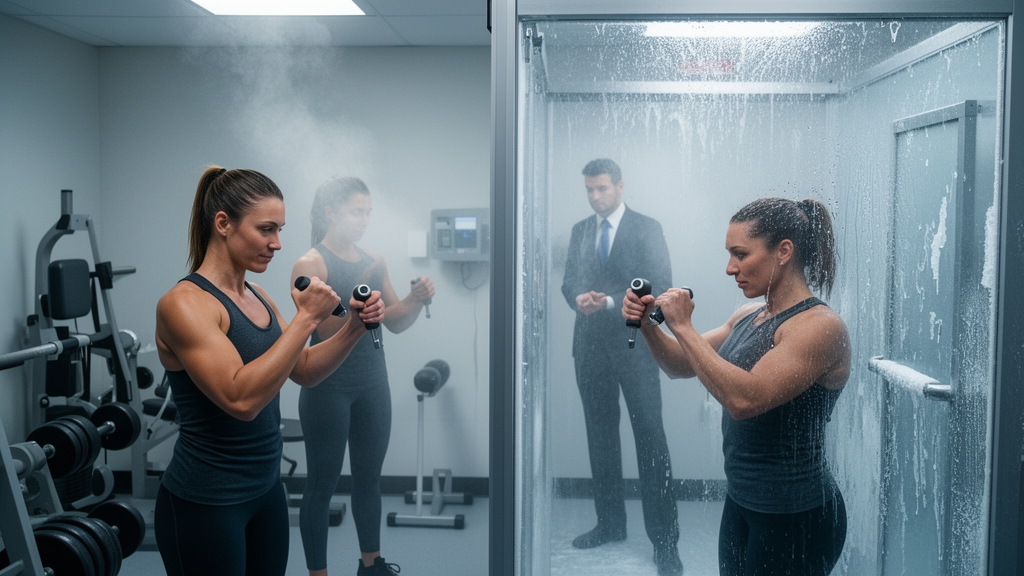
Cold-water immersion did not produce greater recovery of muscle strength than heat-based recovery methods following exercise-induced muscle damage, according to a peer-reviewed study involving 40 healthy, physically active adults. Participants completed an intensive exercise protocol designed to cause temporary muscle damage and delayed-onset muscle soreness, then underwent one of four recovery strategies. Muscle strength improved gradually over the 72-hour monitoring period, but the researchers observed no statistically significant differences among the treatments.
The study, led by researchers at the University of East London and published in the Journal of Thermal Biology, used a randomized four-group design. The conditions were 30 minutes of hot-water immersion at 42°C, 15 minutes of cold-water immersion at 9°C, 30 minutes of hot-air exposure at 30°C, and passive recovery at room temperature. Researchers monitored muscle strength, muscle soreness and molecular markers associated with muscle damage and inflammation during the following 72 hours. Immediately after exercise, strength had decreased by approximately 36% across all groups, providing a common starting point for comparing the recovery approaches.
Although strength recovered over time, the absence of statistically significant differences between the four strategies meant that none of the tested interventions showed a clear advantage for strength recovery. The treatments did, however, produced distinct physiological responses. Participants receiving heat-based recovery showed increased expression of heat shock protein 72, or HSP72, a cellular stress protein associated with protective and repair-related processes in muscle. In addition, concentrations of creatine kinase-MM, a marker commonly associated with muscle damage, returned toward baseline more rapidly in the heat-based recovery groups than in the cold-water immersion group.
These biomarker changes did not translate into significantly greater improvements in muscle strength or reductions in muscle soreness. The findings therefore support an important distinction between biological responses and functional outcomes: heat-based recovery altered markers linked with cellular stress, protection and muscle repair, but those changes did not correspond to superior strength recovery or lower soreness during the 72-hour study period. Lead author Freya Bayne, a lecturer in sport and exercise science at the University of East London, said the results show that physiological changes do not necessarily translate into immediate improvements in functional recovery. She also said further research is needed to understand whether repeated exposure to heat-based recovery strategies might produce longer-term benefits, an effect not established by this study.
The experiment was limited to healthy, physically active adults and followed recovery after a single bout of muscle-damaging exercise for three days. Its results show that, among the specific temperatures, durations and recovery conditions tested, heat-based methods did not offer a statistically significant advantage over cold-water immersion or passive recovery in restoring muscle strength. The clearest supported differences were observed at the molecular level, particularly increased HSP72 expression and a faster return of CK-MM toward baseline in the heat-based groups. Those differences did not produce a measurable functional advantage for strength or soreness over the observation period, and the study did not establish whether the approaches would produce different results with repeated use or in other populations.
Subject of Research: Effects of heat and cold recovery methods on muscle recovery after exercise-induced muscle damage
Article Title: Beyond the ice bath: How heat and cold affect recovery
Article References: Beyond the ice bath: How heat and cold affect recovery. Original publication (Bibliographic details unavailable.)
Image Credits: AI Generated
DOI: Not provided
Keywords: exercise recovery, cold-water immersion, hot-water immersion, hot-air exposure, muscle damage, muscle strength, HSP72, creatine kinase, exercise physiology, randomized trial, Beyond, bath
News Source: Drew Townsend. (October 21, 2026). Heat and cold showed similar muscle strength recovery after exercise. Scienmag.