


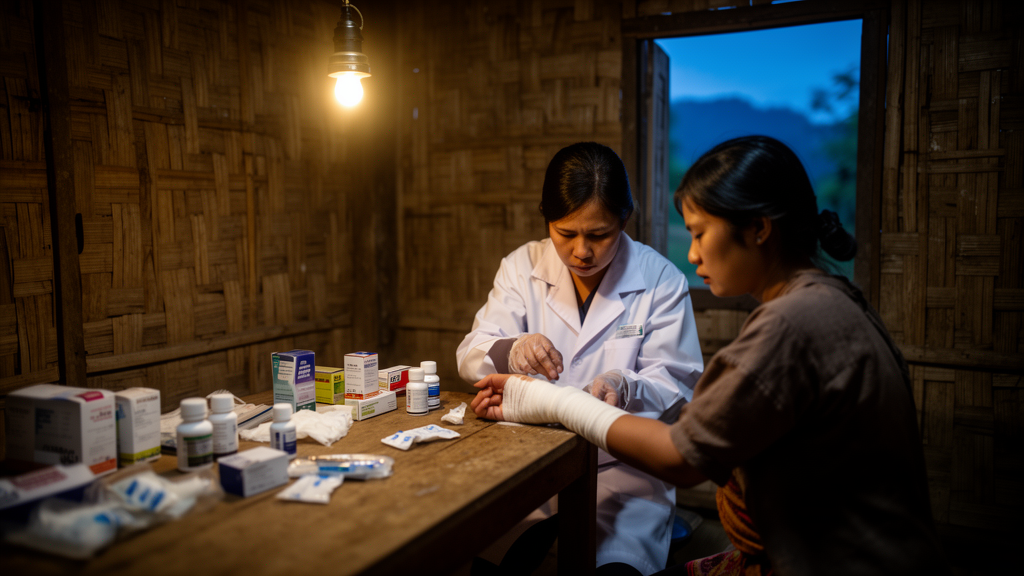
Healthcare in Myanmar’s eastern Karenni State has been sustained since the 2021 military coup by a fragile, improvised network of urban-trained medics, nurses and ethnic health organisation workers, according to a qualitative study published in the journal Conflict and Health. The research, based on remote semi-structured interviews conducted in 2024 and 2025 with 19 healthcare professionals across the state, documents how care is being delivered amid armed conflict, attacks on health personnel and the dismantling of public health programmes.
The study’s background notes that decades of dictatorship left Myanmar with inadequately resourced healthcare and poor health outcomes, despite committed urban medical and rural ethnic health organisation workforces. Some improvements occurred during the post-2011 democratisation period, but the authors report that conditions deteriorated sharply after the coup, with frequent attacks on health workers, the breakdown of public health programmes and large-scale internal displacement of populations.
Participants described social conditions that were often harsh, particularly for displaced populations, driven by poverty, insufficient food and water, and minimal or absent public health services. The health problems they encountered spanned war-related traumatic injuries, communicable and non-communicable diseases, and mental health issues, with women and children identified as especially affected groups.
A central finding concerns how the health workforce has evolved. New arrivals from urban areas have joined established practitioners and ethnic health workers, often working innovatively in challenging conditions. The authors report high levels of individual commitment among these professionals, but also considerable risks and stresses, and they conclude that effective integration and coordination across the different groups remains elusive.
Methodologically, the study collected eyewitness accounts from healthcare professionals about health and social conditions, obstacles to delivering care, and community responses. Interviews were recorded, transcribed and subjected to thematic analysis using accepted techniques. As a qualitative study of 19 participants in a single state during an active conflict, its findings describe the experiences and perceptions of those workers rather than providing population-wide health statistics, and the published version is an accepted-manuscript release subject to further editing before the final version of record.
The authors conclude that pressures on health and healthcare in Karenni State are intense, reflecting both the direct and indirect effects of long-term dictatorship, the breakdown in social conditions and the ongoing armed conflict. They characterise the resulting system of healthcare delivery as complex and precariously balanced, incorporating workers from different backgrounds and ethnicities who, in their words, work courageously but not always harmoniously while supporting the civilian resistance and delivering much-needed care to local populations.
Subject of Research: Qualitative research on healthcare delivery and health worker responses in Karenni State, Myanmar, following the 2021 military coup.
Article Title: Responding to health needs under fire in Myanmar implications of, and responses to, the 2021 military coup in Karenni State
Article References: Komesaroff, P., Htay, T., Way, R. T., Tip, E., Yint, D., Lyn, E., Ko Ko, M. K., & Sundram, S. (2026). Responding to health needs under fire in Myanmar implications of, and responses to, the 2021 military coup in Karenni State. Conflict and Health. https://doi.org/10.1186/s13031-026-00849-3
Image Credits: AI Generated
DOI: 10.1186/s13031-026-00849-3
Keywords: Myanmar, Karenni State, military coup, healthcare workers, armed conflict, qualitative study, internal displacement, ethnic health organisations, public health, mental health, Responding, health
News Source: Courtney Benton. (October 29, 2026). Health Workers in Myanmar’s Karenni State Rebuild Care Under Fire After 2021 Coup. Scienmag.



