


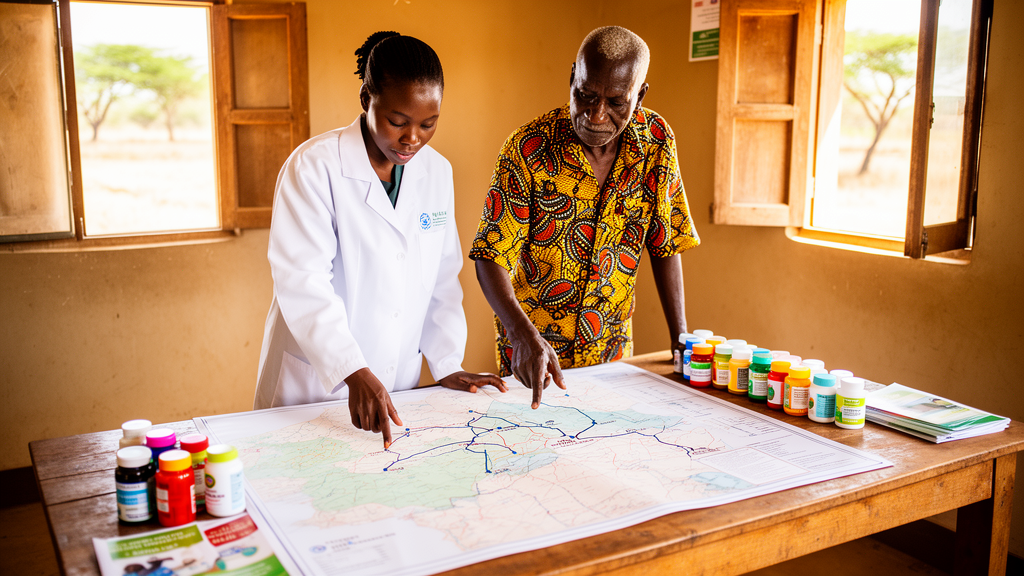
Yet before these options can reach the clinics where pregnant and postpartum women receive care, health systems need to know what might stand in the way. A new qualitative study from western Kenya offers one of the early roadmaps, drawing on the people who would actually deliver and receive the drugs.
Researchers conducted focus group discussions with healthcare workers at five clinics and with members of a community advisory board, gathering 45 participants across nine focus groups between August and October 2023. The healthcare workers included nurses, clinical officers, counselors, pharmacy technicians, mentor mothers, and facility leadership involved in antenatal care, postnatal care, and PrEP delivery. The community advisory board brought together local community leaders, women from the community, and representatives from the Kenyan Ministry of Health and county maternal and child health departments. The work, published in Discover Health Systems, was part of a larger clinical trial of PrEP adherence for pregnant and postpartum women in Kisumu and Siaya counties, a region where adult HIV prevalence reaches 19.9 percent and climbs to 28 percent among pregnant women.
The interview guides were structured around two established implementation science frameworks, the Exploration, Preparation, Implementation, Sustainment framework and the Consolidated Framework for Implementation Research, with adaptations for low- and middle-income settings. Because long-acting PrEP had not yet been introduced in western Kenya at the time of the discussions, the questions focused on the exploration and preparation stages of implementation. Each focus group lasted roughly 90 to 120 minutes, was conducted in the participant’s preferred language of English, Luo, or Swahili, and was audio-recorded, transcribed, and translated. The team used a rapid qualitative analysis approach, building summary sheets, organizing themes into matrices, and coding findings to framework constructs, with quality checks including back-translation of one healthcare worker and one community focus group.
The central finding is that the determinants of implementation are deeply interconnected. Training emerged as the anchor concern, but participants repeatedly stressed that training cannot succeed in isolation. It depends on funding to pay for sessions and transport, on personnel who can be released from clinical duties to attend, and on the actual availability of commodities such as injectable PrEP or vaginal rings. One community advisory board member put the dependency bluntly: money is needed to make all of these things happen and even to retain current staff. Financial gaps, participants warned, can delay implementation outright.
Attitudes toward the new products were largely positive. Healthcare workers and community members agreed that injectable PrEP offers significant advantages over daily oral pills because it is discreet and requires far less frequent dosing. Some participants were aware of recent clinical trials showing high effectiveness of the bi-monthly and twice-yearly injectable formulations. Providers noted that injections are simple to administer and could be delivered much like family planning injections already offered in the same clinics. But concerns surfaced consistently around cost and affordability, particularly for women with constrained finances who would need to travel from home to facility for each dose.
The outer setting raised its own complications. Community advisory board members observed that the very discretion that makes long-acting options appealing could be interpreted negatively in some communities, feeding stigma rather than reducing it. In remote areas with limited access to information infrastructure, and where environmental disruptions such as extreme weather can interrupt communication, awareness of new options may spread slowly. Participants emphasized that successful rollout requires partnerships between government, health providers, and community leaders, and that national guidelines are essential. As one community leader explained, people tend to believe that anything not signed by the government is null and void; if a health activity is unknown to the local chief, no one will take part.
Inside the clinics, opinions diverged on workload. Some healthcare workers believed long-acting PrEP would actually reduce their burden, since a woman receiving a two-monthly injection returns less often than one on daily pills who needs reminders. Others, already juggling antenatal checkups, cancer screening, and PrEP counseling in the same visit, worried that demand for a new injectable option would push them past capacity. Space constraints were a parallel concern. Healthcare workers expressed confidence that proper training would let them counsel on multiple PrEP options effectively, and they called for ongoing refresher trainings to keep pace with new information and to bring newly hired staff up to speed. They also cautioned that insufficient data could fuel injection hesitancy, drawing a parallel to what was seen with the COVID-19 vaccine, and worried about a pattern in which only a few individuals within a health system get trained while others are left without information. Community members additionally flagged the risk of external implementing partners pulling out, leaving questions about who would continue services.
From these discussions, the researchers mapped a wide range of potential implementation strategies using the Expert Recommendations for Implementing Change taxonomy, spanning six strategy clusters. Suggestions included providing financial incentives such as transportation reimbursements to encourage clinic visits for refills and testing, deploying community health providers to conduct sensitization at the household level, integrating long-acting PrEP into family planning clinics that already have the setup for injections, expanding access points to trusted community spaces like pharmacies, and using door-to-door outreach, pharmacies, and mass media to build demand, with initial communication coming from trusted local sources such as village elders and community health providers. Participants also proposed involving pregnant women as peer advocates and training all facility providers rather than a select few, to create a collaborative learning environment.
A distinctive feature of the study was a prioritization activity in the healthcare worker focus groups, where groups ranked their own suggested information, training, and support needs by ease of implementation and by helpfulness. Common priorities included national guidelines, training, personnel, space, and commodities, but the rankings varied across the five clinic groups, reflecting differences in local resources and infrastructure. The authors note this variability directly: strategies for long-acting PrEP implementation may differ by location in terms of helpfulness and ease, so a one-size-fits-all package is unlikely to work.
The study has clear limitations that the authors acknowledge. Provider-identified strategies may not match how clients actually prefer to access information and services. Some determinants are difficult to forecast without real-world delivery experience, and many identified barriers were not specific to pregnancy and postpartum contexts. The data were collected before the publication of results for lenacapavir, the six-monthly injectable, so findings may not capture formulation-specific considerations. Purposive sampling focused on providers already involved in PrEP or antenatal care, potentially excluding perspectives from clinics with weaker PrEP programs, and community advisory board members’ ties to PrEP research may have biased the groups toward optimism. Still, as a pre-implementation study, the work provides an evidence base for health system readiness assessments and for future research that should prioritize, test, and evaluate which strategies actually move the needle once long-acting PrEP becomes available to pregnant and postpartum women in Kenya.
Subject of Research: Barriers and implementation strategies for long-acting HIV pre-exposure prophylaxis in antenatal and postpartum care in Kenya
Article Title: A rapid qualitative analysis of health care worker and community focus groups on determinants and implementation strategies for long-acting PrEP in antenatal and postpartum settings in Kenya
Article References: Concepcion, T., Strong, M., Kinuthia, J., Otieno, F. A., Akim, E., Aketch, H., Gómez, L., John-Stewart, G., Suh, B. M., Ngumbau, N., Nzove, E. M., Mogaka, J. N., Obatsa, S., Odhiambo, B. O., Omom, C., Wagner, A. D., Watoyi, S., & Pintye, J. (2026). A rapid qualitative analysis of health care worker and community focus groups on determinants and implementation strategies for long-acting PrEP in antenatal and postpartum settings in Kenya. Discover Health Systems, 5(1), Article 74. https://doi.org/10.1007/s44250-026-00415-x
Image Credits: AI Generated
DOI: 10.1007/s44250-026-00415-x
Keywords: long-acting PrEP, HIV prevention, Kenya, antenatal care, postpartum women, implementation science, qualitative research, healthcare workers, community advisory board, cabotegravir, dapivirine ring, family planning integration
News Source: Harold Sullivan. (October 29, 2026). Health workers and community leaders map the path to long-acting PrEP in Kenya. Scienmag.



