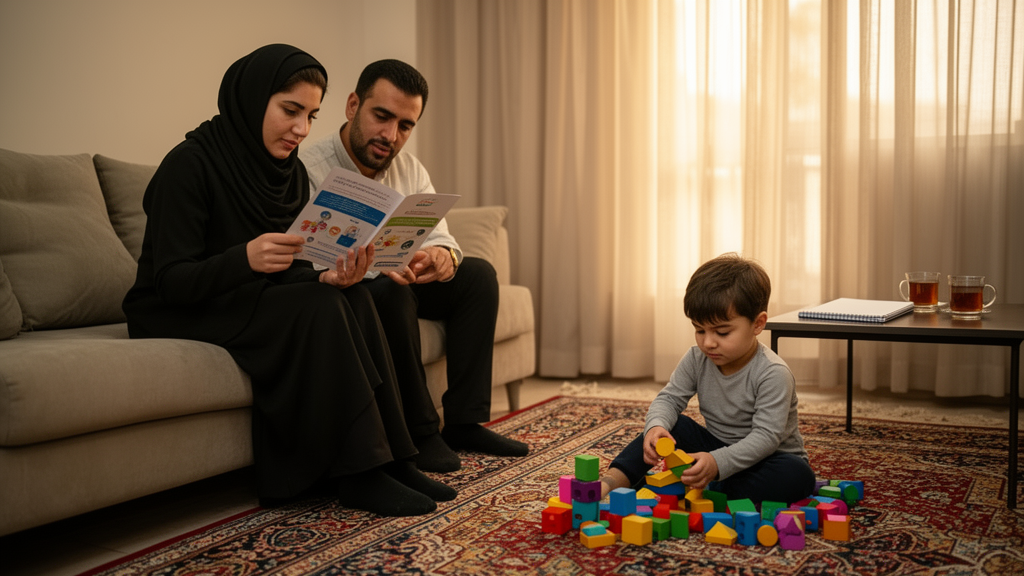
Raising a child with autism spectrum disorder is a demanding, round-the-clock undertaking, and in many parts of the world it falls almost entirely on families rather than formal services. A new cross-sectional study from Iran, published in BMC Pediatrics, offers a quantitative look at how well-equipped those family caregivers are to look after both their children and themselves. The research, led by Faride Yousefizadeh of Qom University of Medical Sciences together with colleagues at Tehran, Isfahan, and Kashan Universities of Medical Sciences, examined the relationship between health literacy and health-promoting behaviors in parents of children with autism spectrum disorder, and its central finding is strikingly consistent: the more health-literate a parent is, the more likely they are to engage in behaviors that protect and improve health.
The study arrives at a moment when autism prevalence estimates continue to climb globally and health systems everywhere are grappling with how to support affected families. In Iran, the authors note, formal services for children with autism spectrum disorder are limited, which means parents are not merely advocates or coordinators of care; they are the primary source of daily health management. Diagnostic decisions, therapeutic routines, dietary choices, and emotional support all flow through the household. That structural reality makes the health capabilities of parents themselves a matter of clinical significance, not just personal well-being. When a caregiver’s own health falters, the entire architecture of care for the child is placed at risk.
Health literacy, in the technical sense used by public health researchers, refers to the cognitive and social skills that determine the motivation and ability of individuals to gain access to, understand, and use information in ways that promote and maintain good health. It is not simply the ability to read a pamphlet. It encompasses navigating health systems, evaluating the credibility of sources, interpreting risk, and translating abstract guidance into concrete daily actions. Health-promoting behaviors, meanwhile, are the observable practices—physical activity, nutrition, stress management, interpersonal relations, spiritual growth, and health responsibility—that collectively constitute a health-sustaining lifestyle. The Iranian study set out to measure both constructs in the same population and to test whether they move together.
The methodology was straightforward but carefully executed. Conducted in 2024, the cross-sectional study enrolled 178 parents of children with autism spectrum disorder using convenience sampling. Participants completed a demographic questionnaire, a health literacy questionnaire, and a health-promoting lifestyle questionnaire. The researchers then applied a standard analytical toolkit: descriptive statistics to characterize the sample, independent t-tests and analysis of variance to compare subgroups, and Pearson correlation coefficients to quantify the strength of association between health literacy and each dimension of health-promoting behavior. The study was reported in accordance with the STROBE checklist, the widely used reporting guideline for observational studies, and received ethics approval from the Qom University of Medical Sciences Research Ethics Committee, with written informed consent obtained from all participants’ guardians.
The headline numbers tell a coherent story. Parents achieved a mean health literacy score of 127.78 with a standard deviation of 20.07, and a mean health-promoting behavior score of 131.60 with a standard deviation of 24.42. More importantly, the researchers found a statistically significant positive correlation between health literacy and every single dimension of health-promoting behaviors, with a p-value below 0.001 across the board. In epidemiological terms, this is an unusually uniform pattern. It suggests that health literacy is not narrowly tied to one type of healthy behavior but operates as a general enabling capacity, supporting everything from exercise habits to interpersonal relationships.
The granularity of the correlations is where the findings become most interesting. The strongest association appeared in the domain of physical activity, with a correlation coefficient of 0.55—a moderate-to-strong relationship by the conventions of behavioral science. This makes intuitive sense: engaging in regular exercise requires understanding recommendations, recognizing personal barriers, and planning around a demanding caregiving schedule, all of which draw heavily on health literacy skills. The weakest association, by contrast, was found in stress management, with a coefficient of 0.27. That gap is arguably the most clinically meaningful detail in the paper. Parents of children with autism spectrum disorder face chronic, structural stressors—uncertainty about prognosis, service scarcity, social stigma, and financial strain—that knowledge alone cannot dissolve. Stress management, in other words, may depend less on information and more on resources, respite, and psychological support that no amount of literacy can substitute for.
Why should this matter to readers far beyond Iran? Because the pattern the study documents is likely to generalize, with local variations, to any health system where families shoulder a disproportionate share of care for children with special needs. Even in high-income countries, waiting lists for autism-related services are long, and parents routinely become de facto case managers, therapists, and health educators. The Iranian data provide a clean test of a principle that health services researchers have long suspected: investing in the health literacy of caregivers is a lever for improving health behaviors at the family level, potentially more scalable and cost-effective than individually delivered interventions.
The authors are explicit about the practical implications. Enhancing parental health literacy, they conclude, may be a practical strategy for improving family-centered care in contexts where family caregivers are the primary source of support for children with autism spectrum disorder. They point to three concrete avenues for the healthcare system: developing and implementing educational programs to build literacy skills, fostering cultural shifts toward self-care, and improving access to reliable health information. Each of these addresses a different failure mode. Educational programs target the comprehension gap; cultural shifts address the motivation and normalization of self-care among caregivers who often deprioritize their own needs; and improved access to trustworthy information counters the misinformation that proliferates in autism communities online, where unproven and sometimes dangerous treatments circulate freely.
It is worth pausing on that last point, because the information environment surrounding autism is uniquely treacherous. Parents searching for answers encounter a dense thicket of conflicting claims, from dietary interventions to alternative therapies of dubious provenance. Low health literacy in this environment is not a neutral deficit; it is a vulnerability that can be exploited. A parent who cannot critically appraise sources may adopt ineffective or harmful practices, delay evidence-based care, or exhaust family finances on false hope. Conversely, a parent with strong health literacy functions as a filter, protecting the child from misinformation while extracting genuine value from legitimate guidance. The study’s findings, though correlational, are consistent with this protective model of caregiver literacy.
Certain caveats apply, as they do to any cross-sectional design. The study captures a single moment in time, so it cannot establish whether higher health literacy causes better health behaviors or whether some third factor—education, income, social support—drives both. Convenience sampling means the 178 participants may not perfectly represent all Iranian parents of children with autism spectrum disorder, and self-reported questionnaires are always subject to response biases. The authors acknowledge these constraints implicitly by framing their work as evidence-building rather than definitive. Still, the strength and uniformity of the correlations, spanning every measured dimension of health-promoting behavior, lend the findings considerable weight, and the STROBE-based reporting supports their transparency.
The broader lesson extends well beyond autism. Caregivers everywhere—parents of children with chronic illness, adult children caring for aging parents, spouses supporting partners with disability—occupy the same structural position the Iranian researchers describe: they are the interface between a fragile patient and an overextended health system. This study suggests that treating caregivers as targets for health promotion in their own right, rather than merely as instruments of patient care, pays dividends across the whole family. A parent who exercises, manages stress, eats well, and maintains social connections is not just healthier; they are a more durable, more capable caregiver. In that sense, the path from knowledge to action that the study’s title describes may be one of the most cost-effective routes to better child health that any health system can take.
Subject of Research: The relationship between health literacy and health-promoting behaviors in parents of children with autism spectrum disorder in Iran
Article Title: From knowledge to action: health literacy and health-promoting behaviors in parents of autistic children, a cross-sectional study in Iran
Article References: Yousefizadeh, F., Ebrahimpour Roodposhti, M., Tavakol, N., & Ebrahimpour Roodposhti, M. (2026). From knowledge to action: health literacy and health-promoting behaviors in parents of autistic children, a cross-sectional study in Iran. BMC Pediatrics. https://doi.org/10.1186/s12887-026-07701-w
Image Credits: AI Generated
DOI: 10.1186/s12887-026-07701-w
Keywords: autism spectrum disorder, health literacy, health-promoting behaviors, parenting, caregivers, Iran, cross-sectional study, physical activity, stress management, public health, BMC Pediatrics, family-centered care
News Source: Ophelia Keating. (October 9, 2026). Health Literacy Emerges as Key Driver of Healthy Habits in Parents of Autistic Children in Iran. Scienmag.