


Orthodontists treating Class II Division 1 malocclusion in growing children face a recurring choice: correct the bite by restraining maxillary growth with an extraoral appliance, or push the upper molars backward with bone-anchored mechanics inside the mouth. A new case report published in the journal Digital and Aligner Orthodontics compares these two routes head to head, using clear aligners as the shared foundation of both treatment plans. The report, authored by Giuseppe Manti and Marco Rosa, describes two 11-year-old girls with strikingly similar diagnoses who were treated with different non-extraction protocols, one built around a high-pull headgear and the other around temporary anchorage devices, known as TADs, supporting molar distalization.
The two patients were deliberately selected for comparability. Both were 11-year-old girls in the permanent dentition at the pubertal growth phase, both presented with bilateral Class II molar and canine relationships, increased overjet and maxillary incisor protrusion, and both showed an ANB angle of 5 degrees, indicating a similar sagittal skeletal discrepancy, together with a hypodivergent vertical growth pattern. The authors are explicit that the comparison was intended as a descriptive biomechanical analysis rather than a controlled clinical comparison, and they caution that no statistical or causal conclusions can be drawn from two cases.
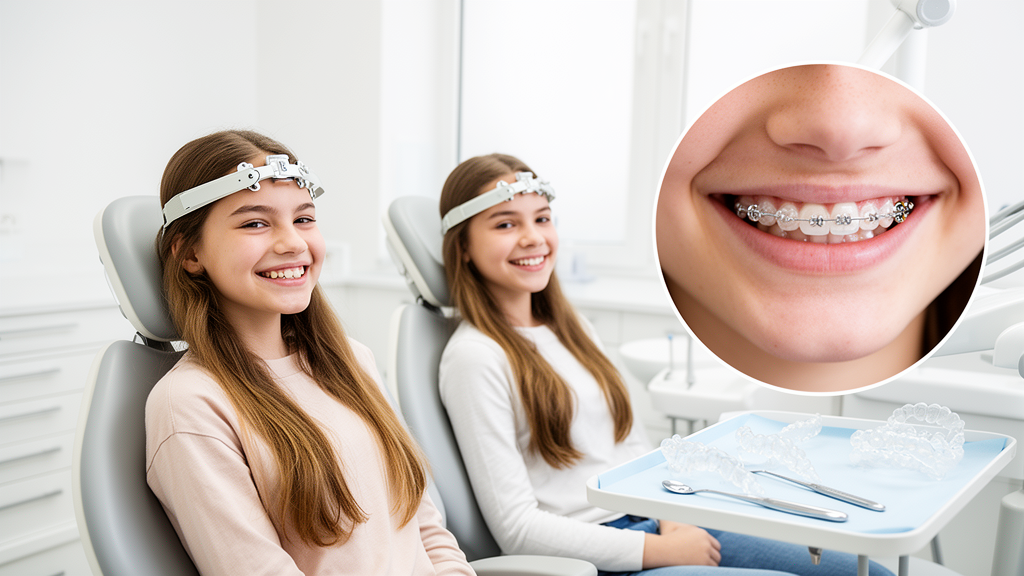
Case 1 received a protocol combining a high-pull headgear anchored to bands on the maxillary first molars, clear aligners in both arches, and Class II elastics for en masse distalization. Digital planning was performed with ClinCheck Pro. The first sequence included 19 aligners per arch, changed weekly, to distalize the maxillary molars to Class I, reshape the arch, retract the incisors and begin flattening the curve of Spee. The maxillary aligners were trimmed distal to the second premolars so that the orthopedic headgear force could act on the entire maxillary arch without aligner interference. The patient was instructed to wear the headgear 14 hours per day and the aligners 22 hours per day. Class II elastics were worn during the hours without headgear, while Class I elastics were worn at night alongside the headgear.
After 18 months, all treatment objectives in Case 1 had been achieved with excellent compliance. The cephalometric analysis confirmed normalization of the skeletal discrepancy, with the ANB angle falling from 5 degrees to 1 degree due to restricted maxillary growth, as the SNA angle dropped from 80 to 77 degrees. The vertical dimension remained stable, with the SN-GoGn angle changing only from 26 to 25 degrees. The maxillary incisors were retroclined from 119 to 106 degrees relative to the ANS-PNS plane, the mandibular incisors were retracted from 98 to 89 degrees, and the overjet decreased from 8 millimeters to 3.5 millimeters while the overbite remained stable at 3 millimeters. Superimpositions according to the structural method developed by Björk showed sagittal mandibular growth, mild vertical changes and restricted maxillary growth attributable to the headgear.
Case 2 followed a fundamentally different biomechanical path. Two palatal TADs, each 8 by 1.7 millimeters, supported a distalizing appliance with 250-gram NiTi coil springs. Maxillary aligner therapy was deliberately delayed to allow spontaneous distal drift of the premolars through the supracrestal transeptal fibers, while mandibular aligners with attachments and 0.2 millimeters of interproximal reduction addressed incisor intrusion, retraction and mild crowding from the outset. After seven months, bilateral Class I molar relationships had been achieved, and the maxillary right premolars showed distal drift while the left premolars and canine spontaneously reached Class I. Maxillary aligners were then introduced, trimmed from second premolar to second premolar, with the distalizer remaining in place to continue molar distalization and provide anchorage. Class II and Class I elastics were worn bilaterally until incisor retraction and canine correction were complete, after which the distalizer and TADs were removed and 20 finishing aligners were delivered.
The outcome in Case 2 was dentally successful but skeletally different. After 26 months, bilateral Class I molar and canine relationships with coincident midlines had been achieved, maxillary incisor proclination and mandibular crowding were corrected, the overjet fell from 6 to 2 millimeters and the overbite from 4 to 2.5 millimeters. However, the ANB angle remained at 5 degrees, indicating that the mild skeletal Class II discrepancy persisted, and the vertical dimension increased, with SN-GoGn rising from 21 to 26 degrees. Superimpositions showed clockwise mandibular rotation, reduced chin projection and slight downward-forward maxillary growth, along with molar distalization and extrusion. The authors attribute this pattern to the purely dentoalveolar nature of TAD-supported distalization, which lacks the orthopedic vertical control that the headgear provided in Case 1.
Despite these divergent cephalometric trajectories, the esthetic consequences were modest in both patients. The authors note that in hypodivergent patients, clockwise rotation may be partially compensated by spontaneous counterclockwise mandibular growth and remodeling of the symphysis and chin, and that the skeletal differences did not produce clinically appreciable profile changes. E-line assessment showed a slight increase in lip retrusion in both cases, which the authors considered within normal growth variation, consistent with evidence that nasal growth alone may account for 2 to 3 millimeters of apparent lip retrusion. They add a note of caution for other patient types: in normodivergent and hyperdivergent patients, clockwise rotation from distalization may worsen vertical dimension and facial balance, so distalization without vertical control may be contraindicated, underscoring the need for careful case selection based on growth pattern.
The practical differences between the protocols lay mainly in burden rather than outcome. Case 1 required 17 visits over 18 months, whereas Case 2 required 28 visits over 26 months plus minor palatal TAD surgery, with possible but generally well-tolerated discomfort and soft-tissue irritation. In the authors’ private clinical setting, the TAD-based protocol cost approximately 35 percent more, an estimate they stress is practice-specific and reflects their own fee structure, laboratory costs, clinical workflow and appointment burden, and should not be generalized to other practices, countries or health-care systems. The headgear protocol, by contrast, was strictly compliance-dependent, limiting its suitability to highly motivated patients willing to wear a removable appliance for 14 hours a day.
The report also details several biomechanical considerations relevant to aligner-based Class II correction. Maxillary molar distalization has been identified as one of the more predictable movements achievable with clear aligner therapy, with anteroposterior corrections of 2.5 to 3 millimeters reported when attachments are used on all teeth from canine to second molar, but predictability of planned tooth movements remains limited and treatment typically requires additional refinement sequences. Both cases in this report were completed with an initial aligner sequence followed by two refinement sets. The authors highlight the risk of posterior open bite, which arises primarily from the occlusal thickness of the aligners in the posterior segments rather than from the distalization mechanics themselves; in both cases the maxillary first molars were excluded from aligner coverage during distalization to eliminate this intrusive effect. They further note that intermaxillary elastics influenced vertical and sagittal outcomes, with the findings suggesting that the effects of elastics depend more on wear duration than on force magnitude alone.
The authors frame their observations within important limitations. This is a descriptive comparison of two clinical cases rather than a controlled clinical study, the patients cannot be considered matched controls despite their similar diagnostic features, and growth response, compliance, appliance acceptance, local fees and clinical workflow may differ substantially among patients and practices. They also situate the work in the broader evidence base, noting that two-phase treatment has not proven more effective than one-phase therapy for correcting skeletal discrepancies, that early intervention mainly reduces the risk of incisor trauma in selected patients, and that comprehensive treatment in the permanent dentition is generally more efficient in the absence of specific early-treatment indications. Because patients with increased overjet face a higher risk of maxillary incisor trauma, the authors observe that aligners may provide continuous protection by functioning as a mouthguard. Both patients received lower fixed retainers bonded from first premolar to first premolar and passive maxillary aligners for nighttime wear, and the authors emphasize that long-term retention is critical in Class II Division 1 malocclusion because of the high risk of overjet relapse, with lifelong retention sometimes required. The findings, they conclude, should be read as clinical and biomechanical considerations for case selection and planning, not as evidence of the general superiority of either protocol.
Subject of Research: A descriptive two-case comparison of headgear-assisted versus TAD-supported clear aligner treatment for Class II Division 1 malocclusion in growing patients.
Article Title: Comparison of Class II Division 1 treatment in similar growing patients with clear aligners: headgear-assisted versus TAD-supported distalization
Article References: Manti, G., & Rosa, M. (2026). Comparison of Class II Division 1 treatment in similar growing patients with clear aligners: headgear-assisted versus TAD-supported distalization. Digital and Aligner Orthodontics, 1(1), Article 6. https://doi.org/10.1007/s44525-026-00008-2
Image Credits: AI Generated
DOI: 10.1007/s44525-026-00008-2
Keywords: clear aligners, Class II Division 1 malocclusion, high-pull headgear, TAD-supported distalization, molar distalization, growing patients, hypodivergent growth pattern, cephalometrics, orthodontic biomechanics, treatment duration, treatment cost, case report
News Source: Ophelia Keating. (October 29, 2026). Headgear or TADs? Two Similar Girls, Two Clear Aligner Routes to Class II Correction. Scienmag.



