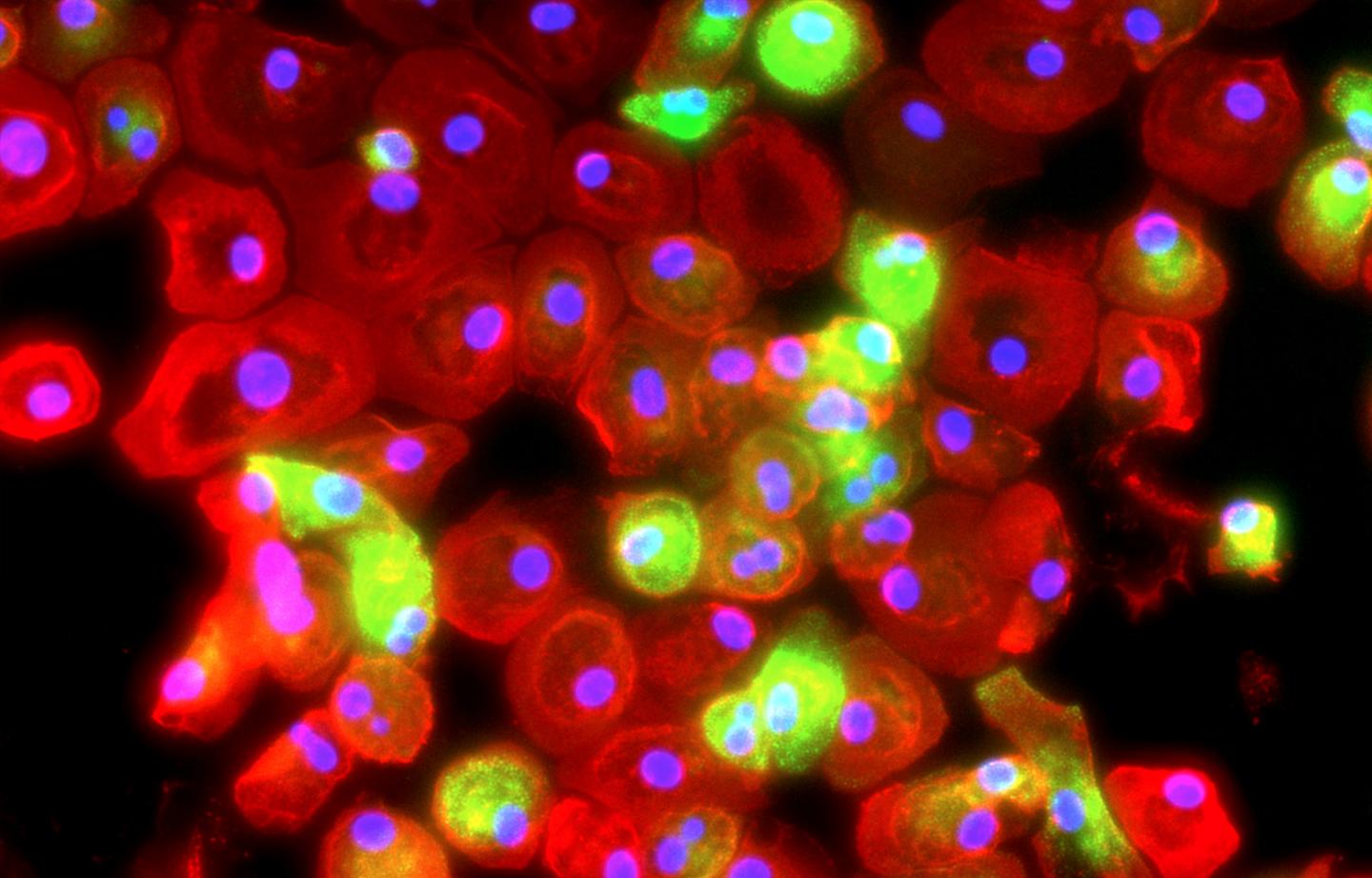
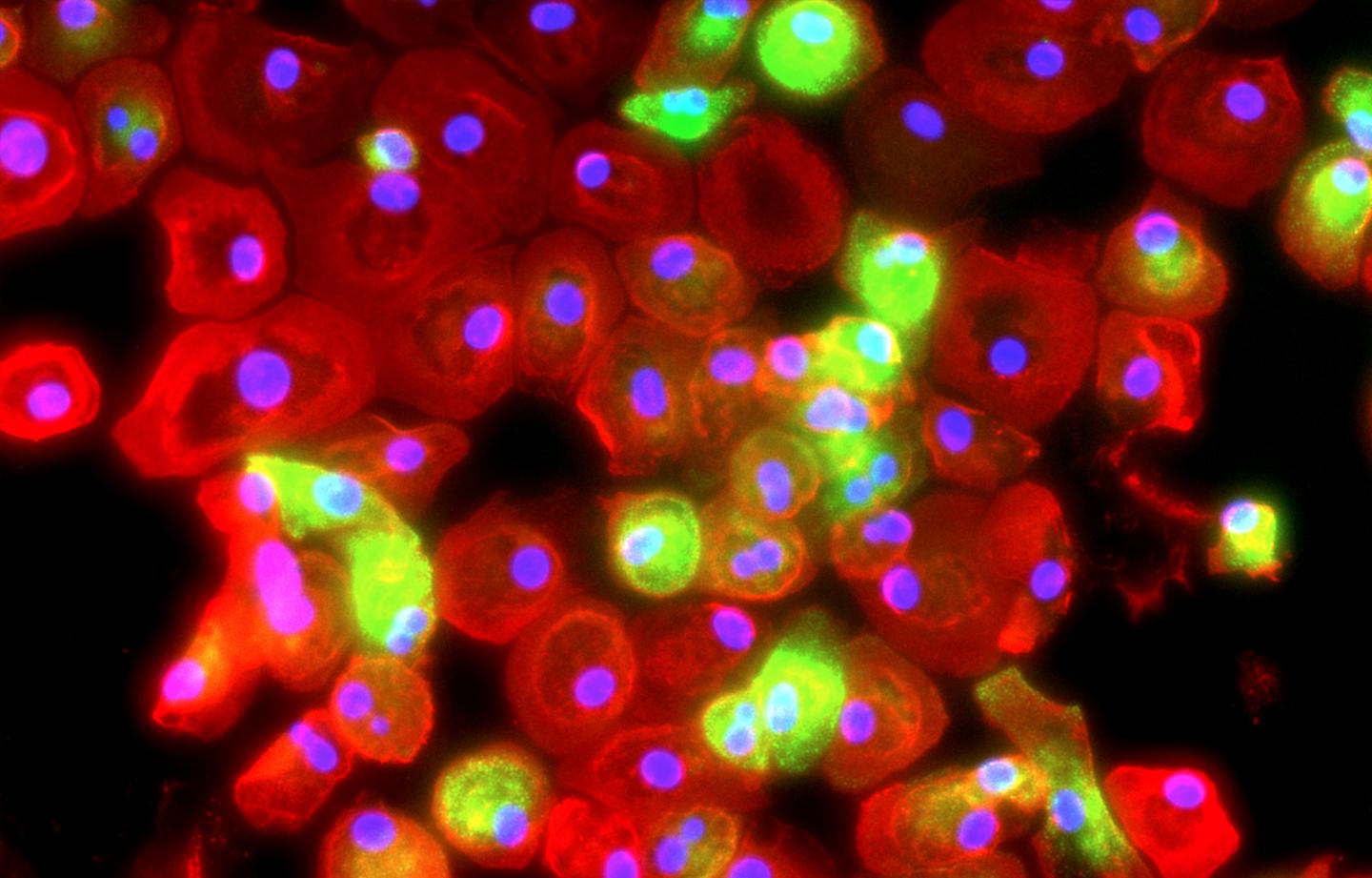
IMAGE: This is a microscopic view of macrophages, immune system cells that are key to blood vessel growth.
Credit: Kara Spiller
In what could be a pivotal step toward repairing non-healing wounds and damaged organs, a Drexel University biomedical engineer has identified an immune cell as a potential strategy for growing blood vessels.
Kara Spiller, PhD, an assistant professor in the School of Biomedical Engineering, Science and Health Systems, will seek to better understand the relationship between the body's natural healing process and tissue regeneration with a five-year $1.9 million grant from the National Institutes of Health (NIH) awarded this month.
Scientists are getting closer to mending damaged tissue and even creating whole organs, thanks to advancements in regenerative medicine. But a significant roadblock stands in the way of tissue repair: the absence of blood vessels.
"Damaged tissue — due to cancer, a bone fracture or a disease like diabetes — happens because insufficient blood vessel growth has cut off oxygen," Spiller said. "If we cannot figure out a way to engineer blood vessel networks, then we cannot repair any types of tissue."
Spiller has been studying ways to naturally spawn blood vessel growth by taking advantage of the body's response to injury and disease. She believes that vital immune system cells, called macrophages, are key to that process.
Macrophages roam throughout all tissues in the body and engulf any pathogens in their path. Though these immune cells destroy foreign invaders, they have earned a bad reputation, Spiller says, because they also contribute to the body's inflammatory response, causing bruises, ulcers and sometimes, degenerative diseases.
However, more recent studies have shown that macrophages, and inflammation more generally, can play an important role in tissue repair and regeneration, due to the cells' ability to change their form (phenotype) and function — each orchestrating events specific to different stages of repair. Though this process has been identified, it is not well understood.
In Spiller's previous studies, she has looked at why, in some cases, injured tissues heal perfectly, while others fail to repair themselves.
As part of her new NIH-funded project, Spiller will expand on this idea by investigating how the functions of different macrophage phenotypes do — or do not — promote the growth of blood vessels. Once that relationship is better understood, Spiller and her research team plan to develop a biomaterial platform and strategy for delivering drugs, which will control macrophage behavior and encourage vascularization by the body's own cells.
"The idea is that if you can manipulate the macrophages via just a single drug, then the macrophages will be able to control the blood vessels," Spiller said. "The benefit of the strategy, which we are hoping to design by the end of the project, is that you'd be promoting healing via the body's natural healing mechanisms, as opposed to trying to do it in some artificial way."
Spiller's lab focuses primarily on the healing of chronic diabetic foot ulcers, caused by a disturbance to the wound healing process.
Spiller's research could have big clinical implications for healing these painful and debilitating lesions and beyond, said Ken Barbee, PhD, professor and interim director of the School of Biomedical Engineering, Science and Health Systems.
"This work shows how discoveries in one field — wound healing — can lead to breakthroughs in others – tissue engineering. Learning how to modulate the phenotype of macrophages has far-reaching implications for a host of clinical applications," Barbee said.
Spiller is working in collaboration with Shulamit Levenberg, an associate professor of biomedical engineering at the Technion in Israel and Dave Mooney, a professor of bioengineering at Harvard — two of the world's leading experts in blood vessel growth and biomaterials.
"There is no disease that does not have inflammation as a central theme," Spiller said. "So understanding more about how inflammatory and immune cells interact with other cells in the body could help the therapy of many different problems."
###
Media Contact
Lauren Ingeno
[email protected]
215-895-2614
@DrexelNews
http://www.Drexel.edu/