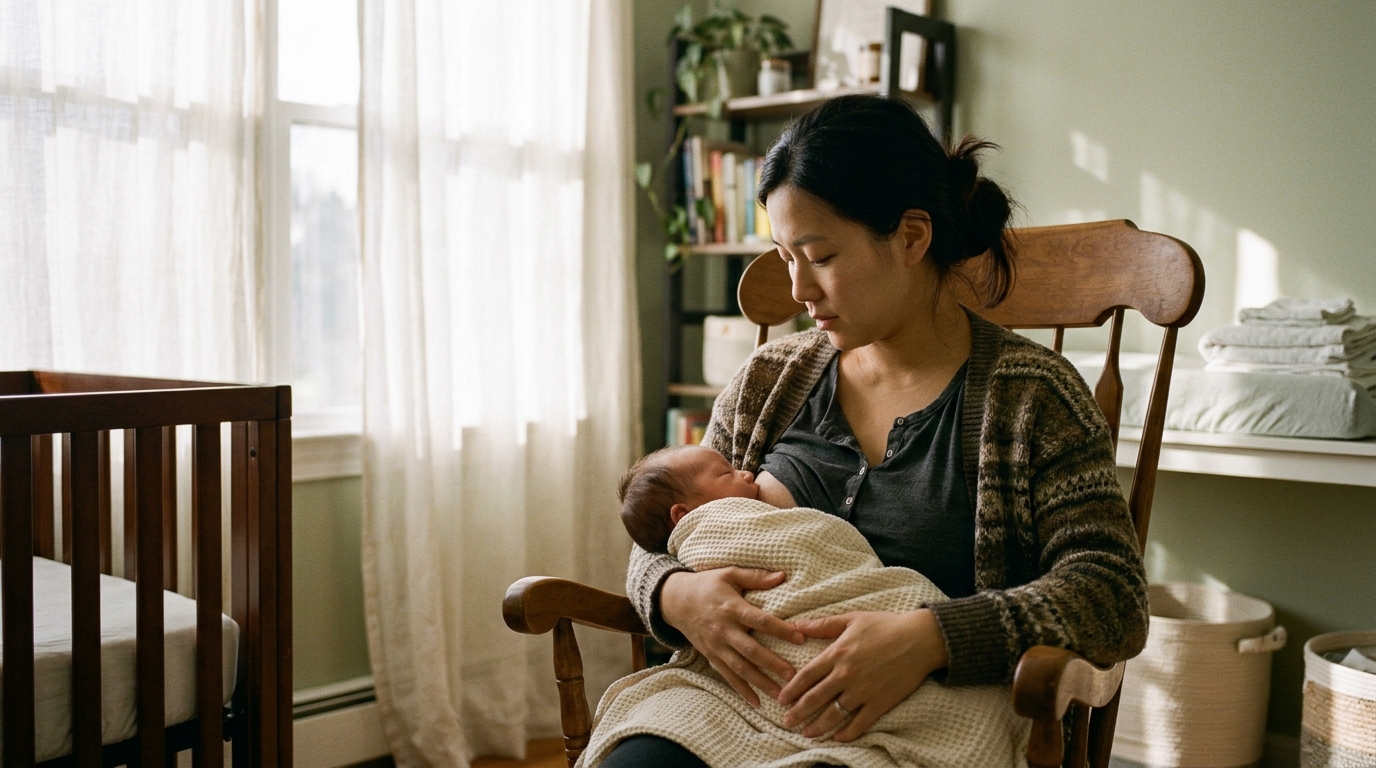
Just over half of preterm infants fed directly at the breast at least once during their first week home from the neonatal intensive care unit, according to a multicenter prospective cohort study conducted in two Chinese tertiary hospitals. Of 421 preterm infant-parent units enrolled between July 2025 and July 2026, 215 infants, or 51.07 percent, had any direct breastfeeding during the first 7 days after NICU discharge. Within that group, 76 infants, or 18.05 percent, fed exclusively at the breast, while 139, or 33.02 percent, combined feeding at the breast with bottle feeding. The remaining 206 infants, or 48.93 percent, were never put to the breast during that week, irrespective of whether they received expressed human milk or formula by other routes.
The study, published in Frontiers in Pediatrics, recruited families consecutively at the NICUs of Shanghai First Maternity and Infant Hospital and Taicang First People’s Hospital in Jiangsu Province. From 446 infants screened, ten were excluded on clinical grounds and 15 families declined participation, leaving 421 infant-parent units, all of which completed both the discharge assessment and the 1-week post-discharge follow-up.
During hospitalization, mothers independently completed a general information questionnaire, the 14-item Breastfeeding Self-Efficacy Scale-Short Form, the Edinburgh Postnatal Depression Scale, and the Zung Self-Rating Anxiety Scale, while fathers completed the Father’s Breastfeeding Self-Efficacy Scale-Short Form.
Because the outcome covered the whole week rather than a single day, the researchers describe it as any direct breastfeeding during the first 7 days after discharge rather than a point prevalence at discharge.
All 421 infants entered the univariate analysis, while 404 had complete data for every variable in the multivariable model and entered the complete-case adjusted analysis, comprising 213 infants with any direct breastfeeding and 191 without. The final model contained eight variables. The authors note that this data-driven selection was exploratory and that the retained variables should not be interpreted as all independent determinants of feeding at the breast.
The adjusted results pointed to two hospitalization-related practices as the variables most strongly associated with the outcome. Infants who received oropharyngeal colostrum administration at least once had 5.58 times the adjusted odds of any direct breastfeeding compared with those who never received it (adjusted odds ratio 5.58, 95 percent confidence interval 2.48 to 12.58). Infants who fed directly at the breast at least once during hospitalization had 5.41 times the adjusted odds of feeding at the breast after discharge (adjusted odds ratio 5.41, 95 percent confidence interval 2.34 to 12.50). The authors caution that both variables may partly reflect previous feeding success, clinical stability, or unit practice rather than independent effects, and that the associations do not establish that either intervention causes later breastfeeding.
Severity of illness showed a graded inverse association. Using the Neonatal Medical Index with grade 1 as the reference, the overall association was statistically significant (P < 0.001), and the adjusted odds of any direct breastfeeding were 0.09 for grade 3 (95 percent confidence interval 0.03 to 0.24) and 0.02 for grade 4 or above (95 percent confidence interval 0.01 to 0.07) relative to grade 1. The contrast for grade 2 versus grade 1 did not reach statistical significance. The authors suggest that critically ill preterm infants, who often require respiratory support and indwelling gastric tubes, may have weaker oral motor function, though oral motor function was not directly measured in the study, so these mechanisms remain plausible interpretations rather than demonstrated findings.
Socioeconomic and parental factors also emerged. Mothers with a bachelor’s degree or above had 4.78 times the adjusted odds of any direct breastfeeding compared with mothers with junior college education or below (adjusted odds ratio 4.78, 95 percent confidence interval 1.97 to 11.58). Households with monthly incomes of 10,000 to 19,999 CNY and of at least 20,000 CNY had 4.16 and 4.35 times the adjusted odds, respectively, compared with households below 10,000 CNY, with the overall income association statistically significant (P = 0.008). Each 1-point increase in the maternal anxiety score was associated with lower adjusted odds of any direct breastfeeding (adjusted odds ratio 0.90, 95 percent confidence interval 0.85 to 0.96), while each 1-point increase in paternal breastfeeding self-efficacy was associated with higher adjusted odds (adjusted odds ratio 1.07, 95 percent confidence interval 1.04 to 1.10). Notably, it was paternal rather than maternal self-efficacy that remained in the final model, a pattern the authors attribute to the variable-selection procedure rather than evidence that the father’s confidence is causally more important, since the two measures may be correlated.
Timing complicates the interpretation of the psychological measures. Both the anxiety scale and the paternal self-efficacy scale were completed shortly before discharge, by which point mothers and fathers had already accumulated experience of success or difficulty with feeding at the breast. The authors therefore describe these associations as potentially bidirectional: higher anxiety may reduce the likelihood of feeding at the breast, but difficulty with feeding may equally raise anxiety, and previous successful feeding may itself have raised a father’s confidence. Because both variables were measured at the same time point as each other and close to the outcome, the direction of the association cannot be determined from these data.
The authors list several limitations. Convenience sampling at only two NICUs limits generalizability, residual confounding by unmeasured hospital- and family-level factors cannot be ruled out, and the data-driven variable selection may have omitted important confounders and carries a risk of overfitting. Combining exclusive and partial feeding into one binary outcome discarded information, some feeding information relied on parental recall, and the anxiety and depression measures were self-reported and subject to social desirability bias. Missing clinical data were more concentrated in the no-direct-breastfeeding group, so the complete-case analysis could have introduced selection bias if missingness was not completely at random. The study was observational and cannot establish causality. The authors conclude that the identified factors, including oropharyngeal colostrum administration, feeding at the breast during hospitalization, maternal anxiety, and paternal breastfeeding self-efficacy, represent potential targets for future interventional evaluation rather than established intervention components, and that confirmation in interventional studies is needed before the findings are used to guide care.
Subject of Research: Prevalence of and factors associated with direct breastfeeding during the first week after NICU discharge among preterm infants in China
Article Title: Direct breastfeeding during the first week after NICU discharge among preterm infants: prevalence and associated factors
Article References: Zhang, Y.-Y., Liu, R., Zhao, P., Chen, L.-L., Yin, X.-L., Zheng, W., Zhang, H., & Zhao, L.-J. (2026). Direct breastfeeding during the first week after NICU discharge among preterm infants: prevalence and associated factors. Frontiers in Pediatrics, 14, Article 2002068. https://doi.org/10.3389/fped.2026.2002068
Image Credits: AI Generated
DOI: 10.3389/fped.2026.2002068
Keywords: direct breastfeeding, preterm infants, NICU discharge, oropharyngeal colostrum, breastfeeding self-efficacy, maternal anxiety, severity of illness, prospective cohort, China, logistic regression, kangaroo mother care, human milk
News Source: Harold Sullivan. (November 5, 2026). Half of Preterm Infants Fed at the Breast in First Week After NICU Discharge, Chinese Cohort Finds. Scienmag.