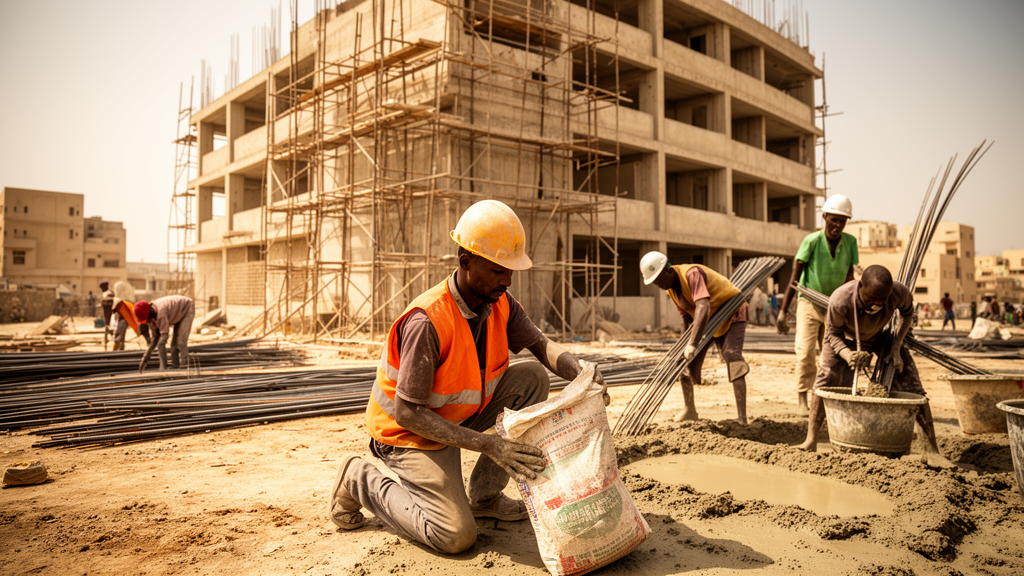
More than half of manual construction workers in Mogadishu are living with low back pain, according to a cross-sectional study of 191 laborers published in Frontiers in Public Health. The survey, led by researchers at the University of Nairobi in collaboration with Benadir University, found a period prevalence of 51.9 percent, with a 95 percent confidence interval stretching from 43.5 to 60.3 percent. The finding comes from a post-conflict region where epidemiological data on musculoskeletal disorders in unregulated construction sectors has been extremely scarce.
The study population was notably young, with a median age of just 26 years. Participants were drawn through stratified random sampling from five major construction companies operating in Mogadishu, a design intended to capture variation across sites rather than relying on a single employer. Data collection relied on a culturally adapted version of the Nordic Musculoskeletal Questionnaire, which assessed socio-demographic, lifestyle, and occupational exposures.
To identify the factors associated with the observed pain, the researchers fitted a multivariable mixed-effects logistic regression model that accounted for clustering by company, a statistical safeguard when workers on the same site share tasks and working conditions. Results were expressed as adjusted odds ratios with 95 percent confidence intervals, allowing each exposure to be evaluated while holding the others constant.
The strongest predictor in the adjusted analysis was income status. Workers living below the extreme poverty line faced markedly elevated odds of low back pain, with an adjusted odds ratio of 7.60 and a confidence interval of 2.48 to 23.28. The authors conclude that foundational socioeconomic hazards shape injury risk in ways that site-level safety measures alone cannot reach.
Biomechanical overload also left a clear statistical fingerprint. Workers who frequently performed heavy lifting had adjusted odds of 4.29, with a confidence interval of 1.26 to 14.56, while frequent bending carried an adjusted odds ratio of 5.35, spanning 1.33 to 21.45. The authors argue that team-lifting protocols and similar site-level ergonomic interventions could directly target these exposures.
Recovery-related factors emerged as significant as well. Workers reporting fewer than six hours of sleep had adjusted odds of 4.11, with a confidence interval of 1.28 to 13.24, which the authors characterize as reflecting inadequate physiological tissue recovery. Tobacco use was associated with an adjusted odds ratio of 5.70, spanning 1.94 to 16.78, and being underweight raised the odds by a factor of 5.22, with a confidence interval of 1.24 to 21.94.
Experience in the trade carried its own weight. Workers with more than six years on construction sites showed adjusted odds of 4.85, with a confidence interval of 1.56 to 15.11, a pattern consistent with cumulative exposure to the physical demands of manual construction work.
The study’s design imposes important limits on interpretation. As an analytic cross-sectional survey, it captures exposure and outcome at the same point in time, so the reported odds ratios describe association rather than proven causation. The confidence intervals are also wide, reflecting the modest sample of 191 participants, and the restriction to five major companies may limit generalizability to smaller or informal sites across the city.
Even with those caveats, the authors describe the situation as a crisis requiring action on two fronts. At the site level, they call for ergonomic interventions such as team-lifting protocols that distribute heavy loads across multiple workers. At the policy level, they argue that establishing baseline wages is essential to address the extreme poverty that proved the single strongest predictor in their analysis. In a construction sector operating largely outside formal regulation, the study offers quantitative evidence that spinal health in Mogadishu is associated as much with poverty and sleep as with the weight of the loads workers carry.
Subject of Research: Prevalence and associated factors of low back pain among construction workers in Mogadishu, Somalia
Article Title: Prevalence of and factors associated with low back pain among construction workers in Mogadishu, Somalia
Article References: Ali, A. Y. H., Karimi, K. J., & Mweu, M. M. (2026). Prevalence of and factors associated with low back pain among construction workers in Mogadishu, Somalia. Frontiers in Public Health, 14, Article 1978211. https://doi.org/10.3389/fpubh.2026.1978211
Image Credits: AI Generated
DOI: 10.3389/fpubh.2026.1978211
Keywords: low back pain, construction workers, Somalia, occupational health, ergonomics, public health, prevalence, cross-sectional study, Mogadishu, musculoskeletal disorders, factors, associated
News Source: Phoebe Ingram. (October 26, 2026). Half of Mogadishu Construction Workers Report Low Back Pain in New Survey. Scienmag.