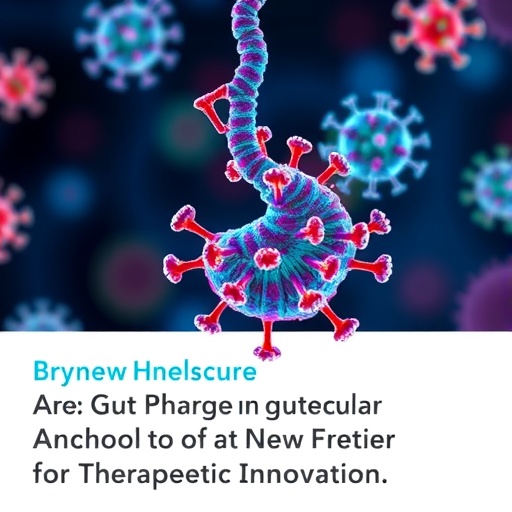
A groundbreaking study has unveiled a sophisticated biological mechanism by which certain gut bacteriophages, viruses that infect bacteria, directly interact with human epithelial cells. Contrary to previous beliefs that phages solely target bacteria, researchers from the Biological Research Centre in Szeged have discovered that these viruses possess modular adhesion proteins enabling them to attach to and enter human cells. This revelation not only reshapes our understanding of gut virome dynamics but also paves the way for novel therapeutic strategies leveraging phage-cell interactions.
Phages have long been characterized as bacterial predators, instrumental in controlling microbial populations. However, this new research establishes that phages carry specialized surface proteins, termed molecular anchors, which mediate binding to the epithelium lining the gut. By applying advanced genetic engineering techniques, the team successfully transferred these adhesion proteins onto other phages that naturally lack such capabilities. Remarkably, engineered phages showcased enhanced binding affinity, increased intracellular entry, and prolonged persistence within the murine gastrointestinal tract, as opposed to their non-engineered counterparts which were rapidly eliminated.
The data suggest that epithelial adherence is not an incidental phenomenon but rather an evolutionarily conserved function, likely offering these phages an ecological advantage. Such binding may assist phages in navigating the complex intestinal milieu composed of mucus, bacteria, and host cells. This molecular adaptation signifies a strategic shift from the traditional view where phage survival depended solely on their bacterial hosts, to one where direct host cell engagement contributes to their ecological success.
Microscopy-based analyses revealed that once internalized by epithelial cells, phages are trafficked predominantly to organelles like the Golgi apparatus and the endoplasmic reticulum. These compartments are central to cellular metabolism and signaling and, importantly, participate in non-degradative pathways. Unlike lysosomal degradation which dismantles viral particles, trafficking through these routes may allow phages to remain structurally intact, suggesting a potential for intracellular stability that was previously unappreciated.
This intracellular journey raises pertinent questions about the fate and functional impact of phages inside human cells. Are phages transient passengers, or do they modulate cellular processes during their residency? Moreover, the extent to which internalized phages remain intact and whether their presence influences physiological homeostasis or disease states remain critical avenues for future exploration. Such insights might unlock phage-based therapeutic delivery systems capable of precise intracellular targeting.
The ecological implications extend to our conception of the gut microbiome itself. Traditionally viewed as a bacterial ecosystem, the gut is now recognized as one of the most virus-rich habitats within the human body. This study highlights that phages, beyond their bacterial interactions, engage directly with the epithelial environment, possibly contributing to gut homeostasis or pathology in ways not yet fully understood. Such epithelial binding could influence microbial colonization, immune modulation, or barrier integrity.
Researchers emphasize that phages do not traverse the gut environment passively. Instead, the presence of specific adhesion proteins equips them to persist in this intricate ecosystem. By anchoring to mucosal surfaces, phages could optimize their spatial distribution and interactions with bacterial hosts. This modularity in adhesion strategies likely confers adaptability across diverse host environments, enhancing phage survival and propagation.
Importantly, phages bearing these adhesion-related genes are prevalent among dominant gut virome constituents. Their abundance in healthy individuals suggests these molecular anchors enable phages to thrive in stable mucosal environments, potentially serving as markers of gut health or imbalance. However, researchers caution against interpreting their presence as direct health promoters, emphasizing that their role is more likely linked to successful ecological integration.
From a translational perspective, these findings hold promise for the future of phage therapy. To effectively combat pathogenic bacteria, therapeutic phages must localize precisely to infection sites and maintain functional presence. Engineering phages with tailored adhesion properties could substantially enhance their efficacy, ensuring better retention and interaction within human tissues. Such advancements could revolutionize treatments for antibiotic-resistant infections.
The multidisciplinary study, led by the Synthetic and Systems Biology Unit under Bálint Kintses at the HUN-REN Biological Research Centre, exemplifies the integration of microscopy, microbial genomics, bioinformatics, and synthetic biology. The comprehensive approach enabled not only the visualization of phage-cell interactions but also their mechanistic characterization at the genetic and molecular levels. This collaborative effort underscores the importance of convergent science in unraveling complex biological phenomena.
In sum, the discovery that prevalent gut phages encode modular adhesins facilitating epithelial binding and intracellular trafficking challenges existing paradigms in virology and microbiome research. It unlocks new conceptual frameworks regarding virus-host interactions and offers a blueprint for innovative therapeutic interventions. As we deepen our understanding of the gut virome’s organization, these findings herald a new era of phage biology with far-reaching implications for human health and disease.
Subject of Research: Cells
Article Title: Prevalent gut phages encode modular adhesins mediating epithelial binding and endoplasmic reticulum trafficking
News Publication Date: 4-Jun-2026
Web References: DOI link
Image Credits: By Gábor Apjok
Keywords
Bacteriophages, Genetic engineering, Gut microbiome, Virology, Phage therapy, Epithelial binding, Intracellular trafficking, Modular adhesins, Systems biology, Microbial genomics, Synthetic biology
Tags: bacteriophage-based therapeutic strategiesengineered phage adhesion proteinsevolution of phage epithelial adherencegut bacteriophages therapeutic innovationgut phage molecular mechanismsgut virome dynamics researchintracellular phage entry mechanismsmolecular anchors gut phagesnovel gut microbiome therapiesphage epithelial cell interactionphage genetic engineering techniquesphage persistence in gastrointestinal tract