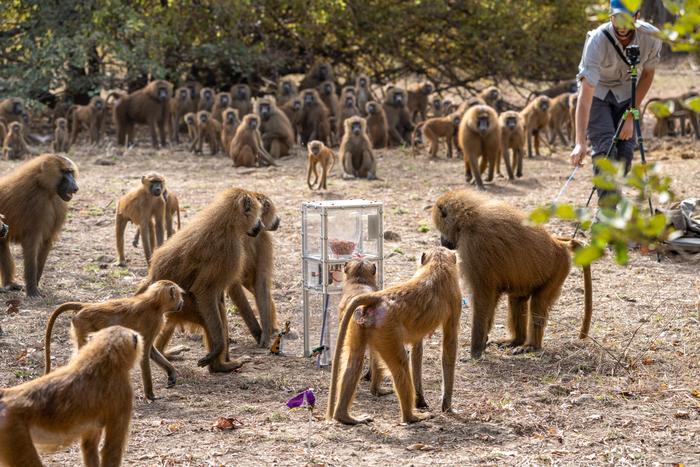

A fascinating new study from the German Primate Center has revealed intriguing insights into the social dynamics of Guinea baboons in their natural habitat. Led by researcher William O’Hearn, this extensive research delves into the behaviors of female Guinea baboons and their preferences for males exhibiting specialized foraging skills. Such unique capabilities may alter mating behaviors, offering profound implications for understanding social interactions within animal communities.
The study, conducted across two distinct groups of Guinea baboons living in the wild in Senegal and another group residing at Nuremberg Zoo, highlights how specific skills can increase a male’s desirability among females. This research not only sheds light on Guinea baboon society but also stimulates thought about the broader aspects of animal behavior and social cognition. The driving question behind this investigation arose from curiosity about whether female baboons make informed social decisions based on the competencies of their male counterparts.
To evaluate this dynamic, the researchers implemented an experimental design where one male in each group was trained to operate a unique food box, a task that required specific skill sets. The result was notable: the females responded by increasing their interest in these skilled males, engaging them in more grooming behaviors and even exhibiting heightened aggression towards other females that sought attention from the same male. This suggests that female baboons are acutely aware of the short-term benefits they could gain from skilled males, utilizing their capabilities to improve immediate social and resource-related advantages.
However, the reaction observed from other males within the group was markedly different. Despite benefiting from the bounty provided by the specialized males, these males displayed minimal changes in their behavior toward the high-skill male. The contrast in reactions between females and males raises interesting questions regarding social hierarchies among Guinea baboons. It appears that male baboons operate under a different set of social rules, possibly indicating a lesser competitive environment when it comes to accessing food resources controlled by skilled males.
One significant takeaway from this research is the concept of pragmatism in social interactions among Guinea baboons. The study indicates that female baboons do not engage with males based on long-term assessments of their abilities but rather respond to immediate gains. The behavioral shifts observed when the food box was present reveal that the attraction to skilled males was transient, directly tied to the benefits provided by their specialized foraging capabilities. Once the food source was removed, female interest swiftly diminished, underscoring the practicality that governs these social dynamics.
By exploring these behavioral patterns in Guinea baboons, the research contributes to a deeper understanding of the evolution of social behavior, drawing parallels to human social structures. As William O’Hearn notes, the experiment introduces a significant understanding of skill attribution, marking a step beyond anecdotal observations of animal behavior. This research offers insights into the precedence of immediate outcomes in shaping social decisions—concepts that may reflect underlying evolutionary strategies shared across species.
Prior to executing the fieldwork in Senegal, researchers conducted preliminary studies at Nuremberg Zoo. The controlled environment of the zoo allowed for initial observations and assessments of the Guinea baboon’s behaviors under structured conditions. By testing hypotheses in this setting, researchers could refine their approaches before venturing into the complexities of the wild. The collaboration with Nuremberg Zoo represents an invaluable opportunity, as zoos can provide critical insights into the behavior and biology of captive animals, laying a foundation for successful field research.
The research underscores the importance of interdisciplinary studies that span both wild and captive settings. By leveraging the collaboration between the German Primate Center and zoological institutions, the findings not only enhance scientific understanding but also contribute to the welfare and enrichment of the animals involved. Cognitive challenges presented in captivity can promote natural behaviors that benefit the species as a whole while informing future conservation efforts.
Furthermore, the study also invites considerations about how similar social behaviors may manifest in other primate species, including humans. The observation that immediate, outcome-based responses can dictate social preferences suggests complex layers of decision-making that may resonate across the animal kingdom. As our understanding of animal cognition evolves, findings such as those from this study may pave the way for new insights into the fundamental mechanisms guiding social behavior across species.
In conclusion, the research led by William O’Hearn signifies a crucial advancement in our understanding of social behavior in Guinea baboons, illustrating not only their complex social structures but also the factors influencing mate selection. As more studies emerge from this field, the rich interplay of skills, social dynamics, and immediate benefits continues to reveal the nuanced fabric of animal interactions, inspiring curiosity and generating vital implications for both evolutionary biology and conservation practices.
Subject of Research: Animals
Article Title: Increased female competition for males with enhanced foraging skills in Guinea baboons
News Publication Date: 5-Mar-2025
Web References: http://dx.doi.org/10.1098/rspb.2024.2925
References: Proceedings of the Royal Society B Biological Sciences
Image Credits: Photo: Tessa Frank
Keywords: Guinea baboons, foraging abilities, social behavior, female attraction, mate selection, primate research, animal cognition, evolutionary biology.
Tags: animal behavior researchbehavioral ecology of primatesfemale baboon preferencesgrooming behavior among baboonsGuinea baboons mate selectionimplications for social cognitionmale foraging skillsreproductive strategies in baboonssocial dynamics in primatesstrategic mate choice in animalsstudy on baboon social interactionswild baboon populations