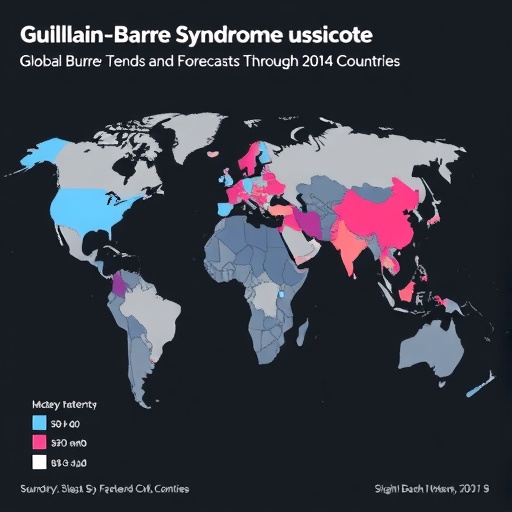
The global burden of Guillain–Barré syndrome, a rare but potentially devastating immune-mediated neurological disorder, has nearly quintupled over the past three decades, and the steepest surge occurred in the years coinciding with the COVID-19 pandemic. Those are the central findings of a sweeping new analysis published in Immunity, Inflammation and Disease, which drew on the Global Burden of Disease Study 2021 database to track the syndrome across 204 countries and territories from 1990 to 2021.
Guillain–Barré syndrome, or GBS, is a disorder in which the body’s own immune system attacks the peripheral nerves, producing the classic clinical picture of symmetrical flaccid muscle weakness in the limbs, sensory disturbances, and weakened or absent tendon reflexes. The condition is typically triggered by an infection or other immune stimulus, with molecular mimicry—a process in which antibodies raised against a pathogen mistakenly target chemically similar structures on nerve cells—believed to play a central role in its pathogenesis. Roughly one in five patients faces death or severe disability, and outcomes are particularly poor among elderly patients and those with axonal nerve involvement. Until now, the condition has received comparatively little attention in global public health planning relative to diseases such as cancer or cardiovascular disease, making the new findings all the more striking.
The study, which used the International Classification of Diseases code G61.0 to identify GBS cases within the GBD framework, found that the number of people living with the syndrome worldwide rose from 96,819 in 1990 to 471,850 in 2021. Expressed as an age-standardized prevalence rate, which adjusts for differences in population age structure, the burden climbed from 1.93 to 5.91 per 100,000 population over the three-decade period, corresponding to an estimated annual percentage change of 0.95. Years lived with disability, a measure that captures the non-fatal health consequences of disease, reached 139,639 in 2021, with an age-standardized rate of 1.75 per 100,000.
What makes the analysis particularly notable is its use of Joinpoint regression, a statistical technique that identifies points in time where disease trends shift direction. The results were unambiguous: while both the prevalence and disability measures showed a steady upward trajectory across the entire study period, with average annual percentage changes of 5.06, the most dramatic inflection occurred between 2019 and 2021. During those two pandemic years, the annual percentage change in the age-standardized prevalence rate spiked to 98.04, an extraordinary acceleration in trend that temporally coincides with the emergence and global spread of SARS-CoV-2.
The authors are careful to emphasize that this timing alone does not establish causation. The relationship between COVID-19 and GBS remains genuinely contested in the scientific literature. Several observational studies have suggested that SARS-CoV-2 infection may increase the risk of developing GBS or worsen its severity, potentially through inflammatory and autoimmune pathways that dysregulate the immune system. Other large epidemiological investigations, however, have found little or no increase in GBS incidence during the pandemic. The study’s authors note that the apparent surge may reflect a complex mixture of factors: COVID-19-related GBS cases may present with more severe manifestations, including respiratory dysfunction, driving higher disability burdens; pandemic-related disruptions to healthcare systems may have altered diagnosis, referral patterns, and care-seeking behavior; and heightened awareness of neurological complications during the pandemic may have improved detection and reporting of milder or atypical cases that would previously have gone unrecognized. In other words, some of the increase may be biological and some may be an artifact of better surveillance—an important distinction that only large-scale prospective and mechanistic studies will be able to resolve.
Beyond the pandemic question, the analysis reveals a deep and widening geography of inequality. Low-socio-demographic-index regions—those with lower income per capita, less educational attainment, and higher fertility—bore a disproportionately heavy burden. In 2021, these regions recorded an age-standardized prevalence rate of 8.03 per 100,000 and an age-standardized disability rate of 2.37, compared with just 3.82 and 1.13 respectively in the high-middle SDI region. Formal inequality analysis using the slope index of inequality and the concentration index showed that the burden became increasingly concentrated in poorer populations over time: the slope index for prevalence shifted from essentially zero in 1990 to −2.19 in 2021, a clear signal of growing disparity. The authors attribute this pattern to a convergence of structural disadvantages—poor sanitation, greater exposure to infectious triggers, limited healthcare access, delayed diagnosis, and insufficient treatment resources—compounded during the pandemic by shortages of healthcare workers, limited intensive care capacity, and unequal vaccine distribution in low-income settings.
The regional and national breakdowns are equally telling. South Asia carried the highest absolute burden in 2021, with 155,150 prevalent cases, and India alone accounted for 120,439 of them—a figure that likely reflects the combined effects of population size, density, uneven sanitation, and unequal access to care. Yet when adjusted for age, the picture changes: Central Latin America showed the highest regional age-standardized prevalence at 9.49 per 100,000, while the small nation of North Macedonia recorded the highest national figure anywhere in the world, at 11.47 per 100,000. East Asia, by contrast, reported the lowest age-standardized burden at 0.63 per 100,000. Between 1990 and 2021, nearly every country saw its burden rise; only New Zealand and Puerto Rico recorded declining trends, possibly reflecting accessible healthcare systems, effective infectious disease control, and robust public health infrastructure. The United Kingdom showed the steepest national increase, with an estimated annual percentage change of 3.41.
The age and sex patterns of the disease follow well-established epidemiological contours. Burden was lowest among children under five and increased progressively with age, consistent with the idea that aging-related immune dysregulation, accumulated comorbidities, and cumulative exposure to infectious agents raise susceptibility over the life course. Males carried a consistently higher burden than females across most age groups, with the gap widest among older adults—a difference that may reflect interactions between immune regulation, hormonal influences, genetic susceptibility, and differential environmental exposure, though the precise mechanisms remain unresolved.
To understand what is driving the overall increase, the researchers performed a decomposition analysis using the Das Gupta framework, which mathematically separates the net change in disease burden into independent demographic and epidemiological components. The verdict: epidemiological changes accounted for 70.36 percent of the growth in both cases and disability years, population growth for roughly 26.6 percent, and population aging for about 3.1 percent. That so much of the increase stems from epidemiological rather than purely demographic factors suggests that changes in infectious disease exposure, diagnostic capacity, surveillance intensity, and healthcare system behavior—not merely more people living longer—are reshaping the global profile of the disease.
Looking forward, the team applied Bayesian age-period-cohort modeling, implemented with integrated nested Laplace approximations, to project trends through 2035. The models, which simultaneously incorporate age, period, and cohort effects, predict that the global age-standardized prevalence rate will climb to 8.25 per 100,000 by 2035, with the disability rate reaching 2.48 per 100,000—though the pace of increase is expected to gradually slow, and the projections carry wide uncertainty intervals. Future trajectories, the authors caution, will depend on healthcare accessibility, diagnostic practices, vaccination programs, and evolving patterns of infectious disease.
The study is not without limitations. The GBD estimates are model-based and depend on input data of variable quality and completeness; hospital-based sources may underrepresent populations with poor healthcare access while overrepresenting severe cases through referral bias. And the ecological, observational design of the analysis forbids any causal inference about COVID-19 and GBS. Still, the GBD methodology remains the most comprehensive systematic synthesis of global data available, and the findings carry clear policy weight. The authors call for strengthened early identification and diagnostic standards for GBS, flexible medical resource allocation for public health emergencies, greater investment in neurological care in low-SDI countries, and deeper research into the syndrome’s pathogenesis and its peculiar geographic hotspots. As the world continues to grapple with the neurological legacy of the pandemic, Guillain–Barré syndrome—a condition long relegated to the margins of global health priorities—appears to be demanding a place much closer to the center.
Subject of Research: The global, regional, and national burden of Guillain–Barré syndrome, including trends from 1990 to 2021, health inequalities, drivers of change, and future forecasts through 2035.
Subject of Research: Medicine
Article Title: Dynamic Changes and Future Trend Forecasts in the Global Burden of Guillain-Barré Syndrome: Analysis of 204 Countries and Regions From 1990 to 2021, Including the Impact of the COVID-19 Pandemic
Article References: Song, Q., Wang, M., Shen, Z., Jing, Z., Fan, Y., Zhang, X., Huang, L., Li, W., Shi, Y., & Yang, D. (2026). Dynamic Changes and Future Trend Forecasts in the Global Burden of Guillain–Barré Syndrome: Analysis of 204 Countries and Regions From 1990 to 2021, Including the Impact of the COVID‐19 Pandemic. Immunity, Inflammation and Disease, 14(6), Article e70473. https://doi.org/10.1002/iid3.70473
Image Credits: AI Generated
DOI: 10.1002/iid3.70473
Keywords: Guillain-Barré syndrome, Global Burden of Disease, COVID-19, SARS-CoV-2, age-standardized prevalence rate, years lived with disability, health inequality, socio-demographic index, Bayesian age-period-cohort modeling, epidemiological changes, neurological surveillance
Cite Scienmag News
APA
MLA
Chicago
Kristina Jarvis. (September 3, 2026). Guillain-Barré Syndrome Global Burden Trends and Forecasts Through 204 Countries. Scienmag. https://scienmag.com/guillain-barre-syndrome-global-burden-trends-and-forecasts-through-204-countries/
Kristina Jarvis. “Guillain-Barré Syndrome Global Burden Trends and Forecasts Through 204 Countries.” Scienmag, 3 September 2026, https://scienmag.com/guillain-barre-syndrome-global-burden-trends-and-forecasts-through-204-countries/. Accessed 3 September 2026.
Kristina Jarvis. “Guillain-Barré Syndrome Global Burden Trends and Forecasts Through 204 Countries.” Scienmag. September 3, 2026. https://scienmag.com/guillain-barre-syndrome-global-burden-trends-and-forecasts-through-204-countries/
Copy citation
Download RIS
Tags: aging and Guillain-Barré syndrome outcomesCOVID-19 impact on neurological healthfuture projections of Guillain-BarrGBS incidence and mortality trendsGBS infection triggers and pathogenesisGBS prevalence and mortality worldwideglobal burden of disease study 2021global disease burden analysisglobal disease burden of Guillain-Barré syndromeglobal health disparities in Guillain-Barré syndromeGuillain-Barré syndrome epidemiologyimmune-mediated neurological disorderslong-term disability from Guillain-Barré syndromelong-term outcomes of Guillain-Barré syndromemolecular mimicry in autoimmune neuropathiesmolecular mimicry in neurological disordersneurological disorder prevalence worldwideneurological impact of COVID-19peripheral nerve autoimmune conditionspublic health strategies for rare neurological diseasestrends in peripheral nerve disorders