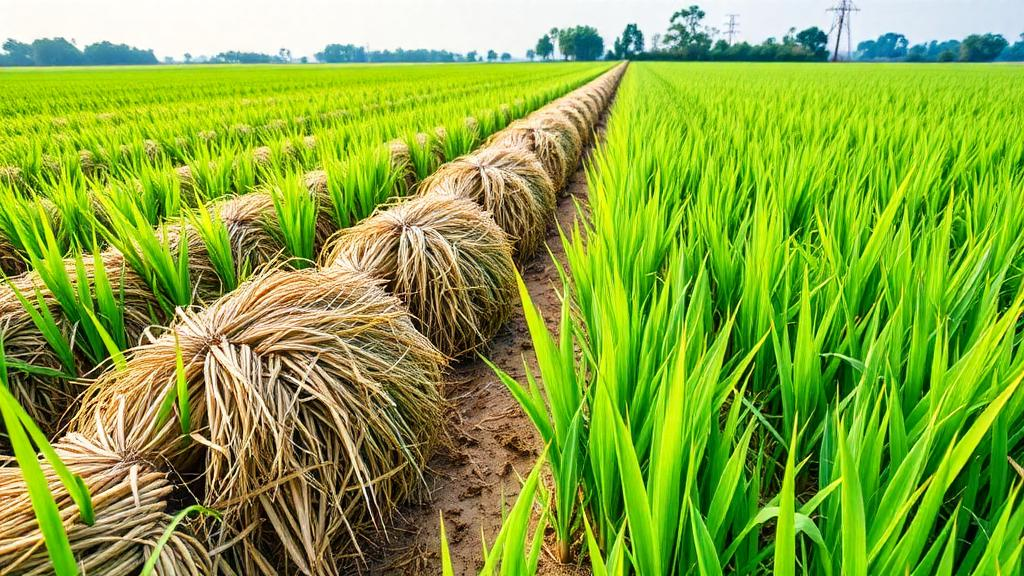
Rice feeds roughly half of humanity, and the double-cropped rice systems of southern China are among the most productive—and most fertilizer-hungry—cropping systems on Earth. A new two-year field experiment published in the Journal of Agriculture and Food Research suggests that a simple change in how farmers manage crop residues could deliver a rare double win: higher rice yields with substantially less synthetic fertilizer, while simultaneously slashing the gaseous nitrogen losses that pollute the air and warm the planet. The study, led by Li Wan of the Jiangxi Academy of Agricultural Sciences, examined what happens when farmers co-incorporate leguminous green manure and rice straw into paddy soils before transplanting rice, rather than relying on conventional chemical fertilization alone.
The research team worked at the Gao’an Experimental Station in Yichun City, Jiangxi Province, a subtropical monsoon region where early rice is transplanted in late April and harvested in mid-July, and late rice follows from late July to mid-October. During the roughly 150-day fallow period between rice seasons, the researchers grew Chinese milk vetch, a leguminous green manure that fixes atmospheric nitrogen through its symbiotic bacteria. In the spring, this biomass was plowed into the top 20 centimeters of soil along with rice straw and synthetic fertilizer, one week before rice seedlings went into the ground. The experiment built on a long-term field trial running since 2015, giving the soils time to respond to the different management regimes.
The design was elegantly simple in concept. Nine treatments compared winter fallow without fertilizer as a control, conventional full fertilization, and combinations of rice straw, green manure, or both, each crossed with either full or 60 percent reduced synthetic nitrogen rates. Green manure was incorporated at 22,500 kilograms per hectare of fresh weight, while rice straw was applied at 6,000 kilograms per hectare of dry weight. The logic behind pairing the two residues lies in their contrasting chemistry: milk vetch is nitrogen-rich with a low carbon-to-nitrogen ratio and decomposes rapidly, sometimes releasing nutrients faster than rice plants can absorb them, whereas rice straw is carbon-rich, decomposes slowly, and can actually tie up soil nitrogen through microbial immobilization. Blended together, the residues moderate each other’s extremes and release nutrients more steadily across the growing season.
The yield results were striking. Early rice yields ranged from 2,477 kilograms per hectare in the unfertilized control to 6,827 kilograms per hectare under co-incorporation with full fertilization. Compared with conventional fertilization alone, the combined organic practice boosted early rice yields by 18.2 percent at full fertilizer rates and 12.0 percent at reduced rates. Late rice also benefited, with gains of 2.8 and 2.2 percent respectively, and the reduced-fertilizer co-incorporation treatment outperformed the reduced-fertilizer-only control by 13.6 percent. Across the full double-cropping year, the best treatment produced 14,070 kilograms of grain per hectare, the highest of all nine regimes tested.
Nitrogen uptake told a parallel story. Annual aboveground nitrogen uptake in the rice plants reached up to 248 kilograms of nitrogen per hectare in green manure treatments, an increase of up to 31.8 percent over conventional fertilization. Apparent nitrogen use efficiency climbed as high as 57.7 percent in the co-incorporation treatment with reduced fertilizer, compared with just 32.0 percent when rice straw was added to full conventional fertilization. Notably, straw alone actually depressed nitrogen use efficiency, confirming that the high carbon-to-nitrogen residue can leave rice plants short of available nitrogen when microbes outcompete roots for it. The synergy only emerges when the fast-releasing legume and the slow-releasing straw work together.
The environmental findings may matter even more than the agronomic ones. Using sponge-trapping devices and potassium chloride extraction to measure ammonia volatilization, and static chambers coupled with gas chromatography to track nitrous oxide, the team quantified gaseous nitrogen losses across every treatment. Ammonia dominated overwhelmingly, accounting for 97.7 percent of total gaseous losses on average, with annual emissions reaching 241 kilograms of nitrogen per hectare under conventional fertilization. Peaks followed fertilizer applications closely, with late-season fluxes running 2.4 to 4.6 times higher than in early rice, reflecting hotter conditions that accelerate the conversion of ammonium to ammonia gas.
Co-incorporation with reduced fertilizer cut these losses dramatically. Ammonia emissions fell by 10.3 percent at full fertilizer rates and by 30.1 percent when synthetic nitrogen was reduced by 40 percent, relative to conventional practice. Nitrous oxide emissions, though far smaller in magnitude, dropped by 13.6 and 45.5 percent under the same comparisons. Overall gaseous nitrogen losses declined by roughly 12.4 percent with organic amendments at full fertilizer rates and by about 31.7 percent when combined with the 40 percent fertilizer reduction. Expressed per kilogram of grain produced, the yield-scaled emissions intensity was lowest in the co-incorporation treatments, meaning farmers would be producing more rice while releasing less reactive nitrogen per unit of food.
To understand the mechanisms, the researchers applied partial least squares path modeling, a statistical technique that traces how multiple soil and management variables jointly influence emissions. The model explained 84 percent of the variability in ammonia emissions and 89 percent in nitrous oxide emissions. Nitrogen input emerged as the dominant driver of both gases, with standardized path coefficients of 0.94 for ammonia and 0.79 for nitrous oxide. Nitrous oxide was additionally shaped by soil chemistry: available potassium and Olsen-phosphorus exerted negative effects, while soil organic carbon and pH had positive ones. The team also found that organic amendments raised soil organic carbon by up to 22.4 percent and boosted Olsen-phosphorus by nearly 39 percent, improvements that enhance the soil’s buffering capacity and slow the pH shifts that drive ammonia volatilization after urea hydrolysis.
The nitrous oxide story carries a subtle twist. Although incorporating organic residues initially stimulated microbial activity and briefly raised nitrous oxide fluxes, the annual totals remained low—just 1.0 to 1.8 percent of applied nitrogen—because flooded paddy conditions and the oxygen consumed by decomposing residues create a strictly anaerobic environment. Under those conditions, denitrifying microbes push the process to completion, reducing nitrous oxide all the way to harmless dinitrogen gas. In other words, the same waterlogged chemistry that makes paddies productive also gives them a partial safety valve against the most potent greenhouse gas in the nitrogen cycle.
The implications extend well beyond Jiangxi. Intensive fertilizer use has driven ammonia emissions up 78 percent and nitrous oxide emissions up 46 percent in heavily fertilized systems, contributing to smog formation, acid rain, biodiversity loss, and climate change, while less than half of applied fertilizer nitrogen typically ends up in the crop. This study demonstrates that a practice already widely adopted across southern China—plowing in milk vetch grown during the winter fallow alongside returned rice straw—can replace a meaningful share of synthetic nitrogen without sacrificing yield, and can even improve it. For a staple crop that must expand production by roughly 10 million tons annually to meet future demand, the message is compelling: the path to sustainable rice intensification may already be growing in the paddies during the off-season, waiting to be turned under come spring.
Subject of Research: Effects of co-incorporating green manure and rice straw with reduced synthetic fertilizer on rice yield and gaseous nitrogen losses in double-cropped paddy fields
Article Title: Co-incorporation of green manure and rice straw with reduced synthetic fertilizer benefits rice yield while decreasing gaseous N losses in double-cropped rice fields
Article References: Wan, L., Ma, T., Liu, H., Chen, X., Qin, W., Li, G., Xie, J., Ge, T., & Liu, J. (2026). Co-incorporation of green manure and rice straw with reduced synthetic fertilizer benefits rice yield while decreasing gaseous N losses in double-cropped rice fields. Journal of Agriculture and Food Research, 31, Article 103345. https://doi.org/10.1016/j.jafr.2026.103345
Image Credits: AI Generated
DOI: 10.1016/j.jafr.2026.103345
Keywords: rice, green manure, milk vetch, rice straw, nitrogen use efficiency, ammonia volatilization, nitrous oxide, paddy soil, double-cropped rice, fertilizer reduction, soil organic carbon, sustainable agriculture
News Source: Alan Morgan. (October 5, 2026). Green Manure Plus Rice Straw Cuts Fertilizer Use and Air Pollution in Rice Fields. Scienmag.