


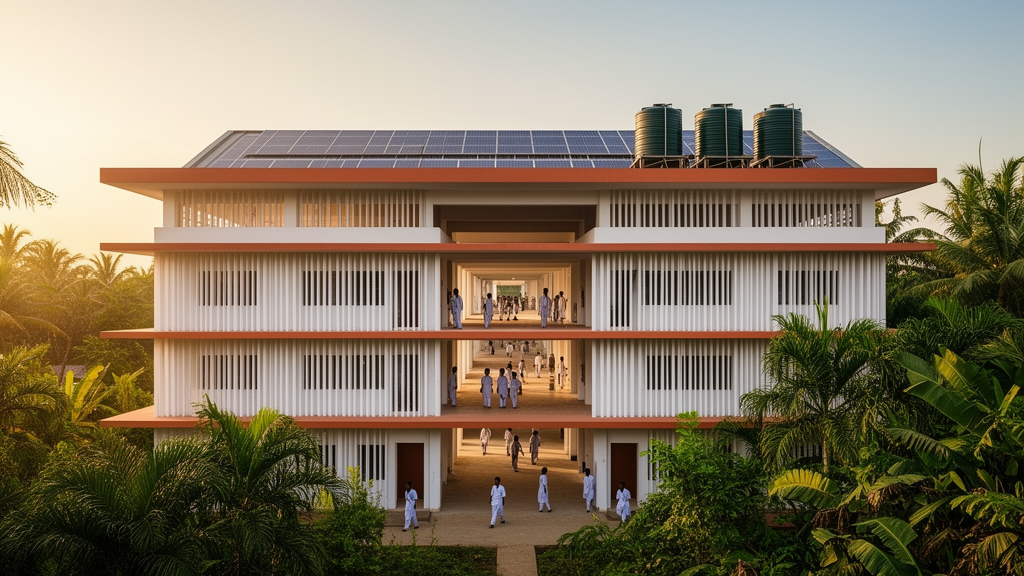
A LEED Platinum-certified garment factory in Rangpur, Bangladesh, kept its indoor air an average of 4.33 °C cooler than the outdoors during the warm season, while a nearby conventional building managed only 1.67 °C, according to a case study published in the journal City and Built Environment. The factory, operated by Karupannya Rangpur Ltd., scored 71 out of 110 points under the LEED rating system, placing it in the Platinum band that begins at 68 points. Researchers from the study combined week-long temperature monitoring, factory water records, and a survey of 20 employees to evaluate how the building performed in practice rather than on paper.
The study addresses a gap the authors identify as persistent: despite growing interest in sustainable construction, empirical research on green buildings in Bangladesh remains limited, and most existing studies focus on barriers to adoption rather than measured performance. Bangladesh ranked second in the World Air Quality Report 2024, with pollution levels 15 times higher than World Health Organization guidelines, and its construction sector accounts for roughly 10 percent of national greenhouse gas emissions. Groundwater in Dhaka drops by 1 to 2 meters per year due to excessive extraction, making water conservation a pressing concern for any building project in the country.
Bangladesh’s green building movement has accelerated over the past two decades. The Eco-Housing Project by the Housing and Building Research Institute introduced low-cost, energy-efficient housing in 2007. The country’s first LEED-certified factory opened in 2010, launching the green ready-made garment movement. By 2012, a draft Green Building Code led by the International Finance Corporation and HBRI fed sustainability rules into the Bangladesh National Building Code, and a 2014 Energy Efficiency Chapter mandated minimum green standards. By May 2025, Bangladesh had 243 LEED-certified factories, the highest number globally in the green ready-made garment category. The BNBC 2020 made renewable energy requirements compulsory for new buildings, and in 2024 the government launched its own Building Energy Efficiency and Environment Rating system.
The factory’s cooling advantage comes from passive design rooted in traditional Bengali architecture rather than from mechanical systems. Large reservoirs face south, so a pond on that side cools incoming air before it enters the building. Ventilators on every floor let hot air rise and escape, following the principle that warm air moves upward while cooler air sinks. Verandas and windows set 4.5 feet high, along with herbaceous plants growing on walls and in front of the buildings, block solar heat from striking the south-facing walls. In winter, northern windows stay shut against cold winds while planters on the south side, irrigated through a deep watering system, help keep interiors warm. Machines on each floor release hot air through floor vents, which then exits through ventilators above the windows.
Peak afternoon reductions reached 6 °C, and the cooling gap remained consistent throughout the day. A one-way ANOVA assuming seven days of stable observations found a statistically significant difference in indoor temperature between the two buildings, F(1, 40) = 63.99, p < 0.001, confirming that the green building consistently maintained lower indoor temperatures.
The cooling design translated into a substantial energy finding. The green building used approximately 80 percent less electricity for indoor cooling than the conventional baseline building, a reduction the authors attribute entirely to passive cooling because no mechanical cooling was required in the monitored areas. This figure comes from historical cooling-related electricity demand rather than a controlled experiment, so it reflects operational savings under the factory’s actual conditions. The energy and atmosphere category carries the heaviest weight in the LEED system at 33 of 110 points, and the factory earned 23 of those 33 points, the largest single contribution to its Platinum score.
Water records showed that rainwater harvesting supplied between 30 and 40 percent of total water use during monsoon months of March and July 2021, and up to 20 percent during the drier January 2021 period. Harvested rainwater reduced dependence on groundwater and served cleaning, toilet flushing, and certain operational needs. The factory draws from two sources: rainwater collection and groundwater from onsite tube wells. The Rangpur Sadar area receives 1932 millimeters of rainfall annually with temperatures ranging from 6.0 to 36.3 °C, conditions that make rainwater capture a practical supplement during wet months.
A survey of 20 employees, including administrative staff and production workers who regularly occupy the monitored areas, captured perceptions of comfort, air quality, health, and satisfaction. Ninety percent of participants reported feeling more productive and cheerful in the green environment. Workers credited natural cooling from the south-facing reservoirs, wall-mounted greenery, and ventilators with keeping them comfortable even in summer. They appreciated the clean, odor-free, low-emission environment and confirmed access to medical centers, canteens, and prayer rooms. Awareness of the LEED certification was moderate, with only 58 percent acknowledging that their factory was certified. The authors note that the sample, while appropriate for perception-based evaluation, is small relative to the total workforce.
The study’s limitations are explicit. It rests on a single case study and a small employee sample, which may not capture the diversity of factory types or worker experiences across the country. Temperature measurements covered only one week, and the authors call for long-term seasonal analysis, multi-site evaluations, larger survey populations, and year-round monitoring to understand performance variability and economic feasibility. The 80 percent energy figure and the water savings percentages come from factory records and historical comparisons rather than randomized trials, so they describe one building’s performance rather than a guaranteed outcome for any green factory.
Broader context matters for interpreting these results. Globally, buildings and construction activities are responsible for roughly 40 percent of carbon dioxide emissions, and the construction industry accounts for approximately 38 percent of global carbon emissions. Green buildings have been associated with reductions of 30 to 50 percent in energy use, 35 percent in carbon dioxide emissions, 70 percent in waste output, and 40 percent in water consumption, though these figures come from general literature rather than this specific case. Bangladesh has over 7,000 factories employing more than 4 million workers, yet green factories remain a small fraction of the total. The authors argue that combining local traditional cooling practices with modern certification principles shows that high sustainability performance can be achieved through low-cost architectural adaptations, not only through advanced technology. They recommend strengthening incentives for LEED and comparable certifications, expanding technical training for architects and builders, and integrating climate-responsive design into the Bangladesh National Building Code to accelerate adoption across the industrial sector.
Subject of Research: Measured thermal, water, and worker well-being performance of a LEED Platinum-certified green factory building in Bangladesh compared with a conventional building.
Article Title: Evaluating the performance and prospects of green buildings in Bangladesh: a case study approach
Article References: Islam, M. S., Mahmud, M., Fares, A., & Rahman, A. (2026). Evaluating the performance and prospects of green buildings in Bangladesh: a case study approach. City and Built Environment, 4(1), Article 4. https://doi.org/10.1007/s44213-025-00067-2
Image Credits: AI Generated
DOI: 10.1007/s44213-025-00067-2
Keywords: green buildings, LEED Platinum, Bangladesh, passive cooling, rainwater harvesting, thermal comfort, energy efficiency, ready-made garment industry, indoor environmental quality, sustainable construction, Rangpur, worker survey
News Source: Denise Maddox. (October 30, 2026). Green Factory in Bangladesh Stays 4.33 °C Cooler and Cuts Water Use with Passive Design. Scienmag.



