• HOME
  • NEWS
  • EXPLORE
    • CAREER
      • Companies
      • Jobs
    • EVENTS
    • iGEM
      • News
      • Team
    • PHOTOS
    • VIDEO
    • WIKI
  • BLOG
  • COMMUNITY
    • FACEBOOK
    • INSTAGRAM
    • TWITTER
Wednesday, September 2, 2026
BIOENGINEER.ORG
No Result
View All Result
  • Login
  • HOME
  • NEWS
  • EXPLORE
    • CAREER
      • Companies
      • Jobs
        • Lecturer
        • PhD Studentship
        • Postdoc
        • Research Assistant
    • EVENTS
    • iGEM
      • News
      • Team
    • PHOTOS
    • VIDEO
    • WIKI
  • BLOG
  • COMMUNITY
    • FACEBOOK
    • INSTAGRAM
    • TWITTER
  • HOME
  • NEWS
  • EXPLORE
    • CAREER
      • Companies
      • Jobs
        • Lecturer
        • PhD Studentship
        • Postdoc
        • Research Assistant
    • EVENTS
    • iGEM
      • News
      • Team
    • PHOTOS
    • VIDEO
    • WIKI
  • BLOG
  • COMMUNITY
    • FACEBOOK
    • INSTAGRAM
    • TWITTER
No Result
View All Result
Bioengineer.org
No Result
View All Result
Home NEWS Science News

Greater primary care continuity among older people is associated with fewer inappropriate prescriptions and prescribing omissions

Bioengineer by Bioengineer
July 25, 2023
in Science News
Reading Time: 2 mins read
0
Maarsingh 21.4
Share on FacebookShare on TwitterShare on LinkedinShare on RedditShare on Telegram

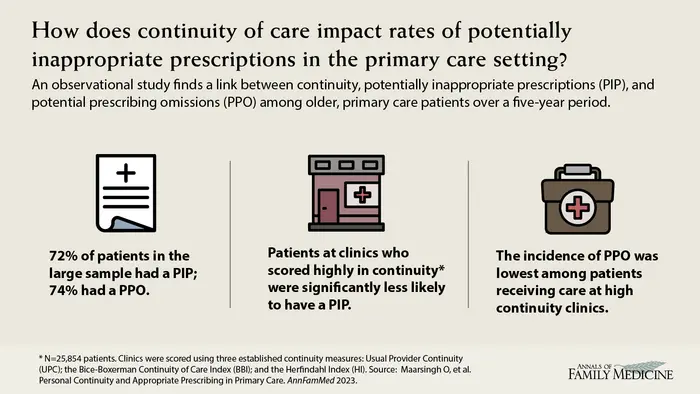
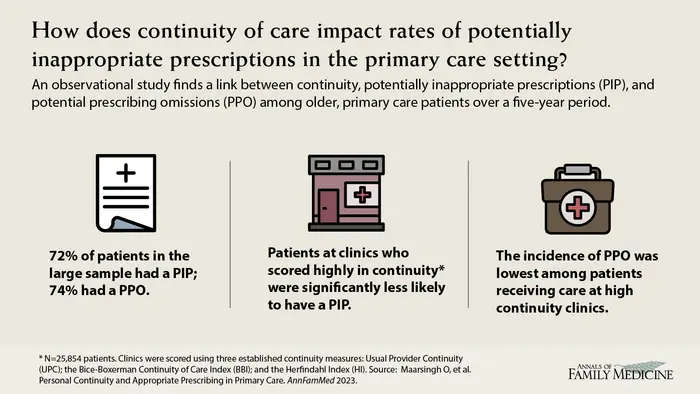
Researchers from the Netherlands conducted an observational study to determine the association between personal continuity and potentially inappropriate prescriptions (PIPs) by family physicians in older patients. PIPs can be categorized as potentially inappropriate medications (PIMs) and potential prescribing omissions (PPOs). The study utilized anonymized routine care data from 269,478 patients, receiving care in 48 Dutch family practices, from 2013 to 2018. They included all patients 65 and older with five or more contacts with their practice in six years, giving them a sample of 25,854 individuals. Personal continuity was measured using three established indices: Usual Provider Continuity (UPC); the Bice-Boxerman Continuity of Care Index (BBI); and the Herfindahl Index (HI). The prevalence of PIPs were determined using screening tools. To assess the association, they conducted analyses with and without adjustment for number of chronic conditions, age and sex.
Maarsingh 21.4

Credit: Annals of Family Medicine

Researchers from the Netherlands conducted an observational study to determine the association between personal continuity and potentially inappropriate prescriptions (PIPs) by family physicians in older patients. PIPs can be categorized as potentially inappropriate medications (PIMs) and potential prescribing omissions (PPOs). The study utilized anonymized routine care data from 269,478 patients, receiving care in 48 Dutch family practices, from 2013 to 2018. They included all patients 65 and older with five or more contacts with their practice in six years, giving them a sample of 25,854 individuals. Personal continuity was measured using three established indices: Usual Provider Continuity (UPC); the Bice-Boxerman Continuity of Care Index (BBI); and the Herfindahl Index (HI). The prevalence of PIPs were determined using screening tools. To assess the association, they conducted analyses with and without adjustment for number of chronic conditions, age and sex.

Higher scores in BBI, HI and UPC were associated with a significant reduction in potentially inappropriate prescriptions. Within the UPC, BBI and HI measures, the mean personal continuity was 0.70 (0.19), 0.55 (0.24) and 0.59 (0.22), respectively. Among more than 25,000 patients the researchers examined, 72.2% and 74.3% had one or more potentially inappropriate medications (PIMs) or PPOs, respectively; and 30.9% and 34.2% had three or more PIMs or PPOs, respectively. The authors conclude that higher personal continuity is associated with more appropriate prescribing and argue that increasing personal continuity may improve quality of prescriptions and reduce harmful consequences.

What We Know: Prescription management is an important aspect of primary care for older patients as inappropriate prescribing can result in avoidable adverse events such as  hospitalizations, falls and acute kidney injury.

What This Study Adds: Researchers found a significant association between increased rates of primary care continuity, as measured by three indices, and a decrease in potentially inappropriate prescriptions (PIPs) among primary care patients.  For potentially inappropriate medications (PIMs), this effect was only observed in the patient group with five to 18 chronic conditions compared to the groups with fewer chronic conditions.

Personal Continuity and Appropriate Prescribing in Primary Care

Otto R. Maarsingh, MD, PhD, et al
Amsterdam UMC location Vrije Universiteit Amsterdam, Department of General Practice, and Amsterdam Public Health Research Institute,
Vrije Universiteit, Amsterdam, The Netherlands.
Permanent link


Journal

The Annals of Family Medicine

Share12Tweet8Share2ShareShareShare2

Related Posts

β-Sitosterol from Ipomoea carnea Jacq. As a promising anti-inflammatory agent: Evidence from in silico modeling and in vitro validation

β-Sitosterol from Ipomoea carnea Jacq. As a promising anti-inflammatory agent: Evidence from in silico modeling and in vitro validation

August 31, 2026
Design, fabrication and characterization of a wearable Fiber Bragg grating sensor for cardiorespiratory monitoring using finger plethysmography

Design, fabrication and characterization of a wearable Fiber Bragg grating sensor for cardiorespiratory monitoring using finger plethysmography

August 31, 2026

KAIST opens the era of industrial-scale microbial foods, proposing growth strategies for the next-generation protein market

August 31, 2026

Virologist awarded $2 million NIH grant to investigate how virus-infected cells live and die

August 31, 2026

POPULAR NEWS

  • β-Sitosterol from Ipomoea carnea Jacq. As a promising anti-inflammatory agent: Evidence from in silico modeling and in vitro validation

    29 shares
    Share 12 Tweet 7
  • Design, fabrication and characterization of a wearable Fiber Bragg grating sensor for cardiorespiratory monitoring using finger plethysmography

    29 shares
    Share 12 Tweet 7
  • KAIST opens the era of industrial-scale microbial foods, proposing growth strategies for the next-generation protein market

    29 shares
    Share 12 Tweet 7
  • Virologist awarded $2 million NIH grant to investigate how virus-infected cells live and die

    29 shares
    Share 12 Tweet 7

About

We bring you the latest biotechnology news from best research centers and universities around the world. Check our website.

Follow us

Recent News

β-Sitosterol from Ipomoea carnea Jacq. As a promising anti-inflammatory agent: Evidence from in silico modeling and in vitro validation

Design, fabrication and characterization of a wearable Fiber Bragg grating sensor for cardiorespiratory monitoring using finger plethysmography

KAIST opens the era of industrial-scale microbial foods, proposing growth strategies for the next-generation protein market

Subscribe to Blog via Email

Success! An email was just sent to confirm your subscription. Please find the email now and click 'Confirm' to start subscribing.

Join 85 other subscribers
  • Contact Us

Bioengineer.org © Copyright 2023 All Rights Reserved.

Welcome Back!

Login to your account below

Forgotten Password?

Retrieve your password

Please enter your username or email address to reset your password.

Log In
No Result
View All Result
  • Homepages
    • Home Page 1
    • Home Page 2
  • News
  • National
  • Business
  • Health
  • Lifestyle
  • Science

Bioengineer.org © Copyright 2023 All Rights Reserved.