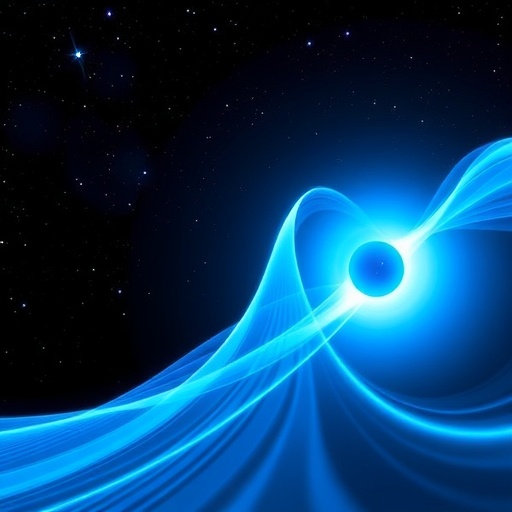
In a remarkable theoretical breakthrough, researchers have unveiled a novel method for detecting gravitational waves by scrutinizing the light spontaneously emitted by atoms. This approach pivots on the subtle shifts that gravitational waves imprint on the frequency of atomic emissions—a concept starkly different from the kilometer-scale interferometric methods currently employed. Published in the prestigious journal Physical Review Letters, the study was undertaken by scientists from Stockholm University, Nordita, and the University of Tübingen, marking a significant advancement in gravitational wave research. While still in the theoretical realm, this work sets the stage for a potential paradigm shift in how we observe and understand these ripples in spacetime.
Gravitational waves, first directly detected in 2015, are oscillations generated by some of the universe’s most cataclysmic phenomena, such as colliding black holes and neutron stars. Traditionally, detection involves laser interferometers that measure infinitesimal variations in distances between mirrors positioned kilometers apart. However, the new framework posits that gravitational waves modulate the quantum electromagnetic field, and consequently, they alter how atoms interact with this field during the process known as spontaneous emission—the quantum event where an excited atom releases photons and returns to a lower energy state.
This phenomenon of spontaneous emission has been a fundamental pillar of quantum physics, understood as atoms emitting photons at specific frequencies corresponding to energy level transitions. However, the researchers propose that when a gravitational wave passes through, it distorts the quantum vacuum fluctuations that govern these emissions. The waves induce directional shifts in the photon’s frequency without changing the overall emission rate. This directional spectral modulation provides a unique fingerprint of the gravitational wave’s directionality and polarization, potentially allowing for discrimination against environmental noise—a critical advancement for increasing detection sensitivity.
Delving deeper into the mechanisms at play, the authors describe how the gravitational wave deforms spacetime in a manner that effectively changes the ‘color’ of light emitted depending on the direction relative to the wave’s propagation. Think of an ensemble of atoms emitting a steady note—a gravitational wave subtly alters the pitch of that note from different angles. This variation encodes essential information about the wave itself. The modulation is not uniform; instead, it introduces anisotropic frequency shifts in the emission spectrum, an effect hitherto unconsidered in gravitational wave detection methodologies.
The implications of these findings for experimental physics and future technologies are profound. Space-based gravitational wave observatories targeting low-frequency waves, such as the planned LISA mission, may benefit from complementary detection strategies embodied by this atomic-scale approach. The researchers suggest that atomic clocks—renowned for their ultraprecise optical transitions—can serve as sensitive testbeds for these phenomena. Cold-atom systems, where atoms are cooled near absolute zero to minimize thermal noise, offer extended interaction times, amplifying the detectable modulation effects induced by passing gravitational waves.
Moreover, embracing this new detection technique could drastically reduce the physical scale required to study gravitational waves. Unlike current infrastructures sprawling across kilometers, a compact, millimeter-scale atomic ensemble might suffice. This miniaturization bears enormous potential for cost reduction, easier deployment, and the creation of portable gravitational wave detectors—a futuristic vision that could democratize access to gravitational wave astronomy beyond large, centralized observatories.
Nevertheless, the authors are candid about the challenges ahead. A rigorous analysis of background noise sources and environmental disturbances is indispensable before declaring practical feasibility. Factors such as thermal fluctuations, electromagnetic interference, and quantum noise could mask or mimic the delicate frequency shifts induced by gravitational waves. Developing strategies to isolate genuine gravitational wave signals amidst this noise is a critical next step. Initial estimates by the authors, however, remain optimistic, hinting that the effects, while subtle, are within reach of forthcoming quantum sensing technologies.
This work also shines a spotlight on the interplay between gravitational physics and quantum optics, bridging two of the most active frontiers in physics today. By leveraging sophisticated computational simulations and modeling, the study elucidates how classical gravitational phenomena subtly influence inherently quantum mechanical processes. Such cross-disciplinary insights not only pave new routes for gravitational wave detection but also deepen our conceptual grasp of the universe at the nexus of quantum mechanics and general relativity.
Adding a compelling narrative element, one of the lead researchers, Jerzy Paczos, emphasizes that gravitational waves alter the quantum electromagnetic field that governs spontaneous emission. These alterations result in photons with shifted frequencies emerging from atoms in a directionally dependent manner—a nuanced effect that has escaped detection until now. This discovery opens exciting avenues not just for sensing gravitational waves but also for probing fundamental quantum field dynamics in curved spacetime.
Navdeep Arya, a postdoctoral scholar part of the research team, elaborates on the practical aspects, noting the prospect of atomic ensembles rivaling the scale of a millimeter for gravitational-wave sensing. This revolutionary miniaturization could transform gravitational wave observatories from massive, fixed installations into compact and possibly even portable devices. The concept tantalizingly hints at a future where gravitational wave detection becomes integrated into laboratory benches or space-faring platforms, expanding observational capabilities across multiple domains.
As the analysis proceeds, the focus remains on refining theoretical models to capture noise contributions precisely and on devising experimental conditions to realize these predictions. The synergy between accurate atomic control, quantum coherence preservation, and gravitational wave detection presents a fascinating frontier. Seeking to exploit the long coherence times and spectral precision inherent in atomic clocks, researchers are optimistic about translating these theoretical foundations into practical instruments in the coming decades.
Ultimately, this pioneering study charts a bold course toward a new epoch of gravitational wave astronomy, rooted in the quantum behavior of atoms. By transforming atomic emission frequencies into a sensitive probe for spacetime distortions, the scientific community stands on the cusp of broadening our cosmic listening toolkit. As experimentalists and theorists join forces to surmount technical hurdles, humanity may soon gain a profoundly new perspective on the gravitational symphony permeating the cosmos.
Subject of Research: Not applicable
Article Title: Gravitational wave imprints on spontaneous emission
News Publication Date: 19-Mar-2026
Web References: http://dx.doi.org/10.1103/1gtr-5c2f
Image Credits: Jerzy Michal Paczos
Keywords
gravitational waves, spontaneous emission, quantum field modulation, atomic clocks, quantum optics, spacetime ripples, frequency shifts, low-frequency gravitational waves, cold-atom systems, compact detectors, quantum sensing, general relativity
Tags: advancements in quantum gravity measurementalternatives to laser interferometryatomic spectroscopy in gravitational researchfrequency shifts in atomic lightgravitational wave detection using atomic emissiongravitational wave signatures in photon frequenciesmicroscopic detection of gravitational wavesquantum effects of spacetime ripplesquantum electromagnetic field modulationspontaneous emission and gravitational wavesStockholm University gravitational wave studytheoretical methods for gravitational wave observation