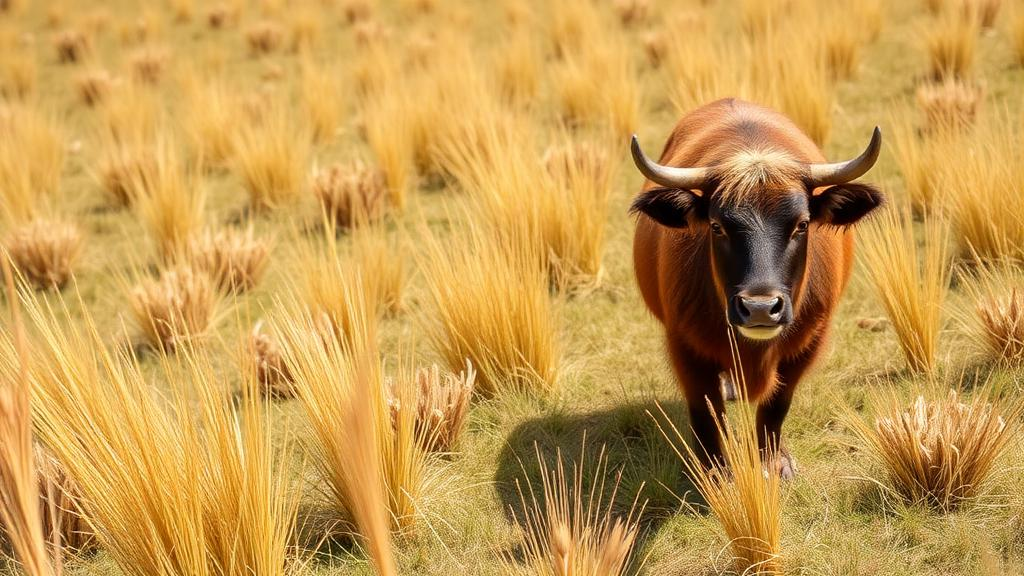
High on the Qinghai-Tibetan Plateau, where the air is thin and the growing season is brutally short, pastoralists have grazed yaks and Tibetan sheep for thousands of years. Yet this ancient system is under strain. A new study published in the journal Plant and Soil by Jing Zhang of Lanzhou University and colleagues presents a fresh, quantitative way to think about a problem that has haunted the plateau for decades: the mismatch between how much forage the land produces and how much food the region’s herds demand, especially through the punishing winter months. Rather than treating the forage-livestock balance as a single, flat number, the researchers break it into three interacting dimensions—type, time, and space—and show that coordinating all three simultaneously can raise the productivity and sustainability of the entire pastoral system.
The core of the problem is seasonal. On the plateau, grass grows vigorously during a brief summer window, but livestock must eat year-round. When winter arrives, natural pastures stop producing, animals lose weight or require costly supplementary feed, and herders face a stark choice: buy in forage, overgraze what remains, or sell animals at depressed prices. Excessive livestock numbers combined with widespread grassland degradation have produced systemic energy deficits across the region, weakening ecosystem functionality and threatening both livelihoods and ecological stability. Previous work has documented this seasonal imbalance extensively, including studies showing that shifts from grazing to forage-based feeding can reshape the rumen microbiota of Tibetan sheep and help them adapt to the cold season, and that supplementing yaks with oat hay improves nitrogen cycling in alpine meadows. What has been missing, the authors argue, is a framework that explicitly quantifies how different management levers interact across scales.
The team’s answer is a multidimensional coupling framework built on three strategies. The first, which they call type coupling, involves combining annual and perennial legumes with grasses in cultivated pastures to maximize biomass yield. Legumes fix atmospheric nitrogen through their symbiosis with rhizobia, complementing grasses that are efficient at taking up soil nitrogen, and mixtures of the two have been shown in other systems to enhance forage production partly through effects on the bacterial community in the rhizosphere. The second strategy, temporal coupling, optimizes when forage becomes available by combining the mowing of cultivated pastures with rotational grazing on natural pastures, ensuring that enough feed is conserved as hay or silage to carry animals through winter. The third, spatial coupling, addresses the sheer geography of the plateau by strategically locating forage production zones to minimize transport distances across a region of continental proportions, and by pairing the plateau’s forage deficit with the supply capacity and resilience of adjacent regions.
The quantitative results are striking. By analyzing the degree of coordinated coupling between forage types and harvest cycles, the researchers found that mixing annual and perennial forages with legumes and grasses could push coupling degrees as high as 69.56, 56.85, and 49.66 across the first, second, and third harvests, respectively. These numbers express, on a standardized scale, how well the supply of forage from a given configuration matches the demand profile of the livestock system. The declining values across successive harvests reflect a familiar agronomic reality: legume-dominated stands and cool-season grasses tend to peak early in the season, and maintaining high yield-and-quality coordination later in the growing season becomes progressively harder. The study’s contribution is to make that trade-off explicit and measurable, so that pasture designers can choose species combinations and cutting schedules that keep coupling degrees high across the full season rather than only at first cut.
Temporal dynamics proved equally consequential. The team found that configurations optimized for winter supplementary feeding achieved a degree of coordinated coupling roughly four points higher than those measured during the summer season. In practical terms, this means that the benefit of getting species mixtures and harvest timing right is amplified when the output is directed at the winter feed gap—the single most dangerous period for the plateau’s livestock. Animals that enter winter with adequate body reserves, or that receive well-preserved, nutrient-dense hay through the cold months, survive better and reproduce more reliably. Earlier work on the plateau has shown that yak body composition fluctuates dramatically with season on un-supplemented grazing alone, and that strategic concentrate and hay supplementation changes metabolism and nitrogen flows in ways that benefit both animals and the meadows they graze. The new framework effectively tells land managers where to invest: in cultivated pastures that produce storable winter forage, harvested at times and frequencies that maximize coordinated output.
The spatial dimension adds a layer that most forage-livestock studies ignore. The Qinghai-Tibetan Plateau is vast, and hauling bulky, low-value commodities like hay over long distances is economically and energetically punishing. The researchers propose a feasible strategy for maximizing inter-regional forage coupling by explicitly considering both the forage deficit within the plateau and the supply resilience of neighboring regions. This resembles the logic of coupling crop and livestock systems through spatial analysis and site selection used elsewhere, where manure and feed transfer hubs are located to minimize transport and tighten nutrient loops. On the plateau, the equivalent is mapping where cultivated forage can be grown most productively—often in valley bottoms, agro-pastoral ecotones, or irrigated tracts—and where those feed resources should flow to relieve grazing pressure on the most degraded rangelands.
What makes the approach conceptually powerful is its synthesis into a single cross-scale model. The authors frame type, temporal, and spatial coupling as nested layers of the same underlying coordination problem: matching supply to demand across species composition, season, and geography. They link this to an evolutionary view of pastoral wisdom on the plateau, suggesting in companion work that traditional herding practices already embodied forms of periodic intelligent intervention, and that modern quantitative tools can formalize and sharpen those instincts. The framework also connects to broader theory about system coupling in social-ecological systems; other researchers have analyzed spatio-temporal changes in the coupling of society and environment on the plateau, and the present study extends that logic down to the level of plants, harvests, and animal feeding.
The empirical grounding of the study deserves emphasis. The experimental plant materials included locally cultivated varieties supplied by co-authors Zhibiao Nan and Qingping Zhou, such as three lines of common vetch—Lanjian No.1, No.2, and No.3—and a cultivar of Poa anceps, a native-ish grass well adapted to high-altitude conditions. Field teams collected samples across the harvest sequence, and the analysis was led by Jing Zhang under the direction of Fujiang Hou at Lanzhou University’s College of Pastoral Agriculture Science and Technology, with collaborators including Nurlan Serekpayev at S.Seifullin Kazakh Agro Technical University in Kazakhstan. The work was funded by China’s National Key Research and Development Program, and its data, while available upon request, rest on field measurements rather than simulation alone—an important credential for a paper whose conclusions are meant to be actionable.
The implications reach well beyond the plateau. Grasslands cover a large share of the terrestrial surface, and seasonal forage deficits are a defining constraint on pastoral systems from the Eurasian steppe to the Sahel. A transferable method for quantifying coupling across type, time, and space offers those systems a template: diagnose the deficit, design mixtures that keep yield-and-quality coordination high across cuts, time harvests to build winter reserves, and place production where transport and ecological costs are lowest. For the Qinghai-Tibetan Plateau itself, the study provides what its authors call a comprehensive conceptual framework, empirical data, and theoretical foundation for mitigating the forage-livestock imbalance. If widely adopted, the type-temporal-spatial approach could mean fewer starving animals in February, healthier meadows in July, and a pastoral economy that finally matches its consumption to what one of the world’s harshest agricultural environments can sustainably provide.
Subject of Research: Forage-livestock balance and sustainable pastoral management on the Qinghai-Tibetan Plateau
Article Title: Enhancing resource productivity and system sustainability on the Qinghai-Tibetan Plateau: a type-temporal-spatial coupling approach for forage-livestock balance
Article References: Zhang, J., Serekpayev, N., Usman, M., Ahmad, N., Hafeez, M. B., Zhou, Q., Hou, F., & Nan, Z. (2026). Enhancing resource productivity and system sustainability on the Qinghai-Tibetan Plateau: a type-temporal-spatial coupling approach for forage-livestock balance. Plant and Soil. https://doi.org/10.1007/s11104-026-09030-4
Image Credits: AI Generated
DOI: 10.1007/s11104-026-09030-4
Keywords: Qinghai-Tibetan Plateau, forage-livestock balance, grass-legume mixtures, cultivated pastures, rotational grazing, winter supplementary feeding, coupling coordination, alpine meadows, yak, Tibetan sheep, grassland degradation, sustainable pastoralism
News Source: William Thompson. (October 14, 2026). Grass, Legumes and Timing: Rebalancing Forage and Livestock on the Tibetan Plateau. Scienmag.