• HOME
  • NEWS
  • EXPLORE
    • CAREER
      • Companies
      • Jobs
    • EVENTS
    • iGEM
      • News
      • Team
    • PHOTOS
    • VIDEO
    • WIKI
  • BLOG
  • COMMUNITY
    • FACEBOOK
    • INSTAGRAM
    • TWITTER
Thursday, May 14, 2026
BIOENGINEER.ORG
No Result
View All Result
  • Login
  • HOME
  • NEWS
  • EXPLORE
    • CAREER
      • Companies
      • Jobs
        • Lecturer
        • PhD Studentship
        • Postdoc
        • Research Assistant
    • EVENTS
    • iGEM
      • News
      • Team
    • PHOTOS
    • VIDEO
    • WIKI
  • BLOG
  • COMMUNITY
    • FACEBOOK
    • INSTAGRAM
    • TWITTER
  • HOME
  • NEWS
  • EXPLORE
    • CAREER
      • Companies
      • Jobs
        • Lecturer
        • PhD Studentship
        • Postdoc
        • Research Assistant
    • EVENTS
    • iGEM
      • News
      • Team
    • PHOTOS
    • VIDEO
    • WIKI
  • BLOG
  • COMMUNITY
    • FACEBOOK
    • INSTAGRAM
    • TWITTER
No Result
View All Result
Bioengineer.org
No Result
View All Result
Home NEWS Science News Chemistry

Graphene controls laser frequency combs in fiber

Bioengineer by Bioengineer
November 11, 2020
in Chemistry
Reading Time: 2 mins read
0
IMAGE
Share on FacebookShare on TwitterShare on LinkedinShare on RedditShare on Telegram

IMAGE

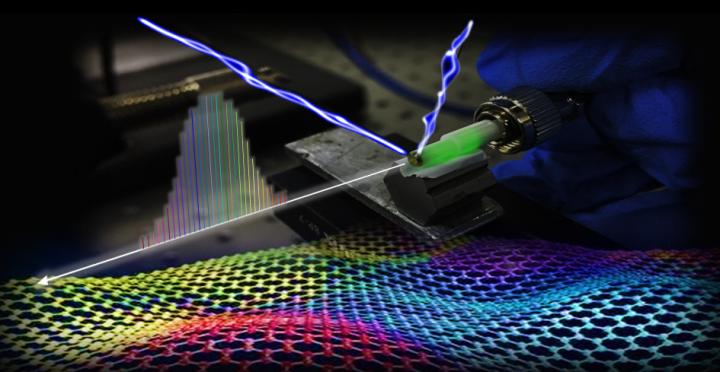
Credit: by Chenye Qin, Kunpeng Jia, Qianyuan Li, Teng Tan, Xiaohan Wang, Yanhong Guo, Shu-Wei Huang, Yuan Liu, Shining Zhu, Zhenda Xie, Yunjiang Rao, & Baicheng Yao

The development of laser frequency combs has revolutionized optical communication, photonic sensing, precision spectroscopy, and astronomical observation. Stable frequency combs could be achieved via mode locking in rare-earth doped fiber lasers, generating Kerr solitons in parametric oscillators, or opto-electrically modulating lithium niobate microresonators with strong second-order nonlinearity. For many out-of-lab applications, people desire a compact comb devices with multiple advances, such as all-in-fiber integration, low driven power but high efficiency, full stabilization, and diverse comb outputs with fast and convenient tunability.

In a recently published paper in Light: Science & Applications, scientists from the University of Electronic Science and Technology of China, Nanjing University, Hunan University and University of Colorado, Bouder, demonstrated a graphene heterogeneous fiber micro resonator. Leveraging the electrical tunability of the graphene semiconductor incorporated in a fiber F-P microcavity, they demonstrate dissipative soliton mode-locked laser combs generation, and the capability to control comb dynamics in situ. Taking advantage of the tunneling diode effect, the researchers realize a remarkable graphene Dirac Fermion tuning from 0 to 0.45 eV. This leads to modulation depth controllable in range of 0.1% to 1.4 %. In consequence, mode locked laser frequency combs with unprecedentedly dynamic tunability are demonstrated, in both fundamental and harmonic states. Moreover, the graphene integrated microlaser device provides a powerful way to opto-electrically stabilize the comb lines after 1/2 octave supercontinuum amplification, the phase noise reaches the instrument-limited floor of -130 dBc/Hz at 10 kHz offset, suggesting timing jitter less than 2.5×10⁻¹⁵ s per roundtrip. Such realization of the microcomb’s dynamic control and stabilization, in a graphene heterogeneous fiber microcavity, would provide a new platform at the interface of single atomic layer optoelectronics and ultrafast photonics, lighting versatile applications for arbitrary waveform generation, fiber communication, signal processing, and spectroscopic metrology.

###

Media Contact
Baicheng Yao
[email protected]

Related Journal Article

http://dx.doi.org/10.1038/s41377-020-00419-z

Tags: Chemistry/Physics/Materials SciencesOptics
Share12Tweet8Share2ShareShareShare2

Related Posts

Researchers Develop High-Efficiency Hydrogen Separation Membranes Using Innovative ‘Mortar-and-Brick’ Design — Chemistry

Researchers Develop High-Efficiency Hydrogen Separation Membranes Using Innovative ‘Mortar-and-Brick’ Design

May 13, 2026
Green Electrosynthesis Paves the Way for Direct Amines Production from Atmospheric Nitrogen — Chemistry

Green Electrosynthesis Paves the Way for Direct Amines Production from Atmospheric Nitrogen

May 13, 2026

Decoding Life’s Chemistry: A Revolutionary Search Engine from Molecules to Meaning

May 13, 2026

How Olympic Weightlifting Harnesses the Barbell’s ‘Whip’ for Peak Performance #ASA190

May 13, 2026
Please login to join discussion

POPULAR NEWS

  • Research Indicates Potential Connection Between Prenatal Medication Exposure and Elevated Autism Risk

    842 shares
    Share 337 Tweet 211
  • New Study Reveals Plants Can Detect the Sound of Rain

    729 shares
    Share 291 Tweet 182
  • Salmonella Haem Blocks Macrophages, Boosts Infection

    62 shares
    Share 25 Tweet 16
  • Breastmilk Balances E. coli and Beneficial Bacteria in Infant Gut Microbiomes

    57 shares
    Share 23 Tweet 14

About

We bring you the latest biotechnology news from best research centers and universities around the world. Check our website.

Follow us

Recent News

UVR8 Variations Influence Plant Heat Tolerance and Yield

Lineage and Organ Signals Forge Intrinsic Nerves

Functional Ability and Heat Vulnerability in Older Adults

Subscribe to Blog via Email

Enter your email address to subscribe to this blog and receive notifications of new posts by email.

Join 82 other subscribers
  • Contact Us

Bioengineer.org © Copyright 2023 All Rights Reserved.

Welcome Back!

Login to your account below

Forgotten Password?

Retrieve your password

Please enter your username or email address to reset your password.

Log In
No Result
View All Result
  • Homepages
    • Home Page 1
    • Home Page 2
  • News
  • National
  • Business
  • Health
  • Lifestyle
  • Science

Bioengineer.org © Copyright 2023 All Rights Reserved.