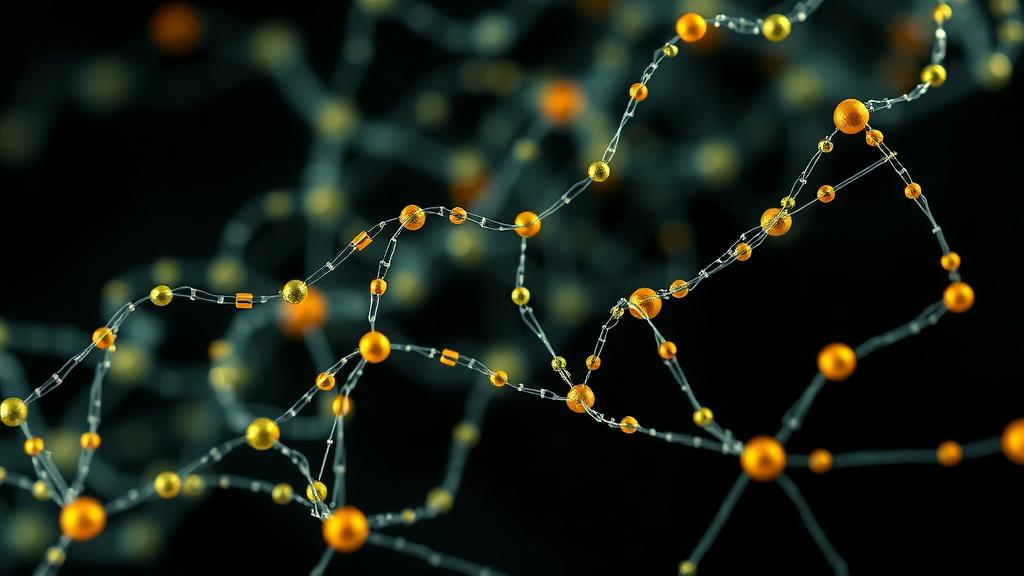
Carbon nanotubes have long been celebrated as one of the most versatile building blocks in modern nanotechnology, finding roles in nanoelectronics, molecular sensors, energy-storage devices, nanocomposites, and multi-terminal nanoscale interconnects. Yet as researchers push beyond simple cylindrical tubes toward more elaborate architectures, a pressing question emerges: how can we quantify the structural complexity of these exotic materials in a rigorous, predictive way? A new study published in Scientific Reports by Muhammad Faisal Nadeem, Ayesha Shabbir, Mohamad Nazri Husin, and Yuslenita Muda tackles exactly this problem, using the mathematical language of graph entropy to dissect a novel class of structures known as hyper armchair carbon nanotubes.
The structures at the heart of the study, abbreviated HCN graphs, are not ordinary nanotubes. Instead of a simple honeycomb lattice of carbon atoms, a hyper armchair carbon nanotube is constructed by replacing every vertex of an armchair nanotube template with a Y-shaped junction module, and every edge of the template with an armchair nanotube segment. The result is a branched, fractal-like network that resembles a nanoscale plumbing system with junctions at every node. Such architectures are of genuine practical interest, because Y-shaped junctions are precisely the kind of connectivity needed for multi-terminal interconnects in nanoscale circuits, where a single conducting channel must split into two or more branches.
To analyze these structures, the authors turned to degree-based topological indices, a family of numerical descriptors that condense the connectivity pattern of a molecular graph into a single number. In a graph representation of a nanotube, vertices correspond to atoms or junction modules and edges correspond to bonds or connecting segments. The degree of a vertex is simply the number of edges meeting at it. Classic degree-based indices, such as the first and second Zagreb indices, sum quantities like the squares of vertex degrees or products of degrees across edges, and decades of research in chemical graph theory have shown that these numbers correlate with physicochemical properties ranging from boiling points to electronic band structures.
However, a single index number can hide as much as it reveals. Two very different graphs can share the same Zagreb index, and a lone descriptor says nothing about how evenly the structural information is distributed across the network. This is where entropy enters the picture. By adapting Shannon’s celebrated information-theoretic entropy measure to topological indices, researchers can quantify not just the total value of an index but the diversity of its contributions across all edges of the graph. A high entropy value signals that the index contributions are spread evenly among many different edge types, while a low entropy value indicates that a small subset of edges dominates the descriptor.
The methodological core of the paper lies in establishing complete vertex-degree partitions and vertex-degree-based edge partitions for the HCN graph. In plain terms, the authors sorted every vertex and every edge of the hyper nanotube into classes according to the degrees of their endpoints, and then verified that these classifications were exhaustive and consistent with the graph’s fundamental invariants: its order (the number of vertices), its size (the number of edges), and the degree-sum identity, which requires that the sum of all vertex degrees equals twice the number of edges. This verification step is far from a formality; incorrect partitions are a common source of errors in the chemical graph theory literature, and the authors’ careful cross-checking lends the resulting formulas a solid foundation.
With the partitions in hand, the team derived closed-form expressions for the selected topological indices of HCN graphs, meaning exact formulas that depend only on the structural parameters of the nanotube rather than on laborious edge-by-edge counting. They then normalized the edge contributions of each index to obtain the corresponding Shannon entropies. Closed forms are particularly valuable because they allow researchers to predict how entropy behaves as a hyper nanotube grows, without recomputing anything from scratch for each new size.
The numerical comparisons reported in the study reveal a clear and somewhat elegant trend: the entropy values of the selected degree-based indices increase along the sequence of structural parameters. In other words, as hyper armchair carbon nanotubes become larger or more complex, the contributions of individual edges to each topological index become more evenly distributed across the network. The graph, in an information-theoretic sense, becomes more democratic as it grows.
Even more illuminating is the explanation the authors offer for a related observation: the entropy values of different indices converge and become close for larger HCN graphs. The culprit is the dominant degree class. In a hyper nanotube, the Y-shaped junction modules and the connecting armchair segments create a degree distribution in which one particular class of edges vastly outnumbers all others. As the graph expands, this dominant class accounts for an ever-larger fraction of all edges, so every degree-based index, regardless of its precise mathematical definition, draws the overwhelming majority of its contribution from the same pool of edges. When normalized into entropies, the indices therefore converge toward similar values, a phenomenon the authors trace directly to the structure of the degree partitions.
This convergence has practical implications for anyone using topological indices to screen nanomaterials. It suggests that for very large hyper nanotubes, the choice among popular degree-based indices may matter less than one might expect, since their entropy profiles become nearly indistinguishable. Conversely, for smaller structures, where the degree classes are more balanced, different indices can yield genuinely different entropy values, making the choice of descriptor more consequential. Researchers designing Y-junctioned nanotube interconnects or hierarchical nanocomposites could use these entropy measures as a diagnostic of structural heterogeneity, complementing traditional indices that capture only aggregate information.
The study, which received funding support from Universiti Malaysia Terengganu, exemplifies a broader trend in which information theory and chemical graph theory join forces to make sense of increasingly intricate nanostructures. As synthetic chemistry gains the ability to assemble ever more elaborate carbon architectures, mathematical tools that can distill their complexity into interpretable, comparable numbers will only grow in importance. For hyper carbon nanotubes, entropy measures of degree-based topological indices now offer exactly that: a rigorous yardstick for the hidden order within branching nanoscale networks, and a reminder that sometimes the most revealing properties of a material are found not in its atoms, but in the abstract pattern of their connections.
Subject of Research: Entropy measures of degree-based topological indices for hyper armchair carbon nanotube graphs
Article Title: Entropy measures of degree-based topological indices for hyper carbon nanotubes
Article References: Nadeem, M. F., Shabbir, A., Husin, M. N., & Muda, Y. (2026). Entropy measures of degree-based topological indices for hyper carbon nanotubes. Scientific Reports. https://doi.org/10.1038/s41598-026-73730-1
Image Credits: AI Generated
DOI: 10.1038/s41598-026-73730-1
Keywords: carbon nanotubes, hyper carbon nanotubes, graph entropy, topological indices, degree-based indices, Zagreb indices, Y-shaped junctions, Shannon entropy, chemical graph theory, nanoelectronics, nanoscale interconnects, Scientific Reports
News Source: Denise Maddox. (October 13, 2026). Graph Entropy Reveals Hidden Order in Hyper Carbon Nanotubes. Scienmag.