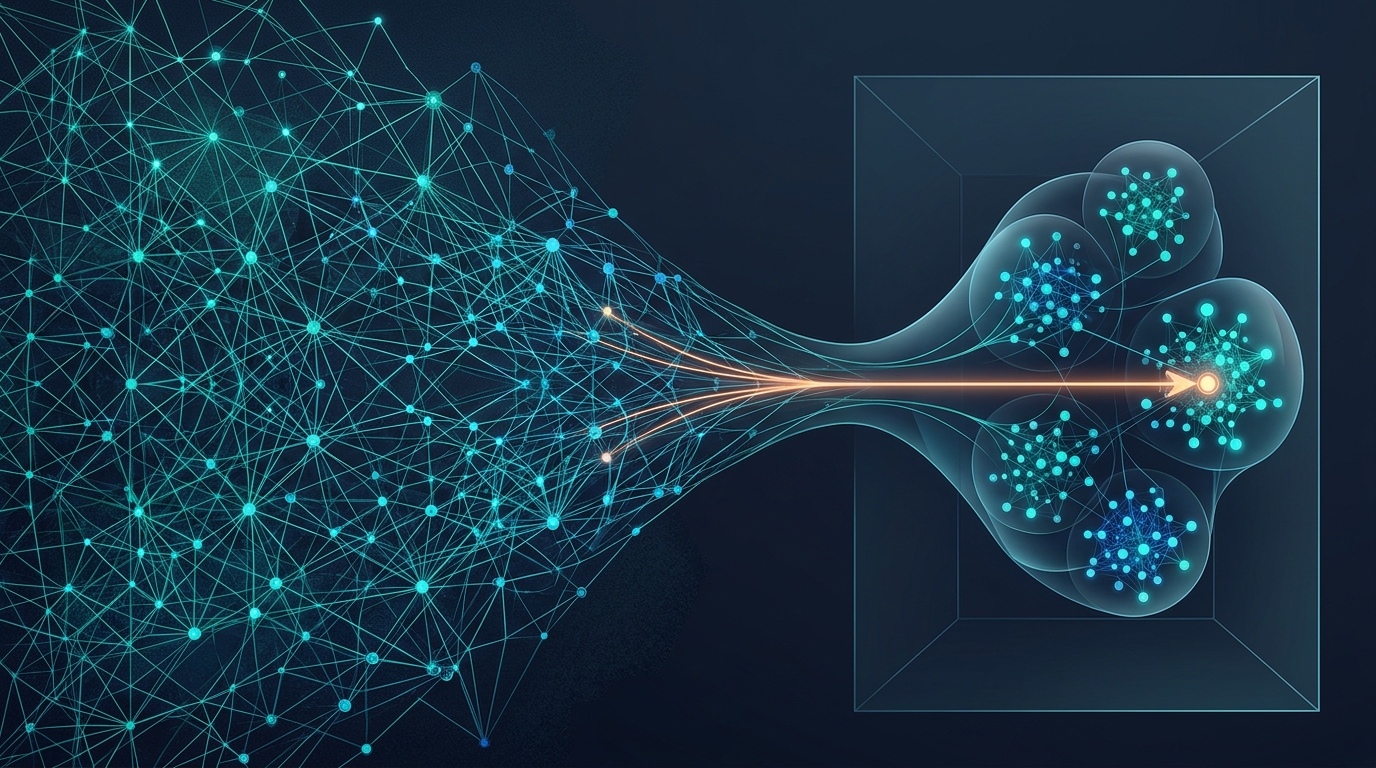
Semantic web service discovery has long promised a way to match software services to user needs by reasoning over formal ontologies, but the approach has struggled with a practical problem: as repositories grow, the computational cost of semantic matching and ranking becomes difficult to sustain. A new study in Knowledge and Information Systems addresses that bottleneck by combining knowledge graph embeddings with clustering, reporting measurable gains in speed, storage, and retrieval quality on a benchmark repository.
The research team, Pooja Thapar and Lalit Sen Sharma, built an integrated knowledge graph repository of semantic web services, called KGSWS, from 48 OWLS-TC v4 ontologies containing 1083 semantic web services. This graph-based representation allowed the authors to treat service relationships as links that machine learning models could learn to encode as compact numeric vectors, replacing the need to traverse heavyweight ontology structures at query time.
The framework was evaluated in three phases. In the first, three knowledge graph embedding models—TransE, ComplEx, and DistMult—were optimized over the KGSWS repository, with embedding quality judged through link prediction. TransE emerged as the strongest performer, achieving a mean reciprocal rank of 0.5792 and a Hits@10 value of 0.6716 among the models evaluated. These scores indicate how well the learned vectors preserve the structure of the service graph when the model must predict missing connections.
In the second phase, the learned representations were tested with different clustering techniques to reduce the candidate search space before service ranking. Clustering groups similar service embeddings together so that a query can be routed to a small subset of likely matches rather than scanning the entire repository. This candidate-selection step is where the framework targets the scalability problem directly, since the expense of semantic matching grows with the number of services examined.
The third phase measured recommendation performance using 38 benchmark queries, scored on Precision@10, Recall@10, NDCG@10, and MAP@10. The TransE combined with K-Means configuration achieved average values of 0.9579, 0.7207, 0.9667, and 0.9873 respectively. Differences among the evaluated configurations were examined statistically using the Friedman test followed by Dunn–Bonferroni post hoc analysis, giving the comparisons a formal significance framework rather than relying on raw score differences alone.
The scalability results are central to the study’s contribution. For the evaluated repository settings, the analysis obtained a search-space reduction of 82.73 percent, a query-processing speedup of 3.61 times, and a latency reduction of 72.27 percent for the complete repository. In practical terms, a discovery system using this approach would examine fewer than a fifth of the services it previously considered for each query while returning results more than three times faster under the tested conditions.
Memory demands also fell. The study reports a 54.66 percent reduction in storage for the embedding representation relative to the serialized ontology representation, under the storage calculation the authors adopted. Because embeddings are fixed-length numeric vectors, they can be substantially more compact than full ontology serializations, which matters when repositories must be held in memory for fast querying.
Retrieval quality did not appear to be sacrificed for these efficiency gains. Compared against ontology-based semantic matching, the approach showed improvements of 13.75 percent in Precision@10, 19.84 percent in Recall@10, 11.80 percent in NDCG@10, and 18.72 percent in MAP@10. These gains suggest that the graph-learned representations captured service relationships well enough to rank relevant services higher than the traditional matching baseline in the benchmark setting.
The authors are careful to scope their conclusions. The results indicate that combining knowledge graph embedding-based semantic representations with clustering-assisted candidate selection can reduce the service search space while maintaining retrieval and ranking performance under the benchmark and experimental settings considered in the study. The evaluation rests on the OWLS-TC v4 repository and its 38 benchmark queries, so performance on substantially different service collections or query distributions remains an open question for future work.
Still, the findings offer a concrete recipe for practitioners building semantic service registries: learn embeddings with a model such as TransE, cluster them to prune candidates, and rank within the reduced set. As service-oriented architectures continue to expand across cloud and enterprise environments, techniques that keep discovery fast without degrading ranking accuracy are likely to draw increasing attention from both researchers and system builders.
Subject of Research: Scalable semantic web service discovery and recommendation using knowledge graph embeddings combined with clustering
Article Title: Navigating scalability to enhance service discovery and recommendations with graph-based embedding models
Article References: Thapar, P., & Sharma, L. S. (2026). Navigating scalability to enhance service discovery and recommendations with graph-based embedding models. Knowledge and Information Systems, 68(1), Article 305. https://doi.org/10.1007/s10115-026-02908-w
Image Credits: AI Generated
DOI: 10.1007/s10115-026-02908-w
Keywords: knowledge graph embeddings, semantic web services, service discovery, TransE, clustering, K-Means, scalability, OWLS-TC v4, link prediction, recommendation systems, search-space reduction, retrieval ranking
News Source: Denise Maddox. (November 3, 2026). Graph embeddings with clustering shrink web service search space. Scienmag.