


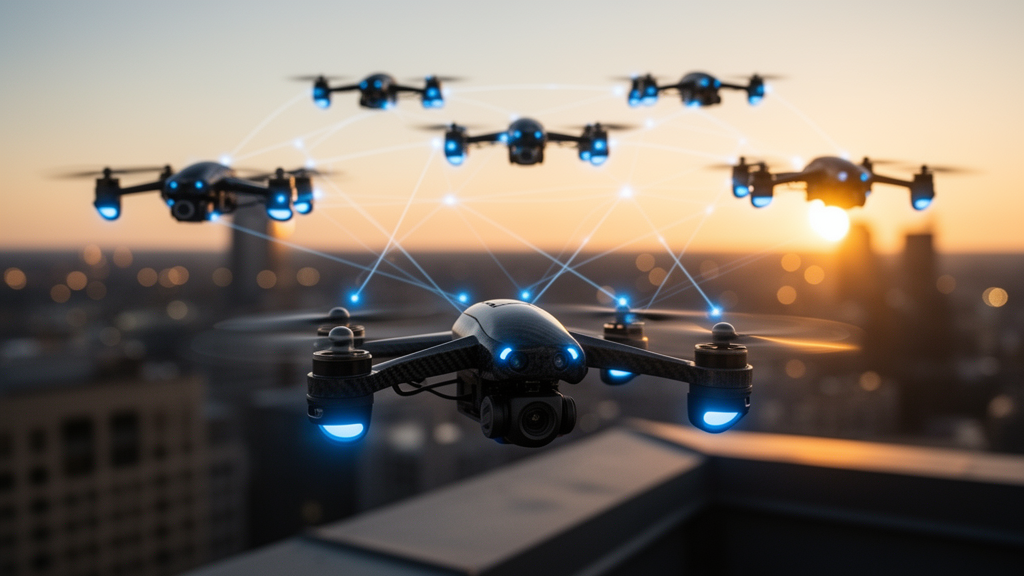
A swarm of autonomous drones flying over a disaster zone or a city with damaged cell towers faces a brutally tangled problem: every aircraft must plan a three-dimensional flight path, decide how much radio power to transmit, and choose which neighboring drone should relay each data packet — all at once, while batteries drain, channels fluctuate, and collisions loom. A new study published in the journal Autonomous Intelligent Systems proposes a machine-learning framework that tackles this joint optimization head-on, and reports substantial simulated gains over established reinforcement-learning baselines.
The work, authored by Zhaopeng Ning, Gang Li, and Wei Li, models the swarm’s task as a multi-agent partially observable Markov decision process and introduces an algorithm called GA-MADDPG — Graph Attention-based Multi-Agent Deep Deterministic Policy Gradient. In simulations of six rotorcraft drones serving ten high-demand ground users across a one-kilometer-square area, the authors report that their method converges roughly 50 percent faster than a single-agent deep deterministic policy gradient approach, raises user service satisfaction by 12 to 18 percent, improves system throughput by 25 to 40 percent, cuts end-to-end delay by 30 to 45 percent, and boosts energy efficiency by 39 to 102 percent relative to the baselines they tested. These figures come entirely from simulation; the framework has not yet been demonstrated on physical aircraft.
The core difficulty the researchers set out to address is one of coupling. Optimizing a drone’s trajectory for radar coverage of ground targets can degrade the air-to-ground communication links it must maintain; maximizing throughput can burn battery reserves needed for a safe return; and routing packets through a network whose nodes are constantly moving means the best forwarding choice changes from one second to the next. The authors formulate this as a multi-objective optimization problem balancing user service satisfaction, communication throughput, and energy consumption, subject to hard constraints on minimum altitude, maximum speed, collision-avoidance separation distances, and a reserved energy margin for emergencies.
Traditional optimization techniques struggle with this formulation for several reasons the paper enumerates. The objectives are non-convex and coupled through drone positions, the collision-avoidance constraint creates a non-convex feasible region, small-scale radio fading makes the problem stochastic, and in real deployment each aircraft can only observe its local surroundings rather than the global state. Convex relaxation, dynamic programming, and heuristics either demand precise channel knowledge that dynamic environments do not provide or scale poorly as the swarm grows.
The proposed solution rests on a centralized-training, decentralized-execution architecture. During training, a centralized critic network evaluates joint actions using global state information, which stabilizes learning in a non-stationary multi-agent environment. The innovation lies in how that critic ingests information: instead of concatenating every drone’s state into a fixed-size vector, the authors encode the swarm’s communication topology as a dynamic graph and apply a graph attention network, which learns to weight each neighbor’s contribution according to its relevance to the current decision. Because attention weights are recomputed at every step, changes in the neighbor set — an inevitability when drones are moving — require no architectural adjustment. The authors state this reduces critic complexity from quadratic in the number of drones to linear in the average neighborhood size, at the cost of roughly 15 percent additional training time in their default configuration.
Each drone’s actor network is hierarchical, with a shared encoder feeding two branches: one outputs continuous commands for three-dimensional velocity and communication power, while the other produces a probability distribution over which reachable neighbor should receive forwarded packets. This hybrid design lets trajectory control and routing decisions remain coupled but tractable. Routing itself is age-of-information-aware: forwarding probabilities depend on link quality, expected remaining hop count to the base station, and how stale each user’s queued packets have become, implemented through a softmax function that the authors say avoids the load imbalance of deterministic routing.
Safety and resource constraints are encoded directly into the reward function through penalty terms. Altitude violations, unsafe proximity between drones, and energy depletion incur large penalties with coefficients set to 100, making them behave almost as hard constraints during training, while a lower penalty of 50 discourages excessively poor line-of-sight probability, which degrades link quality rather than flight safety. The reward simultaneously credits quality-of-service improvements for served users, data successfully forwarded, and penalizes excessive delay, stale information, and energy consumption. A sensitivity analysis in which reward weights were varied by plus or minus 50 percent changed converged satisfaction, throughput, and delay metrics by less than 5 percent, which the authors interpret as evidence the policy is not overly sensitive to coefficient tuning.
The simulation results paint a detailed picture of the learned behavior. GA-MADDPG converged after roughly 600 training episodes to an average reward of about 128.7, compared with about 800 episodes and 115.3 for standard MADDPG without graph attention, about 1,200 episodes and 95.6 for single-agent DDPG, and an oscillating 71.2 for independent Q-learning. On a Pareto frontier obtained by varying the communication reward weight, the method adjusted continuously between 78 to 95 percent sensing coverage and 45 to 120 megabits per second of throughput, reaching roughly 89 percent coverage and 82 megabits per second under the default configuration. Trajectory analysis showed drones spontaneously dividing labor — some moving toward target-dense areas, others toward communication hotspots — and performing detour maneuvers at path intersections to avoid collisions. Energy efficiency reached 0.480 utility units per kilojoule, versus 0.346 for DDPG.
Scalability tests raised the swarm from two to ten drones. Coverage and throughput both climbed with diminishing marginal returns: adding drones two through four lifted coverage from about 65 to 82 percent, while the jump from eight to ten added only about three percentage points. Per-drone inference latency stayed within five milliseconds at every scale, because each deployed aircraft runs only its local policy network, whereas the centralized single-agent baseline’s latency grew linearly to roughly 40 milliseconds at ten drones. The authors are candid about limits: experiments with ten or fewer drones represent a relatively small swarm, and deployments of fifty or more nodes would likely require distributed or federated training to manage the centralized critic’s growing complexity and the inter-drone communication overhead during training.
The paper also stress-tests its modeling assumptions. An enhanced configuration adding a probabilistic line-of-sight channel model, age-of-information routing, and solar energy harvesting raised the simulated line-of-sight link ratio from 52 to 68 percent, cut average information age from 85.3 to 58.7 milliseconds, reduced link switching from 0.42 to 0.29, and improved energy efficiency from 0.372 to 0.480. The authors acknowledge their queuing-delay model, an M/M/1 approximation, becomes optimistic under bursty traffic, and that their channel model does not capture rich multipath scattering or deep shadowing in dense urban canyons, so predicted gains may be optimistic in heavily obstructed environments. They likewise note that the observation design assumes perfect local sensing, whereas real onboard measurements are noisy. Future work, they write, will pursue federated learning for distributed training, safe reinforcement learning for operational robustness, and hardware-in-the-loop and real-flight experiments — the steps that will determine whether these simulated advantages survive contact with the physical world.
Subject of Research: Multi-agent reinforcement learning for UAV swarm communication networking and routing optimization
Article Title: UAV swarm communication networking and routing optimization for high-demand users: a graph attention multi-agent reinforcement learning approach
Article References: Ning, Z., Li, G., & Li, W. (2026). UAV swarm communication networking and routing optimization for high-demand users: a graph attention multi-agent reinforcement learning approach. Autonomous Intelligent Systems, 6(1), Article 9. https://doi.org/10.1007/s43684-026-00131-6
Image Credits: AI Generated
DOI: 10.1007/s43684-026-00131-6
Keywords: UAV swarms, multi-agent reinforcement learning, graph attention networks, routing optimization, MADDPG, air-to-ground communication, energy efficiency, age of information, decentralized execution, simulation study, autonomous drones, network topology
News Source: Blake Davidson. (October 30, 2026). Graph-Attention AI Teaches Drone Swarms to Optimize Communication Networks. Scienmag.



