• HOME
  • NEWS
  • EXPLORE
    • CAREER
      • Companies
      • Jobs
    • EVENTS
    • iGEM
      • News
      • Team
    • PHOTOS
    • VIDEO
    • WIKI
  • BLOG
  • COMMUNITY
    • FACEBOOK
    • INSTAGRAM
    • TWITTER
Sunday, July 5, 2026
BIOENGINEER.ORG
No Result
View All Result
  • Login
  • HOME
  • NEWS
  • EXPLORE
    • CAREER
      • Companies
      • Jobs
        • Lecturer
        • PhD Studentship
        • Postdoc
        • Research Assistant
    • EVENTS
    • iGEM
      • News
      • Team
    • PHOTOS
    • VIDEO
    • WIKI
  • BLOG
  • COMMUNITY
    • FACEBOOK
    • INSTAGRAM
    • TWITTER
  • HOME
  • NEWS
  • EXPLORE
    • CAREER
      • Companies
      • Jobs
        • Lecturer
        • PhD Studentship
        • Postdoc
        • Research Assistant
    • EVENTS
    • iGEM
      • News
      • Team
    • PHOTOS
    • VIDEO
    • WIKI
  • BLOG
  • COMMUNITY
    • FACEBOOK
    • INSTAGRAM
    • TWITTER
No Result
View All Result
Bioengineer.org
No Result
View All Result
Home NEWS Science News Chemistry

GRAPES-3 muon telescope discovers record 1.3 gigavolt potential in a thundercloud

Bioengineer by Bioengineer
March 20, 2019
in Chemistry
Reading Time: 2 mins read
0
IMAGE
Share on FacebookShare on TwitterShare on LinkedinShare on RedditShare on Telegram

IMAGE

Credit: Pranay Godawat/ GRAPES-3 experiment

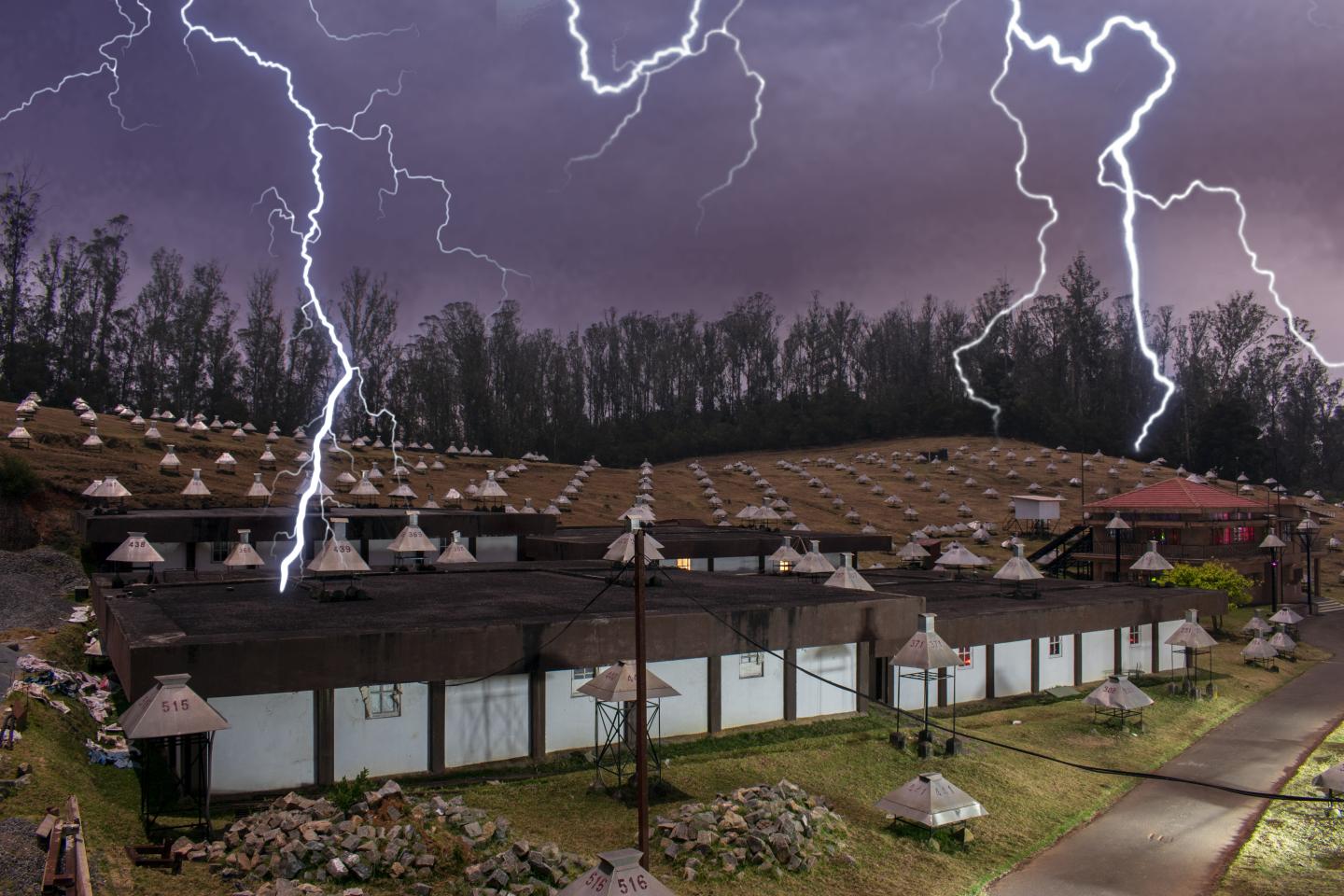
Thunderstorms are a spectacular manifestation of electrical discharges of thunderclouds, and have fascinated humans through millennia. There is a dark side of thunderstorms as thousands of lives are lost every year worldwide, making them a leading cause of death by natural disasters. The technique of muon imaging developed by GRAPES-3 collaboration showed that huge voltages develop in supercharged thunderclouds. The voltage produced by a thundercloud on 1 December 2014 in Ooty measured 1,300,000,000 Volts (1.3 GV) across its height, which is 10 times larger than the previous record voltage of 0.13 GV. This verifies the 90-year-old prediction of 1,000,000,000 Volts (1 GV) by C.T.R. Wilson. Such massive voltages are essential for the production of high-energy (100 MeV) gamma rays in the Terrestrial Gamma Ray Flashes (TGFs) emanating from thunderstorms, first discovered 25 years ago.

The GRAPES-3 muon telescope is a sensitive instrument operated by the Cosmic Ray Laboratory of the Tata Institute of Fundamental Research in Udhagamandalam (Ooty) for a collaboration of several institutes and universities from Japan and India. Embedded within an array of plastic scintillator detectors that together constitute GRAPES-3, the experiment is designed to study muons produced by cosmic rays from outer space. The muon intensity changes due to the presence of electric potential in thunderclouds. Therefore, this change in the muon intensity measured by the GRAPES-3 muon telescope can be exploited to estimate the electric potential in the thundercloud.

The data collected by the GRAPES-3 muon telescope show that this particular thunderstorm was a massive (400 sq. km.) cloud, storing about a trillion Joules of energy. Moving at a speed of 60 km per hour at an altitude of 11.4 km — where passenger jets fly — such thunderstorms could pose a serious threat to passenger safety. The >2 GW power supplied by the strong thermal currents sustaining this thunderstorm is comparable to the existing single biggest nuclear reactors or hydroelectric- or thermal power generators. If only this huge energy could be harnessed in some way, it would be sufficient to power a large metro like New York, London or Mumbai for its duration of 18 minutes.

###

Media Contact
Sunil K. Gupta
[email protected]

Related Journal Article

http://dx.doi.org/10.1103/PhysRevLett.122.105101

Tags: Chemistry/Physics/Materials Sciences
Share14Tweet8Share2ShareShareShare2

Related Posts

Intelligent Microgrid Management Promises Lower Household Energy Bills and Reduced Diesel Emissions — Chemistry

Intelligent Microgrid Management Promises Lower Household Energy Bills and Reduced Diesel Emissions

July 4, 2026
Graz University of Technology Deciphers the Structural Secrets of MOF Thin Films — Chemistry

Graz University of Technology Deciphers the Structural Secrets of MOF Thin Films

July 2, 2026

Breaking Thermodynamic Limits: Wavelength-Driven Catalysis Advances Ammonia Synthesis

July 2, 2026

From Quantum Mechanics to AI-Powered Materials Discovery: MARVEL Marks 12 Years of Transforming Computational Science

July 2, 2026
Please login to join discussion

POPULAR NEWS

  • Detection of EDCs in Breast Milk and Infant Urine Up to Six Months Highlights Early Exposure Risks

    77 shares
    Share 31 Tweet 19
  • Saying Goodbye to PGY-6: Pediatric Fellowship Realities

    103 shares
    Share 41 Tweet 26
  • New Drug Candidate Developed at McMaster Shows Potential for Treating Brain Cancer

    58 shares
    Share 23 Tweet 15
  • KTU Researchers Explore Ultrasound’s Role in Enhancing Blood Flow Beyond Diagnostics

    53 shares
    Share 21 Tweet 13

About

We bring you the latest biotechnology news from best research centers and universities around the world. Check our website.

Follow us

Recent News

Quasi-Bound States Boost Quantum Well Photoresponse

Lysine Pyruvylation Links Glycolysis to Epigenetics

Multiphysics Coupling: Single vs. Multiple DeepONet Branches

Subscribe to Blog via Email

Success! An email was just sent to confirm your subscription. Please find the email now and click 'Confirm' to start subscribing.

Join 83 other subscribers
  • Contact Us

Bioengineer.org © Copyright 2023 All Rights Reserved.

Welcome Back!

Login to your account below

Forgotten Password?

Retrieve your password

Please enter your username or email address to reset your password.

Log In
No Result
View All Result
  • Homepages
    • Home Page 1
    • Home Page 2
  • News
  • National
  • Business
  • Health
  • Lifestyle
  • Science

Bioengineer.org © Copyright 2023 All Rights Reserved.