Credit: Logan Wallace
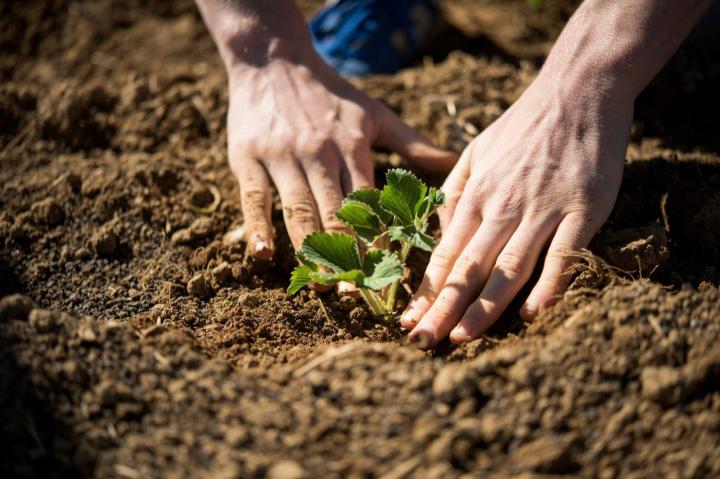
For centuries, scientists have worked above ground, studying plants and their effect on biodiversity. Lying below the scientists’ feet, though, is a world with even richer biodiversity — the soil.
There are an estimated 1 billion cells and thousands of species of microbes in a single gram of soil, making it an extremely complex microbiome.
To help understand the complexity of soil microbiomes and how cover crops can help manage them, a four-year $500,000 grant was awarded to a team of Virginia Tech interdisciplinary researchers by the United States Department of Agriculture National Institute of Food and Agriculture.
The project integrates key agricultural concepts of cover crops – the microbiome, biodiversity, yield, and soil health – to build a whole-system perspective. The project is being led by Brian Badgley, an associate professor of environmental microbiology, and Jacob Barney, associate professor of invasive plant ecology — both in the School of Plant and Environmental Sciences in the College of Agriculture and Life Sciences; and Brian Strahm, an associate professor of forest resources and environmental conservation in the College of Natural Resources and Environment. All three are affiliated faculty members of the Fralin Life Sciences Institute.
The soil microbiome has strong effects on how ecosystems function but is difficult to directly alter. The team is researching whether or not crop mixtures can be designed to change it indirectly with predictable outcomes and benefits.
The team will conduct their work at the College of Agriculture and Life Sciences’ Kentland Farm.
The underlying principle behind the work is to examine how plants affect soil microorganisms, which has mostly been researched looking at only how a single plant affects the soil.
The research team will conduct their work on soil microbiomes at Kentland Farm.
“We don’t have a really good understanding of the aggregate effect on soil microorganisms when we combine multiple plant species,” Badgley said. “By investigating underlying rules about how that happens, we hope to better understand how those effects scale up as you add more plant diversity.”
Cover crops make an excellent model for that because a cover crop mixture could comprise up to five plant species, which, when compared to a giant field of nothing but corn, is quite a bit of diversity.
“On the other hand, cover crop systems are still relatively simple plant communities that will, hopefully, make it easier to see some of these important signals about which parts of the soil microbiome are changing,” Badgley said. “What we learn about cover crops and agricultural sustainability has the added benefit to farmers of direct application in the field. However, by identifying the underlying relationships, we hope that results will also have applied benefits in other contexts, such as ecosystem restoration and potentially even landscaping and gardening.”
Each of the researchers brings a unique perspective into the mix, allowing them to analyze the whole complex system.
“In the end, we want to design mixtures that maximize plant diversity in different ways – either plant characteristics or the diversity of soil microorganisms that they recruit – based on results from individual plants,” Badgley said. “We then hope to understand whether different types of plant diversity ultimately change how the whole system will function.”
If that’s achieved, the research team could mix plants in the field for particular effects on soil microorganisms.
To better support the research, the grant will fund two Ph.D. candidates during its four-year run.
###
Media Contact
Zeke Barlow
[email protected]
Original Source
https:/