• HOME
  • NEWS
  • EXPLORE
    • CAREER
      • Companies
      • Jobs
    • EVENTS
    • iGEM
      • News
      • Team
    • PHOTOS
    • VIDEO
    • WIKI
  • BLOG
  • COMMUNITY
    • FACEBOOK
    • INSTAGRAM
    • TWITTER
Sunday, October 25, 2026
BIOENGINEER.ORG
No Result
View All Result
  • Login
  • HOME
  • NEWS
  • EXPLORE
    • CAREER
      • Companies
      • Jobs
        • Lecturer
        • PhD Studentship
        • Postdoc
        • Research Assistant
    • EVENTS
    • iGEM
      • News
      • Team
    • PHOTOS
    • VIDEO
    • WIKI
  • BLOG
  • COMMUNITY
    • FACEBOOK
    • INSTAGRAM
    • TWITTER
No Result
View All Result
Bioengineer.org
No Result
View All Result
Home NEWS Science News Technology

Graded graphene fabric sensor detects pressure from air to underwater

by
October 25, 2026
in Technology
Reading Time: 2 mins read
0
Graded graphene fabric sensor detects pressure from air to underwater

Graded graphene fabric sensor detects pressure from air to underwater

Share on FacebookShare on TwitterShare on LinkedinShare on RedditShare on Telegram

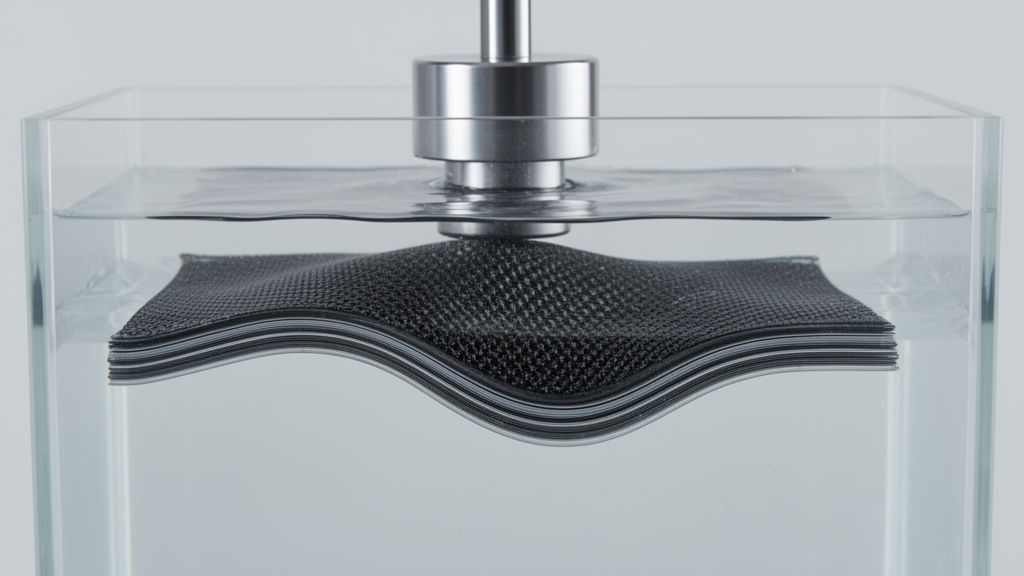
A multilayer graphene/polymer fabric sensor achieved sensitive, wide-range pressure detection in both air and underwater, according to a study in the Journal of Materials Science. The device maintained a broad quasi-linear response from 0.1 to 200 kPa, with fitted sensitivities of 19.69 kPa⁻¹ in air and 37.90 kPa⁻¹ underwater. The results address a central challenge for flexible pressure sensors: combining high sensitivity with a large operating range while preserving operation in wet environments.

The sensor is built around a resistance-gradient architecture that combines conductive fabric layers with different sheet resistances and a porous insulating spacer. As pressure changes, conductive contacts evolve progressively across the structure. This staged response improves sensitivity at low pressures while delaying signal saturation at higher pressures, allowing the device to retain useful output across multiple pressure regimes rather than concentrating its response in a narrow range.

Its superhydrophobic design also contributes to stable sensing in dry and submerged conditions. The conductive network is described as water repellent, and the multilayer configuration allows the pressure response to be measured both in air and underwater. Underwater performance was stronger than the corresponding air performance: the reported fitted sensitivity reached 37.90 kPa⁻¹, compared with 19.69 kPa⁻¹ in air, over the same 0.1–200 kPa sensing interval. The abstract does not provide details about durability, response time, temperature effects, manufacturing reproducibility or performance under movement, so the breadth of the reported claims beyond the tested conditions remains unclear.

Researchers demonstrated that the sensor could monitor physiological signals and track motion underwater, indicating possible uses in wearable electronics and underwater sensing systems. These demonstrations show that the device can register both body-related signals and movement in a submerged environment, but they do not establish clinical performance or prove that the sensor is ready for medical or commercial deployment. The work instead presents a structural strategy for balancing sensitivity, working range and environmental adaptability in fabric-based piezoresistive sensors, with the graded resistance arrangement serving as the central design feature.

Subject of Research: A resistance-graded superhydrophobic graphene/polymer fabric pressure sensor tested in air and underwater.

Article Title: A flexible piezoresistive sensor based on superhydrophobic graphene/polymer composite fabrics for highly sensitive and wide-range pressure detection in complex environments

Article References: Shi, K., Tao, Y., Xu, X., Zhang, D., & Guo, Y. (2026). A flexible piezoresistive sensor based on superhydrophobic graphene/polymer composite fabrics for highly sensitive and wide-range pressure detection in complex environments. Journal of Materials Science, 61(40), 31040-31055. https://doi.org/10.1007/s10853-026-13623-w

Image Credits: AI Generated

DOI: 10.1007/s10853-026-13623-w

Keywords: flexible pressure sensors, graphene composites, piezoresistive sensing, superhydrophobic fabrics, underwater sensing, wearable electronics, resistance-gradient design, wide-range pressure detection, flexible, piezoresistive, sensor, based

News Source: Neil Sanderson. (October 25, 2026). Graded graphene fabric sensor detects pressure from air to underwater. Scienmag.


Tags: Basedflexibleflexible pressure sensorsgraphene compositespiezoresistivepiezoresistive sensingresistance-gradient designsensorsuperhydrophobic fabricsunderwater sensingwearable electronicswide-range pressure detection
Share12Tweet7Share2ShareShareShare1

Related Posts

Smoke lowers RNA methylation enzyme WTAP, stabilizing pIgR to curb lung inflammation in mice

Smoke lowers RNA methylation enzyme WTAP, stabilizing pIgR to curb lung inflammation in mice

October 25, 2026
From Electrons to Biorefineries: How Multiscale Modeling and Machine Learning Are Rewiring Plant-Based Chemistry

From Electrons to Biorefineries: How Multiscale Modeling and Machine Learning Are Rewiring Plant-Based Chemistry

October 25, 2026

Hybrid domain adaptation method defends deep learning models against multi-targeted adversarial examples

October 25, 2026

New Algorithm Brings Controllable Individual Fairness Guarantees to Job Recommendations

October 25, 2026

POPULAR NEWS

  • Air Pollution and Warming Tied to Maternal Mortality Across Asia–Pacific

    Air Pollution and Warming Tied to Maternal Mortality Across Asia–Pacific

    29 shares
    Share 12 Tweet 7
  • Malaria messages linked to net use, not knowledge mediation in Ugandan women

    29 shares
    Share 12 Tweet 7
  • Seven Gene Candidates for Parkinson’s Disease Emerge From Combined Data and Mouse Model Analysis

    29 shares
    Share 12 Tweet 7
  • Collagen-Targeted MRI Agent Spots Tiny Lung Tumors and Hidden Metastases in Preclinical Tests

    29 shares
    Share 12 Tweet 7

About

We bring you the latest biotechnology news from best research centers and universities around the world. Check our website.

Follow us

Recent News

Air Pollution and Warming Tied to Maternal Mortality Across Asia–Pacific

Malaria messages linked to net use, not knowledge mediation in Ugandan women

Seven Gene Candidates for Parkinson’s Disease Emerge From Combined Data and Mouse Model Analysis

Subscribe to Blog via Email

Enter your email address to subscribe to this blog and receive notifications of new posts by email.

Join 85 other subscribers
  • Contact Us

Bioengineer.org © Copyright 2023 All Rights Reserved.

Welcome Back!

Login to your account below

Forgotten Password?

Retrieve your password

Please enter your username or email address to reset your password.

Log In
No Result
View All Result
  • Homepages
    • Home Page 1
    • Home Page 2
  • News
  • National
  • Business
  • Health
  • Lifestyle
  • Science

Bioengineer.org © Copyright 2023 All Rights Reserved.