“This research uncovers GPR141 as a stimulator of breast tumorigenesis and metastasis, making it a candidate target for breast cancer therapeutics.”
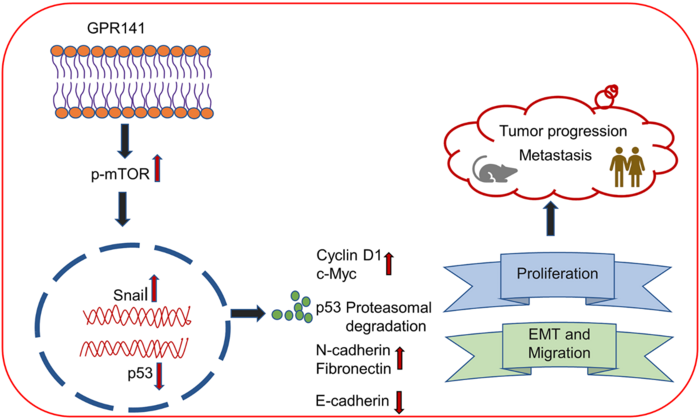
Credit: 2023 Parija et al.
“This research uncovers GPR141 as a stimulator of breast tumorigenesis and metastasis, making it a candidate target for breast cancer therapeutics.”
BUFFALO, NY- May 22, 2023 – A new research paper was published in Oncotarget’s Volume 14 on May 19, 2023, entitled, “G-protein-coupled receptor 141 mediates breast cancer proliferation and metastasis by regulating oncogenic mediators and the p-mTOR/p53 axis.”
Breast cancer morbidity is surging towards the peak in females across the globe. An inherent property of cancer cells is enhanced cell proliferation rate and migration capability, leading to deregulated cell signaling cascades. G-protein-coupled receptors (GPCRs) have recently emerged as a hot-spot target in cancer research.
Researchers Monalisa Parija, Amit K. Adhya and Sandip K. Mishra from the Institute of Life Sciences, Regional Centre for Biotechnology and All India Institute of Medical Sciences identified aberrant expression of G-protein-coupled receptor 141 (GPR141) in different breast cancer subtypes that correlate with poor prognosis. However, the molecular mechanism via which GPR141 advances breast cancer remains elusive. Increased GPR141 expression enhances the migratory behavior of breast cancer, driving oncogenic pathways both in vitro and in vivo through activation of epithelial to mesenchymal transition (EMT), oncogenic mediators and regulation of p-mTOR/p53 signaling.
“Our study unveils a molecular mechanism for p53 downregulation and activation of p-mTOR1 and its substrates in GPR141 overexpressed cells, accelerating breast tumorigenesis.”
In their current study, the researchers found that an E3 ubiquitin ligase, Cullin1, partly mediates p53 degradation via proteasomal pathway. Co-immunoprecipitation results show that the phosphorylated form of 40S ribosome protein S6 (ps6., a p-mTOR1 substrate) forms a complex with Cullin1. These findings suggest an interplay between Cullin1 and p-mTOR1 in GPR141 overexpressed cells that downregulates p53 expression, thus inducing tumor growth.
GPR141 silencing restores p53 expression and attenuates p-mTOR1 signaling events, thereby impeding proliferation and migration in breast cancer cells. Their findings describe the role of GPR141 in breast cancer proliferation, and metastasis, as well as in influencing the tumor microenvironment. Modulating GPR141 expression could pave the way for a better therapeutic approach to regulating breast cancer progression and metastasis.
“In conclusion, our research highlights the gain of function of GPR141 drives breast tumorigenesis by inducing tumor cell properties via the p-mTOR1/p53 axis, altering EMT markers, and enhancing oncogenic mediators.”
Read the full study: DOI: https://doi.org/10.18632/oncotarget.28433
Correspondence to: Sandip K. Mishra
Email: [email protected]
Keywords: G-protein-coupled receptor 141, cell migration, metastasis, p-mTOR, p53
About Oncotarget: Oncotarget (a primarily oncology-focused, peer-reviewed, open access journal) aims to maximize research impact through insightful peer-review; eliminate borders between specialties by linking different fields of oncology, cancer research and biomedical sciences; and foster application of basic and clinical science.
To learn more about Oncotarget, visit Oncotarget.com and connect with us on social media:
- YouTube
- LabTube
- Soundcloud
Click here to subscribe to Oncotarget publication updates.
For media inquiries, please contact: [email protected].
Oncotarget Journal Office
6666 East Quaker Str., Suite 1A
Orchard Park, NY 14127
Phone: 1-800-922-0957 (option 2)
###
Journal
Oncotarget
DOI
10.18632/oncotarget.28433
Method of Research
Experimental study
Subject of Research
Cells
Article Title
G-protein-coupled receptor 141 mediates breast cancer proliferation and metastasis by regulating oncogenic mediators and the p-mTOR/p53 axis
Article Publication Date
19-May-2023