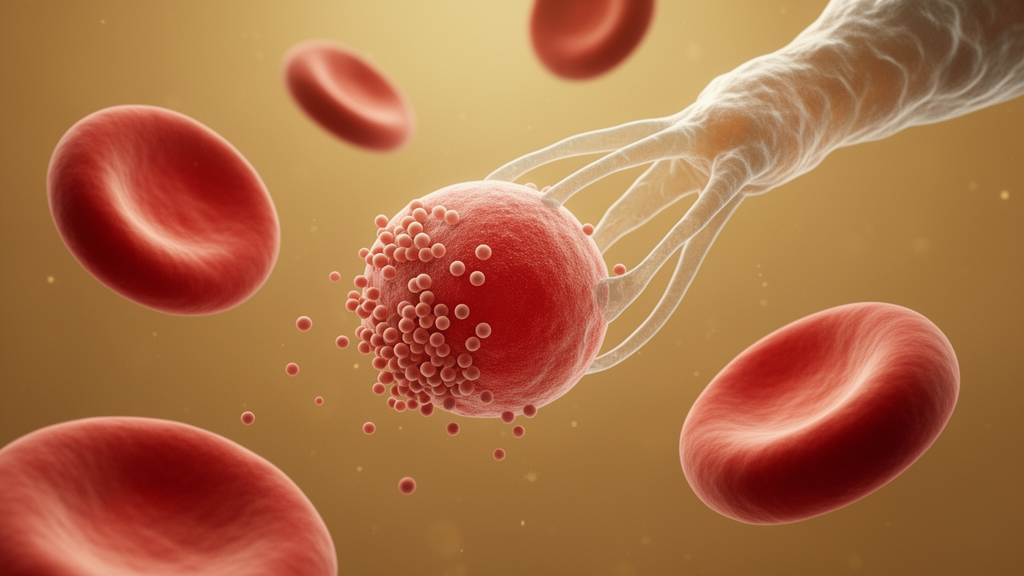
A Golgi-resident protein called GOLGA7 has emerged as a previously underappreciated player in the final stages of red blood cell production. In a mouse study published in Cell & Bioscience, researchers report that deleting the Golga7 gene specifically in hematopoietic cells slows the clearance of the transferrin receptor CD71 from maturing red cells and impairs the animals’ ability to recover from hemolytic stress, ultimately increasing mortality under those conditions.
Terminal erythropoiesis, the process by which erythroid precursors shed their nuclei and remodel their membranes to become mature red blood cells, depends on dynamic membrane trafficking. The study’s authors note that the molecular regulation of these processes has remained poorly understood. Their work identifies GOLGA7, a protein predominantly resident in the Golgi apparatus, as a regulator of CD71 clearance in reticulocytes, the immature red cells that circulate briefly before completing maturation.
At steady state, mice lacking Golga7 in their hematopoietic compartment showed an increased proportion of CD71-positive circulating erythroid cells, indicating that reticulocytes retained the receptor longer than normal. The phenotype became more consequential under hemolytic stress: the knockout animals displayed prolonged CD71 retention, delayed hematological recovery, and increased mortality compared with controls.
These analyses revealed transcriptomic and proteomic alterations associated with vesicular trafficking, consistent with a role for the protein in the membrane remodeling that accompanies red cell maturation.
Functional assays sharpened the picture. Golga7 deficiency delayed cell-surface CD71 clearance and prolonged intracellular transferrin retention, pointing to a defect in the trafficking machinery that normally internalizes and disposes of the receptor and its ligand. Notably, the assays detected no effect on erythroid enucleation ex vivo, suggesting that GOLGA7 acts on receptor trafficking rather than on the nuclear extrusion step itself.
The findings, the authors conclude, highlight GOLGA7’s contribution to terminal erythroid maturation and to effective erythropoietic recovery when the body must replace red cells lost to hemolysis. As a mouse study with hematopoietic-specific gene deletion, the work establishes a mechanistic role in animals and will require further investigation to determine whether analogous pathways operate in human erythropoiesis.
Subject of Research: The role of the Golgi protein GOLGA7 in CD71 clearance during terminal erythropoiesis and recovery from hemolytic stress in mice.
Article Title: Golga7 deletion in hematopoietic cells delays CD71 clearance and impairs erythropoietic recovery under hemolytic stress
Article References: Wang, X., Huang, Y., Zhang, R., Dai, Y., Huang, W., Zhang, W., Xu, P., Yan, L., Huang, X., Ji, S., Ren, R., Jiao, B., & Liu, P. (2026). Golga7 deletion in hematopoietic cells delays CD71 clearance and impairs erythropoietic recovery under hemolytic stress. Cell & Bioscience. https://doi.org/10.1186/s13578-026-01671-3
Image Credits: AI Generated
DOI: 10.1186/s13578-026-01671-3
Keywords: GOLGA7, erythropoiesis, reticulocytes, CD71, transferrin receptor, hemolytic stress, Golgi apparatus, vesicular trafficking, bone marrow, enucleation, hematopoietic cells, Cell & Bioscience
News Source: Drew Townsend. (October 27, 2026). Golgi protein GOLGA7 found to govern reticulocyte CD71 clearance and recovery from hemolytic stress in mice. Scienmag.