• HOME
  • NEWS
  • EXPLORE
    • CAREER
      • Companies
      • Jobs
    • EVENTS
    • iGEM
      • News
      • Team
    • PHOTOS
    • VIDEO
    • WIKI
  • BLOG
  • COMMUNITY
    • FACEBOOK
    • INSTAGRAM
    • TWITTER
Sunday, May 17, 2026
BIOENGINEER.ORG
No Result
View All Result
  • Login
  • HOME
  • NEWS
  • EXPLORE
    • CAREER
      • Companies
      • Jobs
        • Lecturer
        • PhD Studentship
        • Postdoc
        • Research Assistant
    • EVENTS
    • iGEM
      • News
      • Team
    • PHOTOS
    • VIDEO
    • WIKI
  • BLOG
  • COMMUNITY
    • FACEBOOK
    • INSTAGRAM
    • TWITTER
  • HOME
  • NEWS
  • EXPLORE
    • CAREER
      • Companies
      • Jobs
        • Lecturer
        • PhD Studentship
        • Postdoc
        • Research Assistant
    • EVENTS
    • iGEM
      • News
      • Team
    • PHOTOS
    • VIDEO
    • WIKI
  • BLOG
  • COMMUNITY
    • FACEBOOK
    • INSTAGRAM
    • TWITTER
No Result
View All Result
Bioengineer.org
No Result
View All Result
Home NEWS Science News Health

Gold nanoparticles more stable by putting rings on them

Bioengineer by Bioengineer
January 21, 2021
in Health
Reading Time: 2 mins read
0
IMAGE
Share on FacebookShare on TwitterShare on LinkedinShare on RedditShare on Telegram

IMAGE

Credit: Yubo Wang, Takuya Yamamoto

Hokkaido University scientists have found a way to prevent gold nanoparticles from clumping, which could help towards their use as an anti-cancer therapy.

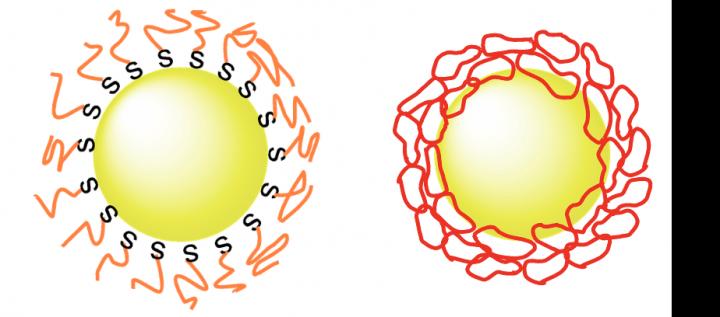
Attaching ring-shaped synthetic compounds to gold nanoparticles helps them retain their essential light-absorbing properties, Hokkaido University researchers report in the journal Nature Communications.

Metal nanoparticles have unique light-absorbing properties, making them interesting for a wide range of optical, electronic and biomedical applications. For example, if delivered to a tumour, they could react with applied light to kill cancerous tissue. A problem with this approach, though, is that they easily clump together in solution, losing their ability to absorb light. This clumping happens in response to a variety of factors, including temperature, salt concentration and acidity.

Scientists have been trying to find ways to ensure nanoparticles stay dispersed in their target environments. Covering them with polyethylene glycol, otherwise known as PEG, has been relatively successful at this in the case of gold nanoparticles. PEG is biocompatible and can prevent gold surfaces from clumping together in the laboratory and in living organisms, but improvements are still needed.

Applied chemist Takuya Yamamoto and colleagues at Hokkaido University, The University of Tokyo, and Tokyo Institute of Technology found that mixing gold nanoparticles with ring-shaped PEG, rather than the normally linear PEG, significantly improved dispersion. The ‘cyclic-PEG’ (c-PEG) attaches to the surfaces of the nanoparticles without forming chemical bonds with them, a process called physisorption. The coated nanoparticles remained dispersed when frozen, freeze-dried and heated.

The team tested the c-PEG-covered gold nanoparticles in mice and found that they cleared slowly from the blood and accumulated better in tumours compared to gold nanoparticles coated with linear PEG. However, accumulation was lower than desired levels, so the researchers recommend further investigations to fine-tune the nanoparticles for this purpose.

Associate Professor Takuya Yamamoto is part of the Laboratory of Chemistry of Molecular Assemblies at Hokkaido University, where he studies the properties and applications of various cyclic chemical compounds.

###

Media Contact
Sohail Keegan Pinto
[email protected]

Original Source

https://www.global.hokudai.ac.jp/blog/gold-nanoparticles-more-stable-by-putting-rings-on-them/

Related Journal Article

http://dx.doi.org/10.1038/s41467-020-19947-8

Tags: cancerChemistry/Physics/Materials SciencesNanotechnology/Micromachines
Share12Tweet8Share2ShareShareShare2

Related Posts

New Study Reveals the Massive Economic Impact of Tuberculosis

May 17, 2026

Age Discrimination Affects Healthcare Use in India

May 17, 2026

Advancements and Insights into Life Expectancy for Chronic Obstructive Pulmonary Disease Patients

May 17, 2026

Intrinsic Capacity, Resilience, Frailty in Stroke Recovery

May 17, 2026
Please login to join discussion

POPULAR NEWS

  • Research Indicates Potential Connection Between Prenatal Medication Exposure and Elevated Autism Risk

    844 shares
    Share 338 Tweet 211
  • New Study Reveals Plants Can Detect the Sound of Rain

    730 shares
    Share 291 Tweet 182
  • Salmonella Haem Blocks Macrophages, Boosts Infection

    62 shares
    Share 25 Tweet 16
  • Breastmilk Balances E. coli and Beneficial Bacteria in Infant Gut Microbiomes

    58 shares
    Share 23 Tweet 15

About

We bring you the latest biotechnology news from best research centers and universities around the world. Check our website.

Follow us

Recent News

Detecting Illicit Bitcoin Transactions with Temporal Graph Learning

New Study Reveals the Massive Economic Impact of Tuberculosis

Age Discrimination Affects Healthcare Use in India

Subscribe to Blog via Email

Enter your email address to subscribe to this blog and receive notifications of new posts by email.

Join 82 other subscribers
  • Contact Us

Bioengineer.org © Copyright 2023 All Rights Reserved.

Welcome Back!

Login to your account below

Forgotten Password?

Retrieve your password

Please enter your username or email address to reset your password.

Log In
No Result
View All Result
  • Homepages
    • Home Page 1
    • Home Page 2
  • News
  • National
  • Business
  • Health
  • Lifestyle
  • Science

Bioengineer.org © Copyright 2023 All Rights Reserved.