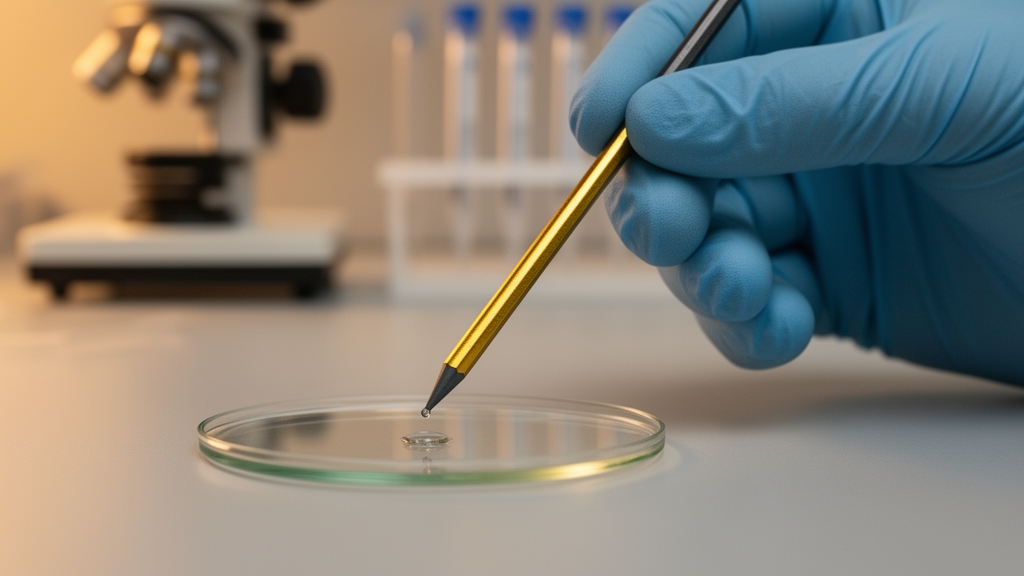
Researchers at the University of the Western Cape in South Africa have built a disposable electrochemical sensor that detects the breast cancer biomarker CA 15-3 without using a single antibody, aptamer, or other biological recognition element. Instead, the device relies on one of the oldest and most reliable partnerships in surface chemistry: the strong bond between gold and sulfur. The work, published in Frontiers in Sensors, describes pencil graphite electrodes coated with electrodeposited gold nanoparticles that register the cancer protein as a concentration-dependent dimming of the gold’s own oxidation signal.
CA 15-3 is a circulating fragment of MUC1, a large transmembrane glycoprotein that is heavily overexpressed and abnormally glycosylated in breast tumors. Healthy serum levels sit below 30 units per milliliter, but 30 to 50 percent of breast cancer patients show concentrations above 100 units per milliliter, making the marker valuable for tracking disease severity, recurrence, and metastasis. Conventional clinical assays such as ELISA and ECLIA detect the protein through antibody binding, but they demand labeling steps, long processing times, and costly reagents. The South African team, led by Nastaran Ghaffari and Priscilla Baker of the SensorLab research group, asked whether the protein’s own chemistry could do the work of a receptor.
The answer lies in cysteine. MUC1 contains multiple cysteine residues, many of which are locked in disulfide bonds, but partial unfolding or interfacial contact can expose sulfur-containing groups capable of binding gold. When the protein meets a nanostructured gold surface, accessible thiols undergo dissociative chemisorption, forming covalent-like gold-sulfur bonds with strengths of roughly 40 to 50 kilocalories per mole. Each bound molecule partially insulates the electrode, blocking electroactive gold sites and suppressing the characteristic gold oxidation peak near 1.2 volts. The more CA 15-3 in the sample, the more the peak fades, providing a built-in, label-free readout that requires no secondary reagents.
To maximize this effect, the researchers turned to an unlikely substrate: pencil lead. Pentel HB pencil graphite rods, 0.5 millimeters in diameter, were cleaned in nitric acid, electrochemically conditioned in acetate buffer, and then coated with gold nanoparticles electrodeposited from a 5 millimolar chloroauric acid solution. Deposition began with a fixed potential of minus 0.6 volts for three minutes, followed by twenty cyclic voltammetry sweeps between minus 1.0 and plus 1.0 volts under constant magnetic stirring. A custom multi-compartment cell machined from polyethylene terephthalate lids allowed eight electrodes to be coated simultaneously, a fabrication strategy that proved critical for reproducibility.
Characterization confirmed the transformation. Scanning electron microscopy with energy-dispersive X-ray spectroscopy showed uniformly distributed, round gold nanoparticles across the graphite surface, while atomic force microscopy revealed predominantly spherical particles smaller than 100 nanometers covering both the machining grooves and the flatter regions of the pencil lead. Electrochemical impedance spectroscopy in a ferricyanide-ferrocyanide probe showed that charge-transfer resistance, measured at 508.3 ohms on the bare graphite, was effectively eliminated after gold modification. Cyclic voltammetry told a similar story: the electroactive surface area jumped from 1.10 to 4.21 square centimeters, the roughness factor rose from 5.8 to 22.3, and the peak-to-peak separation shrank from 0.85 volts to 0.116 volts, indicating fast, nearly reversible electron transfer.
The analytical performance was striking. After a 25-minute incubation with CA 15-3 and a brief chronoamperometric conditioning step at minus 0.5 volts, linear sweep voltammetry recorded the gold oxidation peak at approximately 1.2 volts. Across CA 15-3 concentrations from 1 to 6 parts per billion, the peak current fell in a strong inverse linear relationship with a correlation coefficient of 0.98. The calculated limit of detection, using the standard three-sigma-over-slope method, was 0.12 parts per billion, equivalent to 1.2 times ten to the minus four units per milliliter, orders of magnitude below normal serum levels and far beneath the concentrations seen in most breast cancer patients.
Reproducibility numbers were equally impressive. A single modified electrode held its baseline gold oxidation current within a relative standard deviation of 0.4 percent over five consecutive measurements in buffer. When eight electrodes were coated simultaneously with the multi-electrode technique, the batch-to-batch variation was just 0.5 percent, compared with 2.7 percent when electrodes were prepared one at a time. The platform can therefore operate either as a single-use disposable sensor or be reused at least five times without performance loss, eliminating the cleaning and maintenance burden of conventional gold electrodes.
Selectivity tests probed the mechanism directly. Urea, glucose, and lactate, common plasma components that lack accessible thiol groups, produced negligible changes in the sensor response even at twice the CA 15-3 concentration. Cysteine and human serum albumin, which carries a well-known free cysteine residue at position 34, both caused pronounced additional signal suppression, consistent with gold-sulfur bond formation. The results confirm that the sensor is chemically selective for thiol-bearing species rather than immunochemically specific for CA 15-3, a distinction the authors acknowledge as a limitation of the receptor-free design.
Real-sample testing in diluted human serum plasma demonstrated practical feasibility. Using the standard addition method with samples spiked at 2 parts per billion, the sensor achieved recoveries between 97.5 and 104 percent with relative standard deviations between 1.74 and 2.77 percent across triplicate measurements. The correlation coefficient in the plasma matrix reached 0.999. Thiol-containing plasma proteins create a stable background of surface passivation, but incremental CA 15-3 additions produced measurable additional suppression of the gold oxidation peak on top of that baseline, allowing quantitative determination in a complex biological matrix.
The approach joins a growing family of pencil graphite electrochemical sensors that have recently been applied to epigenetic biomarkers in urine, paracetamol, drug-DNA interactions, and pharmaceutical analysis. Its appeal is obvious: the sensing element costs pennies, fabrication takes minutes, and each measurement can use a freshly prepared electrode. The authors note that mechanical fragility of pencil graphite remains a challenge and suggest future routes such as reconstituting crushed graphite into pellet electrodes with potassium bromide binders or blending pencil graphite with gold nanoparticles into carbon paste formulations for screen-printed electrodes. While clinical deployment will require validation in more complex biological environments and careful management of cross-reactivity with other thiol-containing proteins, the study establishes a chemically driven sensing framework that turns gold surface chemistry itself into the analytical signal, offering a simplified and cost-effective path toward label-free cancer biomarker detection.
Subject of Research: Label-free electrochemical detection of the breast cancer biomarker CA 15-3 using gold nanoparticle-modified pencil graphite electrodes
Article Title: Thiol-mediated electrochemical sensor for the breast cancer biomarker CA 15-3
Article References: Ghaffari, N., & Baker, P. (2026). Thiol-mediated electrochemical sensor for the breast cancer biomarker CA 15-3. Frontiers in Sensors, 7, Article 1807434. https://doi.org/10.3389/fsens.2026.1807434
Image Credits: AI Generated
DOI: 10.3389/fsens.2026.1807434
Keywords: breast cancer, CA 15-3, electrochemical sensor, gold nanoparticles, pencil graphite electrode, label-free detection, biosensors, MUC1, Thiol-mediated, electrochemical, sensor, breast
News Source: Nathaniel Bowman. (October 17, 2026). Gold-coated pencil graphite sensor detects breast cancer biomarker CA 15-3 without antibodies. Scienmag.