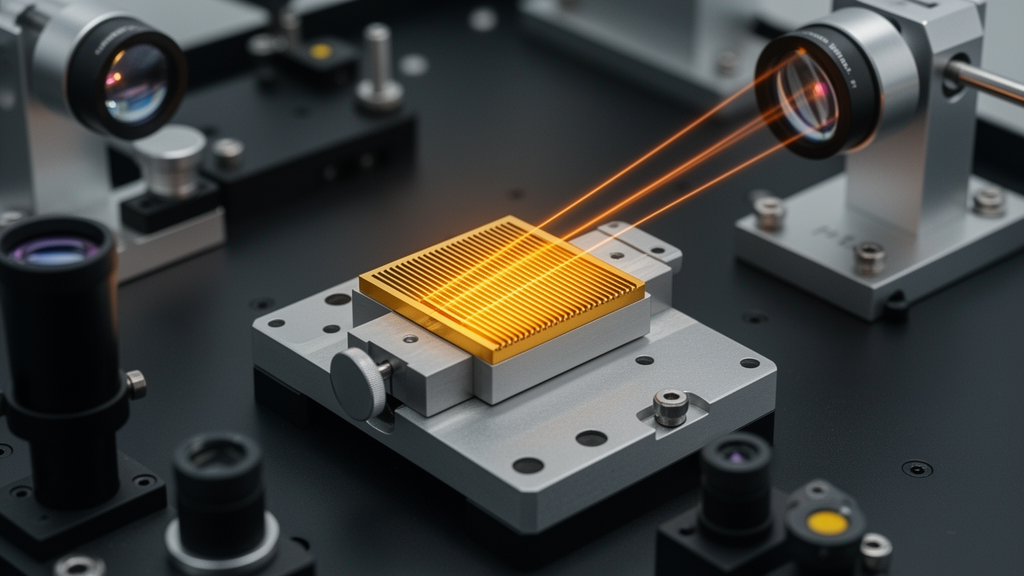
Researchers have designed and fabricated a 1200 lines/mm gold-coated diffraction grating that maintains an average diffraction efficiency of 91.4 percent across the 850–970 nm wavelength band, a performance level that could matter for the pulse compressors at the heart of high-power chirped pulse amplification laser systems. The work, published in Applied Physics B, combines systematic simulation of grating structural parameters with the fabrication of a large-aperture device measuring 320 mm × 230 mm, and it deliberately targets a groove density lower than the values that have dominated the field until now.
Pulse compression gratings are core components in chirped pulse amplification, the technique behind many of the world’s most intense lasers. In a CPA system, laser pulses are stretched, amplified, and then recompressed using pairs of gratings arranged in a Treacy compressor configuration. Gold-coated gratings are often preferred for femtosecond-level, high-power pulse compression because they offer wider operating bandwidth and lower fabrication cost than the all-dielectric and metal-dielectric alternatives. The new study classifies gratings by material composition into exactly these three families and positions the gold-coated variant as the workhorse for broadband, high-energy applications.
The classical four-grating Treacy compressor has only two adjustable parameters: the groove density of the gratings and the incident angle on the first grating, assuming the spacing between gratings is fixed by the required group velocity dispersion. Both parameters face constraints. High diffraction efficiency over a wide band is achievable only within a fairly narrow range of groove densities, and for a given groove density the decoupling condition — the requirement that the second grating must not overlap the beam striking the first — restricts the incident angle. In practice, the incident angle ends up roughly 10 to 15 degrees larger than the Littrow angle, which limits compressor optimization.
The out-of-plane compressor lifts this limitation. In that geometry, decoupling occurs in the plane perpendicular to the diffraction plane, with a nonzero out-of-plane angle, so the incident angle is no longer constrained by decoupling and can even equal the Littrow angle itself. This special case, called a Littrow compressor, offers higher grating diffraction efficiency, particularly for broadband radiation, and a recent compressor design study suggests that lowering the incident angle can raise the output power above that of a plane Treacy compressor. The same design analysis indicates that adopting a lower groove density, down to about 1000 lines/mm, increases the beam size in the compressor while reducing the incidence angles, enabling higher pulse power at the same damage threshold.
Against that background, the team simulated gold-coated gratings across a range of groove densities using rigorous coupled wave analysis, with 171 harmonics and 50 layers to ensure calculation accuracy. For gratings operating in the 850–970 nm range — a band chosen by weighing both gain medium characteristics and compressor design parameters — the simulations showed that groove densities of 1000–1100 lines/mm cannot deliver both high diffraction efficiency and broad bandwidth, while 1200 lines/mm is a reasonable compromise. Under an in-plane geometry with the incident angle set to the Littrow angle at 910 nm plus 10 degrees, the shortest wavelength at which the 1200 lines/mm grating exceeds 90 percent efficiency is 845 nm, comfortably covering the 850 nm short-wavelength edge of the target band.
A key theoretical insight concerns the boundaries of the usable band. According to the grating equation, when the grating period and incident angle are fixed, wavelengths longer than a critical value λ₁ produce no −1st-order diffracted light, while wavelengths shorter than a second critical value λ₂ — exactly half of λ₁ — cause a −2nd order to appear. The high-efficiency region of the gold-coated grating is always confined between these two critical wavelengths, and because the efficiency curve falls off as it approaches them, the practical bandwidth is far smaller than the theoretical interval. For in-plane incidence, the bandwidth with efficiency above 90 percent spans roughly 0.65 times the theoretical interval; for the out-of-plane geometry with a 10-degree azimuth angle, the corresponding fraction drops to roughly 0.51 to 0.56.
The simulations also mapped how sensitive the short-wavelength performance is to the grating’s groove structure. For the 1200 lines/mm design, diffraction efficiency at 850 nm exceeds 90 percent when the groove depth lies between 204 and 261 nm, the duty cycle between 0.68 and 0.92, and the groove profile parameter between 1.16 and 2.55. The 850 nm edge proved the most sensitive point: the high-efficiency regions in the duty cycle and profile parameter tolerance diagrams split into two disconnected zones at the simulated groove depth of 232.5 nm, which would shrink the bandwidth. The authors note that slightly increasing groove depth would reconnect those zones, but for the 850–970 nm target the shallower groove is preferable because it secures efficiency at the short-wavelength end.
Notably, the geometry comparison came out nearly a tie. Under the out-of-plane Littrow geometry with a 10-degree azimuth angle, the simulated average diffraction efficiency over 850–970 nm was 94.98 percent, versus 95.26 percent for the conventional in-plane geometry at the Littrow angle plus 10 degrees and 94.94 percent at the Littrow angle plus 12 degrees — differences of only −0.28 and 0.04 percentage points. The out-of-plane angle of 10 degrees cost just 0.7 percentage points at 850 nm compared with zero azimuth, confirming that this geometry barely penalizes efficiency while freeing the incident angle from the decoupling constraint.
Fabrication followed a well-established route. A diluted photoresist was spin-coated onto a fused silica substrate, exposed in a holographic interference exposure system at 1200 lines/mm using 413.1 nm light, developed in a dilute sodium hydroxide solution, and then coated with a 200 nm thick gold film by magnetron sputtering. Atomic force microscopy at nine points across the 320 mm × 230 mm aperture measured average groove depth, duty cycle, and profile parameter values of 243.5 nm, 0.69, and 1.57 respectively — all within the simulated tolerance windows. Most of the measured points fell inside the region where simulated efficiency exceeds 90 percent, although the authors caution that this particular comparison does not account for groove depth variations between test points.
Measured performance closely tracked the simulations. Using a standard reference mirror to calibrate the measurement system, the team recorded an average diffraction efficiency of 91.4 percent over the 120 nm bandwidth at the grating center, with the measured curve matching the simulated curve fitted to the actual groove profile. Area-scanned measurements at 850, 910, and 970 nm, taken on a 20 mm × 17.5 mm grid, yielded average efficiencies of 85.5, 91.8, and 91.8 percent. The shortfall at 850 nm traces to the grating edges, where stray light during holographic exposure degraded the groove uniformity — an effect that hits the sensitive short-wavelength end hardest, consistent with the simulation findings. Better stray-light control during exposure should therefore raise efficiency further. The authors note that laser-induced damage threshold measurements were not included in this study, though damage performance will be characterized in future work, and that system-level pulse compression validation lies beyond the paper’s scope.
Subject of Research: Design and fabrication of a 1200 lines/mm gold-coated diffraction grating for laser pulse compression in the 850–970 nm wavelength range
Article Title: 1200 lines/mm Gold-Coated pulse compression grating for 850–970 nm
Article References: Zhang, Y., Cao, H., Wang, Y., Zhang, Z., Wang, R., Khazanov, E., & Jin, Y. (2026). 1200 lines/mm Gold-Coated pulse compression grating for 850–970 nm. Applied Physics B, 132(11), Article 111. https://doi.org/10.1007/s00340-026-08696-z
Image Credits: AI Generated
DOI: 10.1007/s00340-026-08696-z
Keywords: pulse compression grating, gold-coated grating, chirped pulse amplification, diffraction efficiency, holographic interference exposure, magnetron sputtering, Littrow geometry, rigorous coupled wave analysis, 850–970 nm bandwidth, high-power lasers, groove density, femtosecond pulses
News Source: Denise Maddox. (October 28, 2026). Gold-Coated Grating Delivers 91.4 Percent Efficiency for Pulse Compression. Scienmag.