• HOME
  • NEWS
  • EXPLORE
    • CAREER
      • Companies
      • Jobs
    • EVENTS
    • iGEM
      • News
      • Team
    • PHOTOS
    • VIDEO
    • WIKI
  • BLOG
  • COMMUNITY
    • FACEBOOK
    • INSTAGRAM
    • TWITTER
Saturday, July 11, 2026
BIOENGINEER.ORG
No Result
View All Result
  • Login
  • HOME
  • NEWS
  • EXPLORE
    • CAREER
      • Companies
      • Jobs
        • Lecturer
        • PhD Studentship
        • Postdoc
        • Research Assistant
    • EVENTS
    • iGEM
      • News
      • Team
    • PHOTOS
    • VIDEO
    • WIKI
  • BLOG
  • COMMUNITY
    • FACEBOOK
    • INSTAGRAM
    • TWITTER
  • HOME
  • NEWS
  • EXPLORE
    • CAREER
      • Companies
      • Jobs
        • Lecturer
        • PhD Studentship
        • Postdoc
        • Research Assistant
    • EVENTS
    • iGEM
      • News
      • Team
    • PHOTOS
    • VIDEO
    • WIKI
  • BLOG
  • COMMUNITY
    • FACEBOOK
    • INSTAGRAM
    • TWITTER
No Result
View All Result
Bioengineer.org
No Result
View All Result
Home NEWS Science News Chemistry

Going the distance for better wireless charging

Bioengineer by Bioengineer
July 21, 2023
in Chemistry
Reading Time: 2 mins read
0
A new theory of wireless power transfer technology presents an opportunity to achieve efficient power transfer over long distances by suppressing radiation loss.
Share on FacebookShare on TwitterShare on LinkedinShare on RedditShare on Telegram

A better way to wirelessly charge over long distances has been developed at Aalto University. Engineers have optimized the way antennas transmitting and receiving power interact with each other, making use of the phenomenon of “radiation suppression”. The result is a better theoretical understanding of wireless power transfer compared to the conventional inductive approach, a significant advancement in the field.
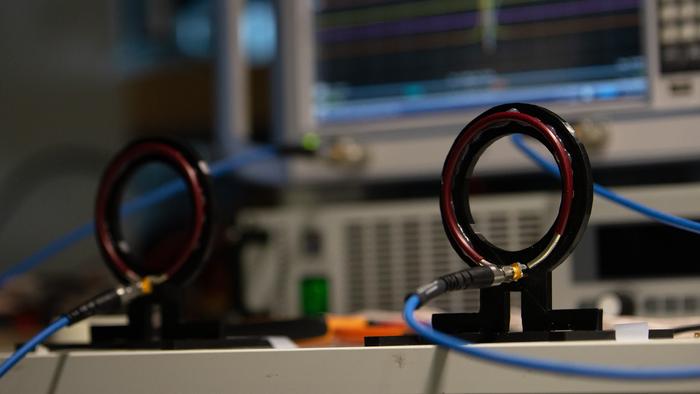
A new theory of wireless power transfer technology presents an opportunity to achieve efficient power transfer over long distances by suppressing radiation loss.

Credit: Nam Ha-Van/Aalto University

A better way to wirelessly charge over long distances has been developed at Aalto University. Engineers have optimized the way antennas transmitting and receiving power interact with each other, making use of the phenomenon of “radiation suppression”. The result is a better theoretical understanding of wireless power transfer compared to the conventional inductive approach, a significant advancement in the field.

Charging over short distances, such as through induction pads, uses magnetic near fields to transfer power with high efficiency, but at longer distances the efficiency dramatically drops. New research shows that this high efficiency can be sustained over long distances by suppressing the radiation resistance of the loop antennas that are sending and receiving power. Previously, the same lab created an omnidirectional wireless charging system that allowed devices to be charged at any orientation. Now, they have extended that work with a new dynamic theory of wireless charging that looks more closely at both near (non-radiative) and far (radiative) distances and conditions. In particular, they show that high transfer efficiency, over 80 percent, can be achieved at distances approximately five times the size of the antenna, utilizing the optimal frequency within the hundred-megahertz range.

‘We wanted to balance effectively transferring power with the radiation loss that always happens over longer distances,’ says lead author Nam Ha-Van, a postdoctoral researcher at Aalto University. ‘It turns out that when the currents in the loop antennas have equal amplitudes and opposite phases, we can cancel the radiation loss, thus boosting efficiency.’

The researchers created a way to analyse any wireless power transfer system, either mathematically or experimentally. This allows for a more thorough evaluation of power transfer efficiency, at both near and far distances, which hasn’t been done before. They then tested how charging worked between two loop antennas (see image) positioned at a considerable distance relative to their sizes, establishing that radiation suppression is the mechanism that helps boost transfer efficiency.

‘This is all about figuring out the optimal setup for wireless power transfer, whether near or far,’ says Ha-Van. ‘With our approach, we can now extend the transfer distance beyond that of conventional wireless charging systems, while maintaining high efficiency.’ Wireless power transfer is not just important for phones and gadgets; biomedical implants with limited battery capacity can also benefit. The research of Ha-Van and colleagues can also account for barriers like human tissue that can impede charging.


Journal

Physical Review Applied

DOI

10.1103/PhysRevApplied.20.014044

Article Title

Effective Midrange Wireless Power Transfer with Compensated Radiation Loss

Article Publication Date

20-Jul-2023
Share12Tweet8Share2ShareShareShare2

Related Posts

Blue Light and Chemistry Simplify Complex Drug Production Steps

Blue Light and Chemistry Simplify Complex Drug Production Steps

July 10, 2026
New Discovery Promises Brighter, More Energy-Efficient Digital Displays

New Discovery Promises Brighter, More Energy-Efficient Digital Displays

July 10, 2026

New Crystalline 3D Frameworks Linked by Spiroborates Developed

July 10, 2026

IBEC Joins Major European Grant on Living Matter Physics

July 10, 2026

POPULAR NEWS

  • Detection of EDCs in Breast Milk and Infant Urine Up to Six Months Highlights Early Exposure Risks

    77 shares
    Share 31 Tweet 19
  • New Drug Candidate Developed at McMaster Shows Potential for Treating Brain Cancer

    58 shares
    Share 23 Tweet 15
  • KTU Researchers Explore Ultrasound’s Role in Enhancing Blood Flow Beyond Diagnostics

    53 shares
    Share 21 Tweet 13
  • 高齢者の骨粗鬆症治療の持続性比較

    51 shares
    Share 20 Tweet 13

About

We bring you the latest biotechnology news from best research centers and universities around the world. Check our website.

Follow us

Recent News

Trends and Advances in Pediatric Mycoplasma pneumoniae Pneumonia Research

Long-Term Home Deep Sleep Modulation Shows Promise in Parkinson’s Disease

Multi-Omics Reveal DNA Methylation Changes in Obesity Rat Model

Subscribe to Blog via Email

Enter your email address to subscribe to this blog and receive notifications of new posts by email.

Join 85 other subscribers
  • Contact Us

Bioengineer.org © Copyright 2023 All Rights Reserved.

Welcome Back!

Login to your account below

Forgotten Password?

Retrieve your password

Please enter your username or email address to reset your password.

Log In
No Result
View All Result
  • Homepages
    • Home Page 1
    • Home Page 2
  • News
  • National
  • Business
  • Health
  • Lifestyle
  • Science

Bioengineer.org © Copyright 2023 All Rights Reserved.