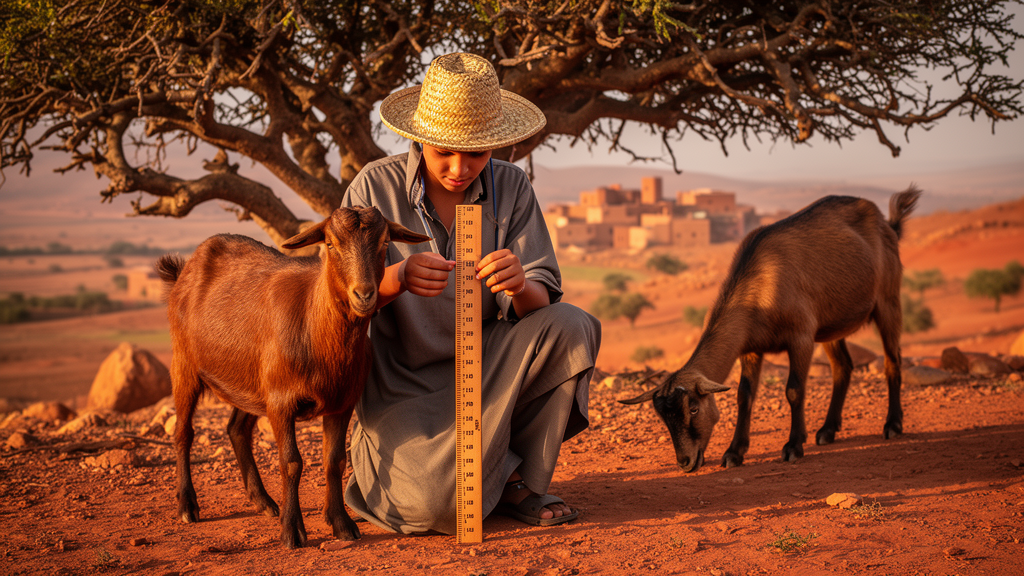
In the argan woodlands of Morocco’s Souss-Massa region, the growth of a young goat turns out to be a story told mostly by the calendar, with nutrition, birth order and geography writing only selective chapters. A longitudinal study of 322 goats, followed across six monthly measurement occasions and yielding 1,932 individual observations, has found that measurement month was the single dominant source of variation in body weight and seven linear body measurements, while the effects of concentrate supplementation, birth type, sex and geographic region were trait-specific and often visible only at particular developmental stages.
The research, published in Frontiers in Animal Science, was conducted in the argan-based agroforestry system of central Morocco, where goat keeping is tightly woven into a semi-arid landscape dominated by Argania spinosa woodlands. The region has a Mediterranean climate with mean annual rainfall of about 300 millimeters, minimum monthly temperatures of 6 to 7 degrees Celsius and maxima of 33 to 35 degrees Celsius. Goats there are managed predominantly under extensive free-grazing systems, browsing tree leaves, herbaceous plants and agricultural by-products. Increasing aridity, water scarcity and vegetation degradation threaten this system, which is why the researchers set out to quantify how management and biological factors shape growth over time rather than at a single snapshot.
The team worked with 24 voluntarily participating goat holders, selected from more than 60 contacted, to build an on-farm “living lab.” Eight herders were ultimately chosen for the longitudinal evaluation. Initial flock sizes in March 2023 ranged from 10 to 150 head but later declined to 5 to 90 because of drought, with some breeders selling all their animals. Within each participating farm, goats were selected according to predefined age, sex and birth-type categories and then allocated to one of two feeding regimes: a control group kept under the usual extensive browsing system without concentrate, and a treatment group receiving a standardized concentrate supplement in addition to browsing. Allocation split matched pairs of animals, matched for sex, age and birth type, between the two groups to minimize confounding.
The twin population consisted of 60 pairs, equally divided among male-male, female-female and male-female combinations, alongside 101 single-born males and 101 single-born females. Half the animals, 161 in each group, received supplementation. The concentrate contained barley, wheat bran, corn and dried alfalfa, offered twice daily in morning and evening feedings. Kids aged 3 to 7 weeks received 500 grams per animal per day, while animals aged 8 weeks or older received 1,000 grams. The authors note that dry matter, crude protein and metabolizable energy supplies were estimated from literature-based composition values, and that individual feed refusals and actual intake were not recorded, so the reported quantities represent feed offered rather than measured consumption.
Each goat was measured once per month for six consecutive months by a single trained person using a digital weighing scale and a measuring tape, with individual animals identified by unique collar tags. The measured traits were body weight, chest circumference, body length, withers height, total length, neck length, head length and head width. Across the full dataset, mean body weight was 12.91 kilograms with a range from 2.41 to 22.57 kilograms, mean chest circumference was 52.60 centimeters, and mean withers height was 46.90 centimeters. Animals ranged in age from 1.5 to 8.5 months, with a mean of 5.00 months.
The statistical backbone of the study was a set of linear mixed-effects models, one per trait, fitted separately. This framework was chosen because repeated observations on the same animal are correlated and cannot be treated as independent; a goat-specific random intercept accounted for between-animal heterogeneity while fixed effects estimated population-level influences of time, feeding system, birth type, sex and geographic region. Measurement month was modeled as a categorical factor with six levels, allowing potentially non-linear growth to be captured without assuming a constant rate of development. Covariance structures including compound symmetry, first-order autoregressive and unstructured forms were compared using Akaike and Bayesian information criteria.
The headline result was the overwhelming importance of time. Measurement month significantly affected all eight traits, each with p less than 0.001. Descriptive trajectories matched the model output: from the first to the sixth measurement, mean body weight rose from 9.85 to 15.08 kilograms, chest circumference from 44.56 to 60.42 centimeters, body length from 41.55 to 52.72 centimeters, withers height from 41.53 to 50.94 centimeters, and total length from 64.65 to 79.06 centimeters. The authors interpret this coordinated increase across mass, thoracic capacity, skeletal length and cranial dimensions as evidence of age-dependent postnatal growth following developmental trajectories rather than a constant rate of gain.
The feeding story was more subtle. Concentrate supplementation showed no significant constant main effect on any of the eight traits, with all p values at or above 0.142. Yet the supplementation-by-month interaction was highly significant for chest circumference, at p less than 0.001, and a Bonferroni-adjusted marginal comparison supported the finding. In other words, supplementary feeding modified thoracic development at specific stages rather than producing a uniform difference throughout the study. Predicted body weight and withers height were numerically higher in supplemented goats at most occasions, but the authors explicitly caution that these separations should be read as descriptive, since neither the main effects nor the interactions reached statistical significance for those traits.
Birth type and sex emerged as developmental modifiers. Birth type significantly affected body weight, chest circumference, withers height and total length, and interacted with month for body weight, withers height, total length, neck length, head length and head width. Singleton-born goats showed higher predicted body weight and withers height during early and intermediate measurements, but the differences progressively shrank and the trajectories converged by the sixth measurement, a pattern the authors describe as an age-dependent effect. Sex significantly affected chest circumference, body length, withers height and total length, and produced significant sex-by-month interactions for all eight traits. Males were consistently predicted to have larger chest circumference than females, with the gap widening at later measurements, while the sex difference in body weight narrowed to near coincidence by the final occasion. Geographic region had a significant main effect only on chest circumference, with region-by-month interactions for body weight and head length, indicating that regional variation expressed itself through developmental paths rather than uniform average differences.
The authors are candid about model limitations. Formal normality tests rejected strict normality for all eight residual series, and body weight, chest circumference and head length showed particularly strong skewness and kurtosis; residual-versus-predicted plots revealed nonconstant dispersion for several traits. They argue that these departures do not negate the mixed-model framework, which remains appropriate for repeated observations, but that valid inference depends on adequate covariance and variance specification, and sensitivity analyses with heterogeneous variance functions could strengthen future inference. Their practical takeaway is that chest circumference is an especially informative field trait, responsive to nutritional, intrinsic and geographic factors and closely related to live body size, making it valuable where repeated weighing is difficult. The broader lesson is methodological: a nonsignificant overall main effect does not mean development over time is identical, and interactions with measurement month should be read alongside main effects to identify the growth stages at which feeding, birth status, sex and environment matter most.
Subject of Research: Longitudinal morphometric development of goats in the Moroccan argan region under different feeding systems and birth types
Article Title: Feeding system and birth type shape short- and long-term morphometric development in goats from the Moroccan argan area
Article References: Tami, H., Ezzaky, Y., Zanzan, M., Sadek, H., Elidrissi, A., & Achemchem, F. (2026). Feeding system and birth type shape short- and long-term morphometric development in goats from the Moroccan argan area. Frontiers in Animal Science, 7, 1968869. https://doi.org/10.3389/fanim.2026.1968869
Image Credits: AI Generated
DOI: 10.3389/fanim.2026.1968869
Keywords: goats, morphometry, longitudinal study, linear mixed models, Morocco, argan agroforestry, concentrate supplementation, birth type, sexual dimorphism, chest circumference, Souss-Massa, animal growth
News Source: Drew Townsend. (October 27, 2026). Goat growth in Morocco’s argan heartland tracked month by month. Scienmag.