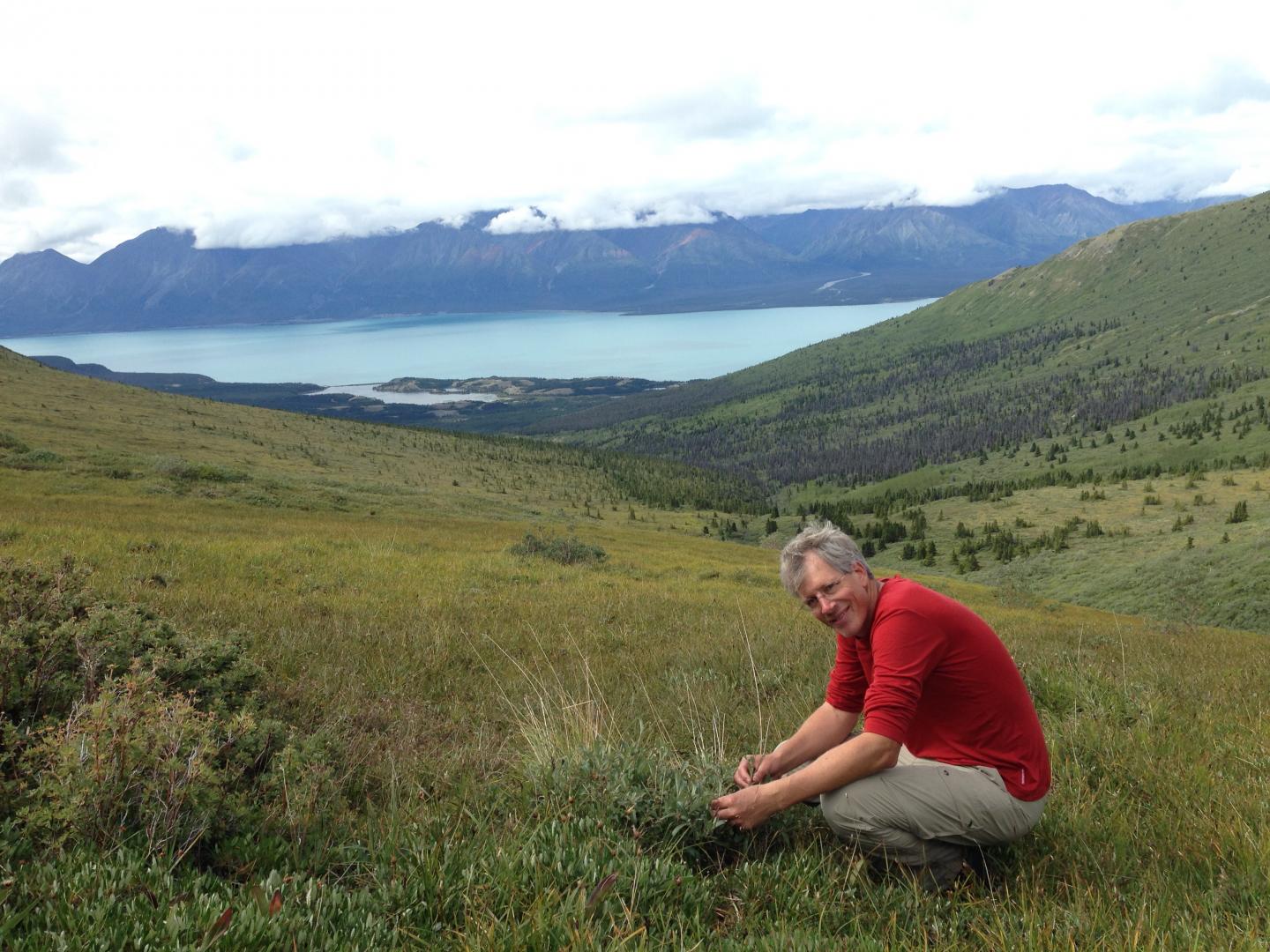
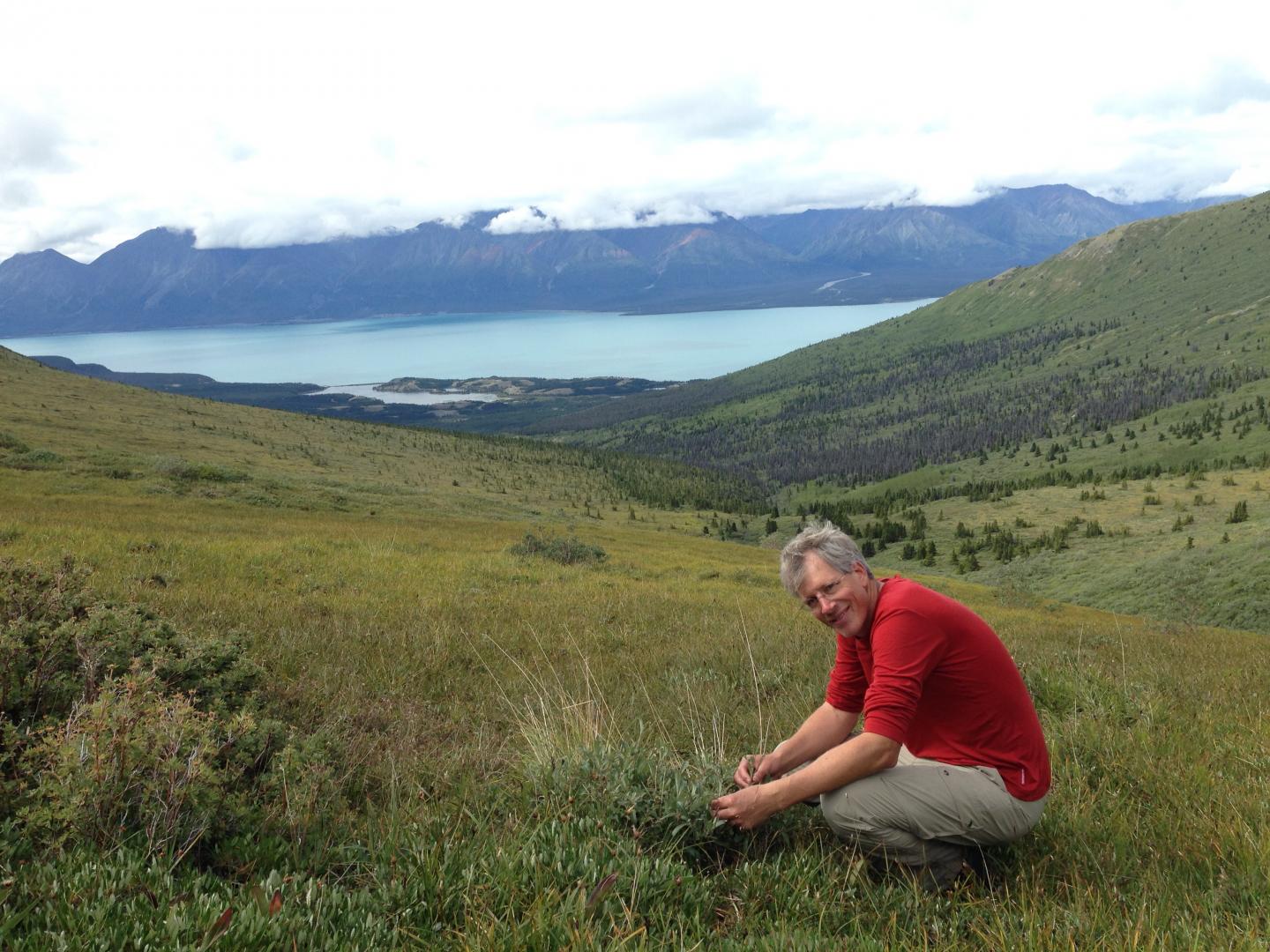
Credit: Courtesy David Hik
A study by more than 100 global researchers is linking the effects of climate change to new and taller plant species in the Arctic and alpine tundra, where low-growing grasses and dwarf shrubs typically grow. Their findings have been published in Nature.
Simon Fraser University biology professor David Hik, whose research is focused on the terrestrial ecology of northern mountains, was part of the massive team. A former PhD student from his lab, Isla Myers-Smith, now at the University of Edinburgh, is one of the study's three lead authors.
The study includes contributions from collaborators working at 117 tundra sites across the northern hemisphere. Researchers sought to better understand the full extent of the relationship between climate and plant traits in cold ecosystems, and the consequences of climate warming on functional change affecting community structure, says Hik, who shared data from his own long-term research site in the Ruby Range, in southwest Yukon.
The researchers identified climate warming as the underlying cause of height increase among plants at sites in the Arctic and alpine regions of Alaska, Canada, Iceland, Scandinavia and Siberia, the Alps and other mountain ranges.
Researchers note that over the three decades covered by the study temperatures in the Arctic have risen by one degree Celsius in summer and 1.5 degrees in winter, among the fastest rates of warming on the planet. Similar warming has been observed in many mountain ranges around the world.
"This paper is significant because we were able to quantify the biome-wide relationships between temperature, soil moisture and key plant traits that represent the foundation of biological form and function, using a dataset of more than 56,000 tundra plant trait observations, and nearly three decades of vegetation survey data from these sites," says Hik.
Among key findings:
- Temperature-trait relationships were generally strong, but soil moisture had a notable influence on the strength and direction of these relationships, highlighting the potentially important influence of changes in water availability on future trait changes in tundra plant communities;
- Plant community height increased with warming across all sites over the past three decades; other traits lagged far behind predicted rates of change;
- Within tundra communities, functions that are tied closely to plant height will experience the most rapid change.
Hik says according to the study, the overall implications are that recent (observed) and future (predicted) changes in plant traits, particularly height, are likely to have important implications for tundra ecosystem functions and feedback effects involving soil temperature, decomposition and carbon cycling, and the potential for soil carbon loss is particularly high.
A major incentive for quantifying spatial temperature-trait relationships is to provide an empirical basis for predicting the potential consequences of future warming. Earth system models are increasingly moving to incorporate relationships between traits and the environment, as this can substantially improve estimates of ecosystem change, notes Hik.
"Over the past decade we have documented changes in alpine tundra vegetation in Yukon that are consistent with this global analysis, including ore tall shrubs and increasing diversity of tundra plant communities.
"The patterns in functional traits described in the paper reveal the extent to which environmental factors shape biotic communities in the tundra. In particular, our study highlights the importance of accounting for future changes in water availability, as this will likely influence both the magnitude and direction of change for many traits."
The researchers also found no evidence of a decline in shorter species due to the taller species, at least so far. They also suggest, that the plant community's response to climate warming will depend on whether the tundra becomes wetter or drier over time.
###
The study was initiated by a team of researchers supported through the German Centre for Integrative Biodiversity Research (iDiv) at the University of Leipzig. Hik's long-term research has been supported by the Natural Sciences and Engineering Research Council (NSERC).
Photos: https://www.flickr.com/photos/sfupamr/44916806481/in/dateposted/
Video clip (drone footage): https://vimeo.com/291954761/d7339b5cd1
Study link: https://www.nature.com/articles/s41586-018-0563-7
Media Contact
David Hik
[email protected]
778-782-9017
@SFU_Media
http://www.sfu.ca
Original Source
https://www.sfu.ca/university-communications/issues-experts/2018/09/global-study-finds-taller-plant-species-taking-over-as-mountains.html