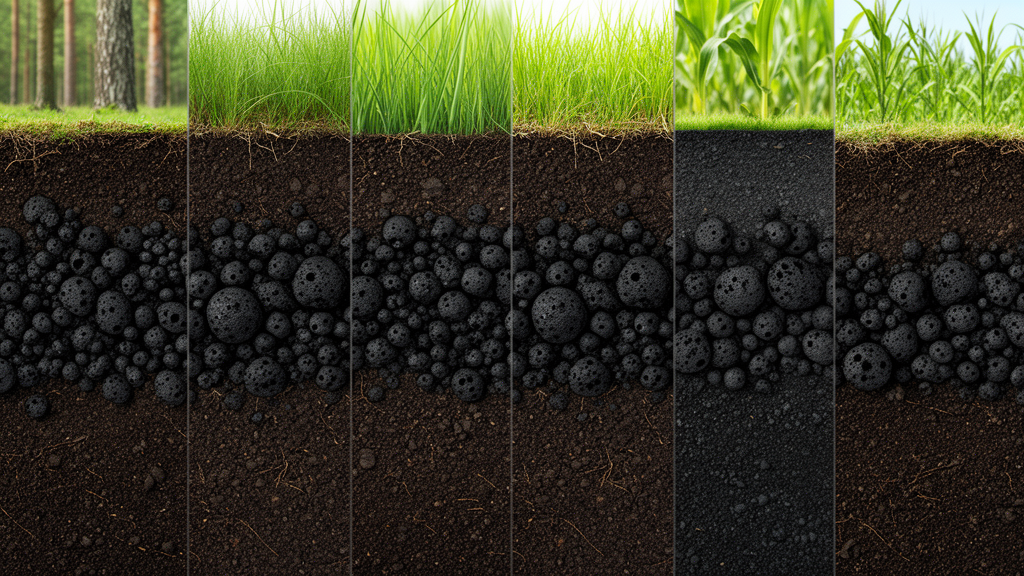
A comprehensive quantitative review of global ecological restoration research has mapped the precise single-application threshold doses of biochar required to revive degraded soils across six major global biomes. By synthesizing ninety-five peer-reviewed field investigations, greenhouse trials, and meta-analyses published between January 2011 and December 2025 across the Web of Science and ScienceDirect databases—screened from an initial pool of 1,533 articles—the synthesis demonstrates that biochar does not operate as a universal ecological remedy. Instead, biochar delivers strictly dose-dependent remediation that requires rigorous habitat calibration. The researchers identified baseline application ranges of 5 to 30 tonnes per hectare for agricultural cropland, 5 to 40 tonnes per hectare for grassland biomes, 5 to 40 tonnes per hectare for forest systems, 10 to 50 tonnes per hectare for coastal wetlands, 10 to 40 tonnes per hectare for arid deserts, and 20 to 60 tonnes per hectare for polar tundra. This framework bridges general material recommendations and actionable restoration practice, establishing a scientific foundation for global standard formulation.
Applying biochar within these calibrated boundaries triggers pronounced ecological improvements, enhancing soil health, structural integrity, and biophysical functionality. Across evaluated restoration settings, targeted dosages increased soil water-holding capacity by approximately 10.0 to 14.3 percent, curtailed greenhouse gas releases by 16.4 to 31.5 percent, diminished heavy metal burdens, and elevated baseline soil organic matter levels. However, surpassing these ecosystem-specific thresholds precipitates severe biogeochemical disruptions. Over-application can destabilize soil chemical equilibrium by inducing extreme pH fluctuations, upsetting delicate soil ion balances, and suppressing the availability of nitrogen and phosphorus. Furthermore, excess biochar introduces biological toxicity, depressing beneficial soil microbial activity and diversity by 30 to 60 percent while slashing the biomass of macrofauna like earthworms by approximately 70 percent. At rates exceeding 100 tonnes per hectare, biochar alters carbon mineralization dynamics, actively offsetting intended carbon sink gains, inhibiting seed germination, and releasing endogenous polycyclic aromatic hydrocarbons into surrounding habitats.
Conversely, applying biochar at rates below these empirically established thresholds proves largely ineffective, leaving degraded ecosystems vulnerable to persistent limitations. Insufficient dosages fail to supply the porous architecture and reactive surface sites required to immobilize hazardous heavy metals like cadmium and lead, leaving contaminants such as veterinary antibiotics and polycyclic aromatic hydrocarbons free to leach. Sub-threshold applications also fail to construct viable microhabitats or supply sufficient organic substrate for degrading bacteria, reducing pollutant degradation efficiency by 30 to 40 percent. Soil nutrient dynamics remain similarly unresponsive under inadequate dosing, with ammonia immobilization dropping as low as 15 percent and nitrite removal stalling below 20 percent. When applied at proper rates, particularly using tailored formulations like iron-modified or nitrogen-doped char, biochar achieves efficient contaminant remediation, removing more than 80 percent of soil antibiotics and cutting cadmium levels by 29.45 to 45.80 percent while raising phosphorus use efficiency by 15 to 25 percent and stabilizing soil pH between 6.5 and 7.8.
In agricultural ecosystems, balancing crop production with environmental preservation dictates a strict dosage threshold of 5 to 30 tonnes per hectare. Field experiments demonstrate that an application rate of 20 tonnes per hectare markedly promotes wheat and maize development, boosting crop yield and vegetative biomass. This rate simultaneously curbs nitrogen pollution, reducing the chemical nitrogen fertilizer emission factor from an untreated baseline of 0.61 ± 0.12 percent down to between 0.31 ± 0.13 percent and 0.2 ± 0.07 percent. Across agricultural landscapes, rates above 20 tonnes per hectare reduce global nitrous oxide emissions by 19 percent, while rates of 20 to 30 tonnes per hectare protect crop chloroplast ultrastructure, enhance stomatal density, and raise photosynthetic efficiency. Specialized applications, such as biochar organic fertilizer applied at 5 tonnes per hectare, stabilize recalcitrant organic carbon and increase crop vitamin C concentrations by 12.8 to 29.9 percent. Exceeding 30 tonnes per hectare, however, induces crop physiological stress, degrades microbial vitality, and risks accumulating toxic polycyclic aromatic hydrocarbons.
Degraded grassland ecosystems require application rates maintained between 5 and 40 tonnes per hectare to restore vegetative cover, stimulate humification, and protect plant communities. In Brazilian tropical pastures, an operational window of 15 to 30 tonnes per hectare serves as an optimal economic and ecological threshold, elevating forage productivity, stimulating microbial cycling, and curbing chemical fertilizer reliance. In Dutch natural grasslands, 10 tonnes per hectare of pruning-derived biochar fostered carbon sequestration with minimal disturbance to biodiversity and productivity, while Canadian trials established that 17 tonnes per hectare of pine woodchip biochar significantly curtailed cumulative nitrous oxide emissions. In alpine soils of China, doses between 10 and 40 tonnes per hectare enhanced fertility across the top twenty centimetres of soil, and United States pasture studies recorded alleviated compaction under 20 to 40 tonnes per hectare. Nevertheless, applying biochar beyond 30 tonnes per hectare can provoke excessively alkaline soil conditions, precipitating micronutrient deficiencies by locking up vital trace elements such as iron and zinc.
Forest ecosystems exhibit acute vulnerability to biochar additions, demanding careful rate governance within an operational range of 5 to 40 tonnes per hectare. In warm-temperate deciduous stands, an application of 10 tonnes per hectare stimulated litter decomposition by 8.6 percent and promoted soil carbon storage, whereas a 5-tonne dose yielded negligible improvements. In Australian sub-tropical forests, applying 10 tonnes per hectare increased soil water content by 14.3 percent in surface horizons and 13.8 percent in sub-surface layers, while cutting nitrogen loss and supporting tree growth. Furthermore, forestry trials recorded that moderate additions of approximately 20.6 tonnes per hectare suppressed cumulative carbon dioxide emissions by 16.4 percent, reduced nitrous oxide output by 27.5 to 31.5 percent, and lowered net global warming potential by 17.2 percent. Worldwide meta-analyses demonstrate an average 41 percent increase in woody plant biomass under 20 to 40 tonnes per hectare, although excessive rates risk salinization and carbon loss.
In coastal wetland environments, where tidal dynamics and elevated salinity govern ecological functions, the optimal remediation window spans 10 to 50 tonnes per hectare. Adding 26 to 50 tonnes per hectare in saline wetlands stimulates alfalfa biomass, lowers soil salinity, and enhances available nitrogen and microbial activity. Similar interventions across Inner Mongolia’s Hetao Plain at 40 to 50 tonnes per hectare lowered electrical conductivity and raised soil moisture, while Yellow River Delta trials using 20 to 40 tonnes per hectare accelerated the growth of Suaeda salsa. Contaminant remediation shows notable success: applying 52 tonnes per hectare of Spartina alterniflora biochar adjusted soil pH to between 8.35 and 8.43, increased available nutrients, and decreased aboveground cadmium accumulation by 29.45 percent. Combining 20 tonnes per hectare of biochar with 0.8 percent rhamnolipid surfactant overcame petroleum hydrocarbon toxicity, elevating wetland algal biomass by up to 30 percent. Laboratory evaluations further confirm that 21 to 63 tonnes per hectare enhance organic carbon stability, although overdosing risks aggravating saline-alkali stress.
Arid desert ecosystems, characterized by sparse vegetation and rapid organic decomposition, respond effectively to biochar amendments maintained within 10 to 40 tonnes per hectare. Utilizing biochar synthesized from native desert shrubs such as Artemisia desertorum increased sand water-holding capacity by 10 to 11 percent and enriched dissolved organic carbon and nitrogen pools, vastly outperforming non-native hardwood chars. In the Thar Desert of India, applying 20 tonnes per hectare improved soil water retention by 11 to 14 percent, while trials in China’s Gurbantunggut Desert revealed that 12.74 tonnes per hectare improved biological soil crust nutrient balances. In sandy soils, applying 40 tonnes per hectare elevated cation exchange capacity to between 37 and 40 centimoles per kilogram, sustaining crop nutrient needs for roughly 150 days. Tomato cultivation under 40 tonnes per hectare yielded enhanced fruit quality, improved soil chemical properties, and increased total harvests. However, exceeding 45 tonnes per hectare suppresses arid plant growth, and applying excessive quantities without proper water management accelerates secondary salinization, offsetting the structural gains achieved by low-dose applications.
In polar tundra ecosystems, extreme cold and frequent freeze-thaw cycles necessitate higher biochar dosages, defining a remediation threshold between 20 to 60 tonnes per hectare. In seasonally frozen soils, an optimal application of approximately 40.5 tonnes per hectare enhanced hydrothermal stability, driving a 22.03 percent increase in saturated hydraulic conductivity. In cold-region agricultural trials, incorporating approximately 42.9 tonnes per hectare enlarged the proportion of medium pores, raised soil aggregate mean weight diameter by 10.2 percent, and mitigated permanent freeze-thaw deformation by 81.19 percent, whereas excessive dosing at 85.8 tonnes per hectare worsened structural deformation. Adding approximately 60 tonnes per hectare of cotton straw biochar increased freeze-thaw soil water storage by 14.88 to 59.5 percent, though exceeding this limit collapsed soil porosity. Biochar also moderates cold-climate greenhouse emissions: applying 20 tonnes per hectare during freezing periods maximized methane uptake, cutting methane emissions by 8.25 to 30.75 micrograms per kilogram. Complementary experiments in the seasonal frozen soil region of Heilongjiang confirmed that 30 tonnes per hectare curbed global warming potential while actively suppressing nitrous oxide and methane discharges.
The synthesis emphasizes that these global thresholds are dynamic boundaries governed by biochar properties, soil matrices, climatic forces, and human management practices. Pyrolysis temperature dictates initial performance: low-temperature chars (400 to 500 °C) rich in oxygenated functional groups suit biologically active forest topsoils, whereas high-temperature chars exceeding 600 °C offer superior aromatic stability for pollutant adsorption. Soil texture heavily influences safety windows; coarse sandy soils raise application limits by roughly 20 percent, while clay soils with iron-aluminum oxide coatings exceeding 40 percent reduce carbon-microbe interface efficiency by 30 percent. High background cadmium exceeding 3.2 milligrams per kilogram lowers application thresholds by 25 percent, whereas soil organic matter above 5 percent elevates contaminant toxicity tolerances by 50 percent. Climatic factors account for 41 percent of global threshold variability, including tropical oxidation and arid dry-wet cycles. Management practices actively alter these boundaries, with rotational grazing raising grassland limits by 25 percent and desert drip irrigation expanding capacity by 40 percent, underpinning ecosystem-tailored restoration frameworks worldwide.
Subject of Research: Global ecosystem-specific dosage thresholds and management strategies for biochar application in ecological restoration.
Article Title: How much biochar should be used in global ecological restoration?
Article References: Bai, X., Yuan, X., Li, X., Liu, Z., Zeng, S., Luo, Y., Chen, J., Zhang, H., Tian, S., Xiong, L., Du, C., Wu, L., Li, H., Hu, Z., Xie, Y., & Dollars, I. K. (2026). How much biochar should be used in global ecological restoration?. Biochar, 8(1), Article 100. https://doi.org/10.1007/s42773-026-00603-1
Image Credits: AI Generated
DOI: 10.1007/s42773-026-00603-1
Keywords: biochar application thresholds, ecological restoration, agricultural ecosystems, grassland restoration, forest management, coastal wetlands, desert restoration, polar tundra, soil water-holding capacity, greenhouse gas mitigation, polycyclic aromatic hydrocarbons, soil microbial diversity, heavy metal immobilization, freeze-thaw cycles, pyrolysis temperature, soil aggregate stability, cation exchange capacity, differentiated application strategies
News Source: Alan Morgan. (November 16, 2026). Global Review Defines Safe Biochar Application Thresholds Across Six Major Ecosystems. Scienmag.