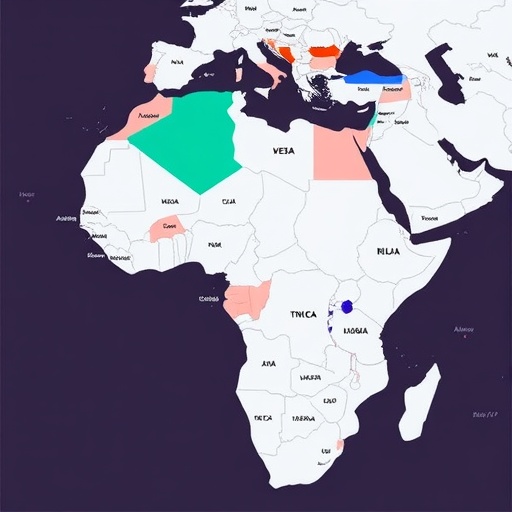
In the evolving landscape of infectious disease research, a new bibliometric study extensively maps the scientific trajectory of Lassa virus (LASV) research over an unparalleled span of 55 years, from 1970 through projections into 2025. This exhaustive analysis uncovers critical insights into the progression, thematic focus, and geographic disparities embedded within the academic dialogue surrounding LASV—a rodent-borne arenavirus responsible for Lassa fever, a hemorrhagic illness endemic to West Africa. By meticulously dissecting 1,566 peer-reviewed publications sourced from the Scopus database, the study spotlights persistent gaps in our understanding and equips the scientific community with a roadmap for future inquiry rooted in the One Health paradigm.
The cumulative research output on LASV demonstrates a tripartite temporal structure characterized by an initial period of low productivity extending from 1970 to 2002, followed by a phase of steady, incremental scientific contributions between 2003 and 2014. These early stages gave way to a vibrant surge in scholarship post-2015, culminating in a crescendo of publications anticipated through 2025. Notably, the Journal of Virology emerges as the principal dissemination platform, underscoring its central role in advancing basic and applied virology in this domain. A substantial 81.1% of publications are categorized as original research articles, reflecting concentrated efforts toward empirical validation and mechanistic elucidation of LASV biology.
Despite this quantitative amplification, the study reveals a pronounced and systemic asymmetry in research origination and leadership, underscoring inequities between high-income countries and those burdened by endemic LASV transmission. The United States, in particular, commands a dominant position in orchestrating international collaborations; however, only 20% of the top 50 prolific authors reside in afflicted African nations. This disproportionate representation challenges the community to reconsider models of research ownership and the imperative for capacity building within endemic settings. There exists an exigent need to empower local scientific institutions to lead nuanced investigations that resonate with the socio-ecological contexts of Lassa fever.
A groundbreaking aspect of this bibliometric study is its identification of a significant neglect of environmental determinants influencing LASV ecology and transmission dynamics. Keyword analyses consistently expose a thematic deficit in studies addressing the interplay between environmental variables—such as rodent reservoir habitats, climatic fluctuations, land-use changes—and viral spillover events. Such a blindspot is alarming, given that the intricate interdependencies inherent in zoonotic diseases demand a multidisciplinary approach for forecasting outbreaks and devising robust prevention measures. This lacuna diminishes the application of One Health principles, which advocate an integrated perspective recognizing the inextricable links between human, animal, and environmental health.
Incorporation of ecological and environmental sciences into LASV research remains fragmented, revealing a research agenda historically skewed towards virology and epidemiology with insufficient dialogue across disciplines. Addressing this omission would entail methodological expansion to include longitudinal environmental surveillance, geospatial modeling, and systems ecology, thereby enriching pathogen transmission models and enhancing public health interventions. Amplifying environmental health research within LASV studies is not only scientifically prudent but necessary to transition from reactive outbreak responses to preemptive disease management.
Further compounding these challenges is the issue of equitable research collaboration and capacity development. The preponderance of LASV scholarships emanating from outside endemic regions risks overshadowing indigenous scientific contributions and perpetuates a dependency framework. Enhancing regional research capacity through strategic investments in infrastructure, training, and leadership opportunities is paramount. Such empowerment would facilitate the generation of localized knowledge, fostering studies that are contextually salient and socially responsive, thereby heightening the overall effectiveness of intervention strategies.
Moreover, fostering collaborative frameworks that genuinely center affected communities stands as a pivotal recommendation. Research partnerships should transcend transactional dynamics to evolve into sustained engagements focusing on bidirectional knowledge exchange and mutual benefit. This approach not only accelerates scientific discovery but ensures that outcomes resonate with and empower communities who bear the brunt of Lassa fever’s morbidity and mortality.
Methodologically, the bibliometric approach employed in this study leverages data mining, network analysis, and thematic mapping to delineate trends, identify key contributors, and quantify research outputs. These techniques permit a panoramic yet granular assessment of scientific evolution. Employing such methodological rigor enables stakeholders to pinpoint research silos and champion interdisciplinary projects leveraging virology, epidemiology, environmental science, socio-economic analysis, and public health practice.
The implications of this research extend beyond academic discourse, signaling a pivotal juncture for global health governance and funding agencies. Prioritization of LASV research necessitates frameworks that integrate environmental monitoring systems, amplify endemic country leadership, and foster transdisciplinary collaboration adhering to One Health imperatives. This strategic pivot is critical to designing interventions with sustained impact and mitigating the public health burden of Lassa fever.
In conclusion, the 55-year bibliometric mapping of Lassa virus research not only charts the scientific milestones achieved but reveals profound structural weaknesses that must be addressed to elevate the field. By illuminating the environmental research void, exposing geographic disparities in authorship, and advocating for One Health integration, this study constitutes a clarion call. It invites the scientific community to reconceptualize LASV research paradigms to foster inclusivity, interdisciplinarity, and ecological sensitivity. Only through such transformative efforts can we hope to develop predictive models, optimize therapeutic and preventive strategies, and ultimately curtail the impact of this pernicious virus.
Subject to ongoing and future challenges posed by LASV’s epidemiology, this comprehensive survey stresses that accelerating publication counts are insufficient markers of progress. Instead, an intentional, strategic reshaping of the research agenda is imperative—one that places environmental context, regional expertise, and collaborative equity at its core. The emergence of an integrated One Health framework within LASV scholarship will be instrumental in steering global efforts towards sustainable control and eradication of Lassa fever.
Subject of Research: Lassa virus scientific research and bibliometric analysis
Article Title: Mapping the scientific landscape of Lassa virus: a 55-year bibliometric study (1970–2025)
News Publication Date: 18-Apr-2026
Web References: http://dx.doi.org/10.1016/j.soh.2026.100156
Image Credits: Uwem Okon Edet, Clement Meseko, Md Zulfekar Ali, Edema Enogiomwan Imalele, Agusi Ebere Roseann, Aniekan-Augusta Okon Eyo, Bassey Edet, Olayinka Asala
Keywords: Bibliometrics, Lassa virus, Epidemiology, One Health, Environmental Drivers, Viral Transmission, Research Capacity, Zoonotic Diseases, Collaborative Research, West Africa
Tags: bibliometric study on Lassa feverfuture directions in Lassa virus investigationgeographic disparities in infectious disease researchhemorrhagic fever academic researchJournal of Virology publicationsLassa virus knowledge gapsLassa virus research trendsOne Health approach in virus researchrodent-borne arenavirus studiesscientific productivity in virologytemporal analysis of virus researchWest Africa Lassa fever endemicity