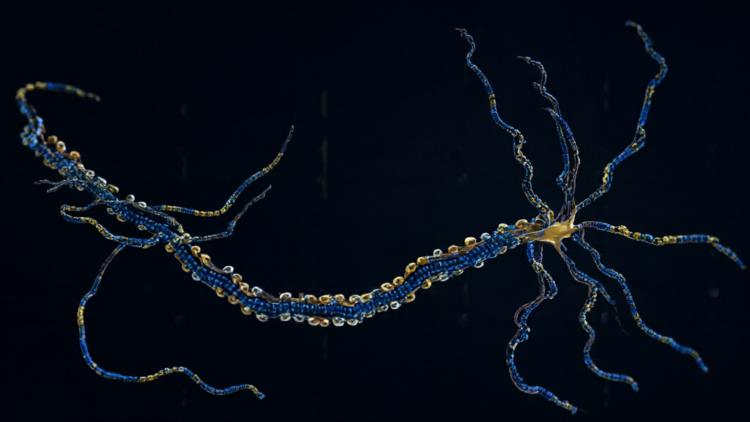
Northwestern University scientists have engineered a class of molecular structures so vast and precisely controlled that they represent a fundamental shift in how chemists approach the design of advanced materials. These supramolecular polymers, often referred to as giga-assemblies, are constructed from self-assembling molecules that spontaneously organize into threads exceeding the diameter of a human cell. By achieving a level of precision previously thought impossible for such dynamic systems, the research team has unlocked the ability to dictate the exact length and chemical composition of these giant structures. The implications of this breakthrough extend far beyond the laboratory bench, offering a novel pathway for creating biomaterials that can actively interact with living cells to promote regeneration and healing.
The scale of these new materials is difficult to grasp by conventional molecular standards. While typical plastics consist of polymers with molar masses in the range of ten million daltons, and the largest proteins in nature reach approximately three to five million daltons, these new supramolecular threads exceed one billion daltons. A dalton is a unit of mass used to measure molecules and atoms, roughly equivalent to the mass of a single proton or neutron. Therefore, these giga-assemblies are roughly 100 times more massive than even the largest known proteins in biology. Despite their enormous size, the structures are not static; they are dynamic, allowing their components to move and reconfigure in ways that mimic the fluidity of biological systems.
The key to controlling these giant structures lies in a previously unknown process termed self-capping supramolecular polymerization. In traditional polymerization, chains grow until they are stopped by chemical termination or lack of building blocks. In this new method, the flexible ends of the growing thread remain highly dynamic at specific temperatures, allowing new molecules to join in a synchronized manner. Once the available building blocks are consumed, these flexible ends fold over to protect the termini of the thread. This capping mechanism effectively shuts down further growth, preventing the threads from fusing together or undergoing Ostwald ripening, a process where smaller structures dissolve to feed larger ones. The result is a population of threads with uniform, predictable lengths that remain stable for months without changing.
Researchers can manipulate the chemical properties of these threads by adding different types of molecules in sequence. By introducing molecules with specific electrical charges at precise intervals, the team created threads with distinct segments carrying positive and negative charges. This segmentation allows for the precise arrangement of chemical structures along the length of the thread. In previous attempts to create charged supramolecular materials, oppositely charged segments would cause the structures to clump together or become unstable in water. However, the self-capping mechanism in these giga-assemblies prevents such aggregation, allowing the researchers to maintain stable, segmented structures in aqueous environments. This stability is crucial for potential biomedical applications where materials must function in the watery interior of the human body.
The biological impact of these precisely segmented threads was discovered when the team tested them on cortical neurons. Neurons carry a strong negative surface charge, which creates a natural repulsion against negatively charged materials and attraction to positively charged ones. When the researchers exposed neurons to threads composed entirely of positively charged segments, the cells died. Conversely, threads with only negative charges had no effect, as the neurons repelled them. Randomly mixed charges also failed to produce a significant response. The breakthrough occurred when the team designed a thread with a small, positively charged segment sandwiched between two longer, negatively charged segments of different lengths.
This specific arrangement created a unique interaction with the neuronal surface. The small positive segment acted as an anchor, binding the thread to the negatively charged membrane of the neuron. The adjacent negative segments, repelled by the neuron’s surface, could not escape but remained highly mobile due to the dynamic nature of the supramolecular structure. This configuration forced the negative segments to stay in close proximity to the cell, creating a localized environment of intense electrostatic activity. The researchers observed that this arrangement did not suffocate the neuron, as the fully positive threads did, but instead stimulated it. The constant motion of the negative segments near the cell surface appeared to trigger a cascade of biological responses that promoted growth and maturation.
In cell culture studies, the effects on the neurons were dramatic. Treated neurons exhibited extensive neurite outgrowth, developing long, highly branched projections that are essential for forming synaptic connections with other cells. After just seven days, the treated neurons displayed significantly higher levels of activity compared to untreated controls. When stimulated, these neurons produced a calcium response, a key indicator of neuronal firing, that was four times greater than that of the untreated group. By day fourteen, the treated neurons had formed a substantially higher number of synapses, the junctions through which neurons communicate. This rapid maturation suggests that the material is not merely supporting cell survival but actively accelerating the developmental processes that are critical for neural network formation.
The mechanism behind this enhanced bioactivity appears to be linked to the recruitment of specific proteins. The researchers hypothesize that the negatively charged segments of the threads recruit neurotrophic factors, which are proteins that support the survival and growth of neurons. These proteins often possess positively charged domains that are attracted to the negative segments of the supramolecular threads. Additionally, laminin, a structural protein important for tissue integrity, was found accumulating along the threads near the neurons. The interplay between the attraction of these proteins and the repulsive forces from the neuronal surface creates a dynamic “tapping” motion on millisecond timescales. This rapid movement may help draw proteins toward receptors on the neuron, enhancing biological signaling without the need for the material to carry specific biological ligands or drugs.
The discovery of this self-capping polymerization strategy opens the door to a new era of materials design. By controlling the sequence of molecules added during assembly, scientists can create threads with complex, multi-segmented chemical profiles. This level of control allows for the design of materials with specific physical and chemical properties over long distances, a capability that was previously unattainable with supramolecular systems. The ability to create stable, giant, and precisely segmented structures suggests that these materials could be tailored for a wide range of applications, from tissue engineering to the development of new sensors and devices. The precision achieved in this study provides a blueprint for building complex molecular architectures that can interact with biological systems in sophisticated ways.
As the research team looks to the future, the possibilities for these giga-assemblies are vast. The current study focused on neurons, but the principles of charge segmentation and dynamic interaction could be applied to other cell types and tissues. The ability to create materials that are inherently bioactive through their physical organization, rather than through the addition of active pharmaceutical ingredients, represents a paradigm shift in regenerative medicine. By understanding how the precise arrangement of electrical charges and dynamic motion influences cell behavior, scientists can design materials that communicate with the body in new and effective ways. This work marks a significant step forward in the field of supramolecular chemistry, demonstrating that the largest and most complex molecular structures can be built with the precision of a master craftsman, offering unprecedented opportunities for advancing human health and technology.
Subject of Research: Supramolecular polymerization and neuronal bioactivity
Article Title: Researchers unlock new level of precision in supramolecular materials
Article References: Researchers unlock new level of precision in supramolecular materials. (n.d.). Original publication
Image Credits: AI Generated
DOI: Not provided
Keywords: supramolecular polymers, giga-assemblies, self-assembly, neuroscience, regenerative medicine, molecular threads, charge segmentation, biomaterials, neurite outgrowth, Northwestern University, Researchers, unlock
Cite Scienmag News
APA MLA Chicago
Cassandra Pierce. (October 2, 2026). Giant Molecular Threads Supercharge Neuron Growth. Scienmag. https://scienmag.com/giant-molecular-threads-supercharge-neuron-growth/
Cassandra Pierce. “Giant Molecular Threads Supercharge Neuron Growth.” Scienmag, 2 October 2026, https://scienmag.com/giant-molecular-threads-supercharge-neuron-growth/. Accessed 2 October 2026.
Cassandra Pierce. “Giant Molecular Threads Supercharge Neuron Growth.” Scienmag. October 2, 2026. https://scienmag.com/giant-molecular-threads-supercharge-neuron-growth/
Copy citation Download RIS
Tags: biomaterialsbiomaterials for promoting neural regenerationcharge segmentationGiant molecular threads in neuron growthgiga-assembliesgiga-assemblies in advanced material designimpact ofinnovative materials for neuron growth enhancementlarge-scale supramolecular structures for regenerative medicinemolecular engineering of neuron-supporting scaffoldsmolecular threadsneurite outgrowthNeuroscienceNorthwestern Universityprecise control of supramolecular assemblyRegenerative MedicineResearchersself-assembling biomaterials for neural repairself-assemblysupramolecular polymerssupramolecular polymers for tissue regenerationultra-large biopolymer structures for cell interactionultramassive biopolymer threads for biological applicationsunlock