• HOME
  • NEWS
  • EXPLORE
    • CAREER
      • Companies
      • Jobs
    • EVENTS
    • iGEM
      • News
      • Team
    • PHOTOS
    • VIDEO
    • WIKI
  • BLOG
  • COMMUNITY
    • FACEBOOK
    • INSTAGRAM
    • TWITTER
Tuesday, June 2, 2026
BIOENGINEER.ORG
No Result
View All Result
  • Login
  • HOME
  • NEWS
  • EXPLORE
    • CAREER
      • Companies
      • Jobs
        • Lecturer
        • PhD Studentship
        • Postdoc
        • Research Assistant
    • EVENTS
    • iGEM
      • News
      • Team
    • PHOTOS
    • VIDEO
    • WIKI
  • BLOG
  • COMMUNITY
    • FACEBOOK
    • INSTAGRAM
    • TWITTER
  • HOME
  • NEWS
  • EXPLORE
    • CAREER
      • Companies
      • Jobs
        • Lecturer
        • PhD Studentship
        • Postdoc
        • Research Assistant
    • EVENTS
    • iGEM
      • News
      • Team
    • PHOTOS
    • VIDEO
    • WIKI
  • BLOG
  • COMMUNITY
    • FACEBOOK
    • INSTAGRAM
    • TWITTER
No Result
View All Result
Bioengineer.org
No Result
View All Result
Home NEWS Science News Chemistry

Giant galactic explosion exposes galaxy pollution in action

Bioengineer by Bioengineer
April 22, 2024
in Chemistry
Reading Time: 2 mins read
0
A galactic fountain
Share on FacebookShare on TwitterShare on LinkedinShare on RedditShare on Telegram

A team of international researchers studied galaxy NGC 4383, in the nearby Virgo cluster, revealing a gas outflow so large that it would take 20,000 years for light to travel from one side to the other.
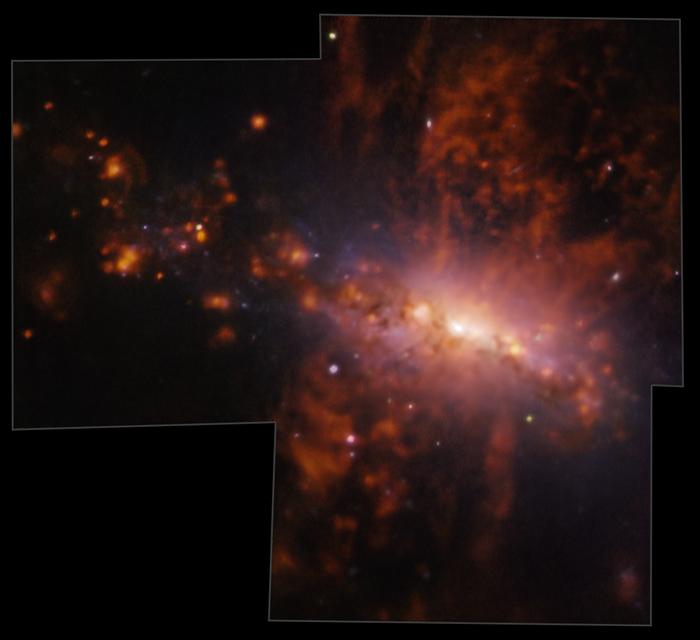
A galactic fountain

Credit: Credit: ESO/A. Watts et al

A team of international researchers studied galaxy NGC 4383, in the nearby Virgo cluster, revealing a gas outflow so large that it would take 20,000 years for light to travel from one side to the other.

The discovery was published today in the journal Monthly Notices of the Royal Astronomical Society.

Lead author Dr Adam Watts, from The University of Western Australia node at the International Centre for Radio Astronomy Research (ICRAR), said the outflow was the result of powerful stellar explosions in the central regions of the galaxy that could eject enormous amounts of hydrogen and heavier elements.

The mass of gas ejected is equivalent to more than 50 million Suns. 

“Very little is known about the physics of outflows and their properties because outflows are very hard to detect,” Dr Watts said.

“The ejected gas is quite rich in heavy elements giving us a unique view of the complex process of mixing between hydrogen and metals in the outflowing gas.

“In this particular case, we detected oxygen, nitrogen, sulphur and many other chemical elements.”

Gas outflows are crucial to regulate how fast and for how long galaxies can keep forming stars. The gas ejected by these explosions pollutes the space between stars within a galaxy, and even between galaxies, and can float in the intergalactic medium forever.

The high-resolution map was produced with data from the MAUVE survey, co-led by ICRAR researchers Professors Barbara Catinella and Luca Cortese, who were also co-authors of the study.

The survey used the MUSE Integral Field Spectrograph on the European Southern Observatoryʼs Very Large Telescope, located in northern Chile.

“We designed MAUVE to investigate how physical processes such as gas outflows help stop star formation in galaxies,” Professor Catinella said.

“NGC 4383 was our first target, as we suspected something very interesting was happening, but the data exceeded all our expectations.

“We hope that in the future, MAUVE observations reveal the importance of gas outflows in the local Universe with exquisite detail.”


Journal

Monthly Notices of the Royal Astronomical Society

DOI

10.1093/mnras/stae898

Method of Research

Meta-analysis

Article Title

MAUVE: A 6 kpc bipolar outflow launched from NGC4383, one of the most Hi-rich galaxies in the Virgo cluster

Article Publication Date

22-Apr-2024

Share12Tweet8Share2ShareShareShare2

Related Posts

Long-Term Use of Biochar Reduces Methane Emissions in Rice Fields — Chemistry

Long-Term Use of Biochar Reduces Methane Emissions in Rice Fields

June 2, 2026
New Study Reveals Saltier Soils Enhance Biochar Longevity — Chemistry

New Study Reveals Saltier Soils Enhance Biochar Longevity

June 2, 2026

Two Decades of Data Reveal Climate Change Transforming Biscayne Bay, Study Finds

June 1, 2026

Transforming Microalgae Waste into High-Performance Membranes for Enhanced Municipal Wastewater Treatment

May 29, 2026

POPULAR NEWS

  • ESMO 2025: mRNA COVID Vaccines Enhance Efficacy of Cancer Immunotherapy

    320 shares
    Share 128 Tweet 80
  • Multi-Hospital Study Reveals Long Covid Burden Is Twice as High as Current Estimates

    85 shares
    Share 34 Tweet 21
  • Saying Goodbye to PGY-6: Pediatric Fellowship Realities

    62 shares
    Share 25 Tweet 16
  • Common Food Preservatives Associated with Elevated Blood Pressure and Increased Heart Disease Risk

    57 shares
    Share 23 Tweet 14

About

We bring you the latest biotechnology news from best research centers and universities around the world. Check our website.

Follow us

Recent News

Probiotics and Preterm NEC: Post-FDA Warning Updates

Genetic Testing Enables Rapid Diagnosis of Rare Pancreatic Disorder in 98% of Infants

Long-Term Use of Biochar Reduces Methane Emissions in Rice Fields

Subscribe to Blog via Email

Enter your email address to subscribe to this blog and receive notifications of new posts by email.

Join 82 other subscribers
  • Contact Us

Bioengineer.org © Copyright 2023 All Rights Reserved.

Welcome Back!

Login to your account below

Forgotten Password?

Retrieve your password

Please enter your username or email address to reset your password.

Log In
No Result
View All Result
  • Homepages
    • Home Page 1
    • Home Page 2
  • News
  • National
  • Business
  • Health
  • Lifestyle
  • Science

Bioengineer.org © Copyright 2023 All Rights Reserved.