


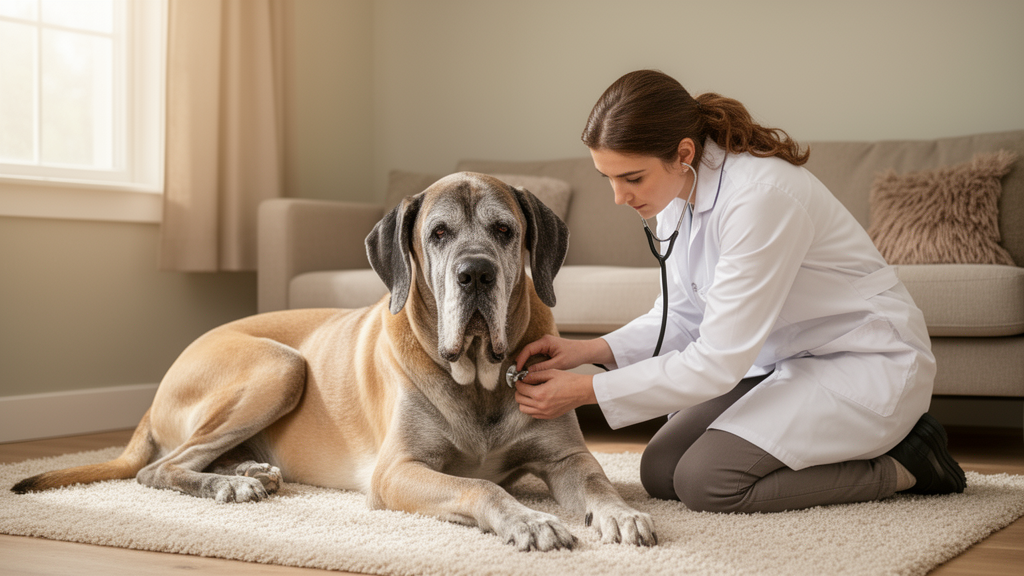
Giant breed dogs in the United Kingdom carry a heavier burden of recorded health disorders and die substantially younger than the general dog population, according to a large cohort study published in Companion Animal Health and Genetics. Drawing on the clinical records of more than 2.25 million dogs under primary veterinary care during 2019, researchers from the Royal Veterinary College identified 28,345 giant breed dogs across 29 breeds, representing 1.26 percent of the study population. Among a randomly sampled subset of 4,316 of these dogs whose records were reviewed in detail, 73.8 percent had at least one disorder recorded during the year, a figure the authors note is higher than the 65.8 percent reported for dogs of all types in an earlier VetCompass study using the same methods and data source.
The study, led by Dan G. O’Neill and colleagues, used the VetCompass programme, which collects anonymised electronic health records from UK primary-care veterinary practices. Dogs were defined as under veterinary care if they had at least one clinical note, treatment or bodyweight record during 2019. Because no universally agreed criteria exist for what constitutes a giant breed, the researchers derived a list of 29 breeds with assistance from the Royal Kennel Club, generally reflecting the tacit convention that breeds with typical adult bodyweights above 45 kilograms qualify. The most numerous giant breeds in the cohort were the Dogue de Bordeaux with 5,156 dogs, the Alaskan Malamute with 3,702 and the Akita with 2,901.
Body size in the cohort was striking. The median adult bodyweight for giant breed dogs overall was 48.8 kilograms, with an interquartile range of 40.4 to 58.0 kilograms and a full range spanning 25.0 to 100.0 kilograms. Breed-level medians varied from 31.4 kilograms in the Hungarian Kuvasz to 65.1 kilograms in the Saint Bernard. Adult males were significantly heavier than females, with a median of 52.4 kilograms against 45.1 kilograms, and dogs of Molossoid breeds, a related ancestral group that includes the Bull Mastiff, Great Dane and Saint Bernard, were significantly heavier still, with a median of 55.0 kilograms compared with 41.3 kilograms in non-Molossoid breeds.
The most common precise-level disorders recorded during 2019 were otitis externa, an inflammation of the external ear canal, at a one-year prevalence of 8.16 percent, followed by overweight or obesity at 8.02 percent and aggression at 5.56 percent. Dental disease and overgrown nails rounded out the top five. When diagnoses were grouped into broader categories, dermatological disorders led at 15.9 percent, followed by musculoskeletal disorders at 13.5 percent and aural disorders at 12.0 percent. The authors compared these lists with a previous VetCompass study of dogs of all types from 2016, in which the most prevalent conditions were periodontal disease, otitis externa, obesity, overgrown nails and anal sac impaction. Four of the five leading disorders were shared between the two groups, which the researchers attribute to basic ageing, degenerative and immunological processes common to all dogs regardless of breed or size.
Yet the contrasts between giant and general populations were disorder-specific rather than uniformly negative. Dental disease was less prevalent in giant breeds than in dogs overall, consistent with earlier reports of protection in larger dogs, while otitis externa and overweight or obesity were more prevalent, in line with previous findings. Aggression stood out as a notable difference, recorded at 5.56 percent in giant breeds, more than double the 2.24 percent reported for dogs overall in 2016. The authors flag this cautiously, noting that much prior research has found higher recorded aggression in smaller dogs, and suggesting that implicit bias, media portrayal of large breeds as dangerous, and experimental evidence that identical growls are rated as more aggressive when attributed to larger dogs may all shape how veterinary teams record such behaviour.
Sex and age shaped the pattern of disease. Among the 31 most common precise-level diagnoses, females had a higher probability of urinary incontinence and cruciate disease, while males had a higher probability of aggression, moist dermatitis, non-wound-related post-operative complications and pruritus. The median age of affected dogs ranged from 3.03 years for diarrhoea to 10.9 years for collapse. Comparing the 10 most common grouped disorders across three age bands, the prevalence of enteropathy, hernia, masses, neoplasia, overweight or obesity, and aural, behavioural, dental, musculoskeletal and skin disorders varied significantly with age. Breed type mattered too: within the giant group, Molossoid breeds had significantly higher prevalence of heart, female reproductive, mass and aural disorders but lower prevalence of overweight or obesity, behavioural and dental disorders than non-Molossoid breeds.
Mortality findings were the starkest. Of the 1,068 giant breed dogs recorded as having died in the available records, the median age at death was 8.94 years. Females lived significantly longer than males, with a median of 9.31 years against 8.49 years. Across breeds, median longevity ranged from 4.77 years in the Tibetan Mastiff to 12.7 years in the Black Russian Terrier. Molossoid dogs, with a median of 8.42 years, lived significantly shorter lives than non-Molossoid dogs at 9.97 years, a gap the authors suggest may largely reflect the well-documented shortening of canine life expectancy as bodyweight increases. Among the 993 deaths with a recorded method, 87.8 percent involved euthanasia and 12.2 percent were unassisted. Where a biomedical cause was reported, the leading grouped causes were neoplasia at 12.4 percent, collapse at 9.46 percent and heart disorder at 4.12 percent.
The 8.94-year median life expectancy represents a roughly 25 percent reduction compared with the 12.0-year median previously reported for dogs overall in England within the VetCompass programme. The finding aligns with decades of research across many countries showing that adult body size is inversely correlated with lifespan in dogs, a pattern thought to be linked to the rapid and excessive growth required by physical giantism, which may accelerate ageing and promote earlier development of multiple degenerative disorders. Individual giant breeds have previously been reported with curtailed longevity, including the Leonberger at 7.7 years, the Irish Wolfhound at 6 to 8 years, the Mastiff at 8.0 years and the Bernese Mountain Dog at 8.4 years.
The authors frame these results as evidence relevant to ongoing debates about extreme conformation in dogs, defined as physical appearance so significantly altered by human selection away from the ancestral canine form that affected dogs commonly suffer poor health and welfare. They argue the data support considering international welfare-based limits on height and bodyweight exaggeration in giant breeds, pointing to existing legislation such as the England regulations barring the keeping of dogs for breeding where breeding from them could detrimentally affect their welfare or that of their offspring. The study also noted that only 22 of the 29 included breeds had median adult bodyweights above 45 kilograms, a discrepancy the authors suggest may reflect divergence between show breed standards and real-world dog populations, exemplified by the Hungarian Kuvasz, whose breed standard requires males to weigh 40 to 52 kilograms despite a real-world median of 31.4 kilograms.
The researchers acknowledge limitations. Disorders were recorded as binary present-or-absent variables without accounting for severity or duration, and recorded diagnoses depended on the clinical acumen and note-taking habits of veterinary teams, potentially underestimating true disorder status. No adjustment for multiple statistical comparisons was applied, so individual significant findings should be treated as hypothesis-generating pending confirmation in independent datasets. The authors also note that the relatively shorter lives of giant breeds could have introduced survival bias into the annual proportional birth rates, which remained stable between 1.51 percent of dogs born in 2013 and 1.49 percent in 2019, possibly masking a true decline in ownership. Despite these caveats, the study provides the first overall benchmark of demography, morbidity and mortality for giant breed dogs as a group in the UK, offering a baseline for evidence-based discussion of how much giantism in companion dogs is ethically and welfare-wise acceptable.
Subject of Research: Health, disorder prevalence and mortality of giant dog breeds under UK primary veterinary care
Article Title: Giant dog breeds under primary veterinary care in the UK: demography, common disorders and mortality
Article References: O’Neill, D. G., Curtis, T. J., York, G. O. J., Brodbelt, D. C., Church, D. B., & Engdahl, K. S. (2026). Giant dog breeds under primary veterinary care in the UK: demography, common disorders and mortality. Companion Animal Health and Genetics, 13(1), Article 4. https://doi.org/10.1186/s40575-026-00152-7
Image Credits: AI Generated
DOI: 10.1186/s40575-026-00152-7
Keywords: giant dog breeds, VetCompass, dog health, life expectancy, otitis externa, obesity, aggression, Molossoid breeds, extreme conformation, animal welfare, veterinary epidemiology, primary veterinary care
News Source: William Thompson. (October 28, 2026). Giant dog breeds face heavier disease burden and shorter lives, UK study finds. Scienmag.



