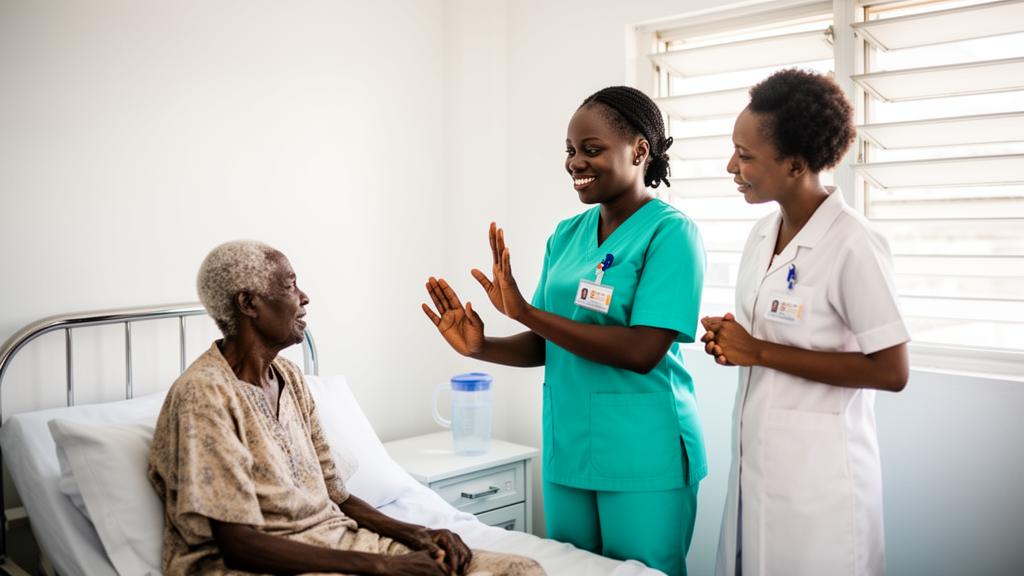
Communication sits at the heart of every clinical encounter, from the first question a nurse asks about symptoms to the final instructions a patient receives before discharge. When that communication breaks down, the consequences can be measured in misdiagnoses, inadequate treatment and poorer health outcomes. A new study from Ghana, published in BMC Nursing, has put hard numbers on one of the most persistent of these breakdowns: the gap between what nurses know and believe about sign language, and what they actually do when a Deaf patient arrives on the ward. The findings reveal a striking paradox, in which nearly every nurse surveyed recognised the importance of sign language for quality care, yet fewer than a third had ever used it in practice.
The research, led by Helena Ami Delali Heymann of the Ashanti Regional Hospital in Kumasi, together with colleagues at Kwame Nkrumah University of Science and Technology, Komfo Anokye Teaching Hospital and the Department of Nursing at KNUST, set out to determine nurses’ knowledge, attitudes and practices regarding sign language usage with Deaf patients. The team used a cross-sectional design, recruiting 140 nurses and midwives at Kumasi South Hospital through simple random sampling. Data were analysed in STATA version 16.0 and Excel, with results presented using descriptive statistics and logistic regression to identify the factors that predicted high knowledge and use of sign language.
The headline numbers tell a story of awareness without action. A large majority of participants, 128 of the 140 surveyed, or 91.4 percent, were aware of the importance of sign language in caring for Deaf patients. Even more emphatically, 96.4 percent agreed that sign language is essential for delivering quality care. Yet when the researchers asked about actual clinical practice, only 31.4 percent reported having used sign language with patients. In other words, roughly two out of three nurses who believed in the necessity of signed communication had never deployed it at the bedside, a discrepancy the authors describe as a gap between positive attitudes and low application in practice.
The statistical modelling added nuance to that picture. Logistic regression showed that nurses aged 21 to 25 years had significantly higher odds of possessing high sign language knowledge, with an adjusted odds ratio of 3.42 and a 95 percent confidence interval of 1.24 to 9.45, and a p value of 0.018. Experience, by contrast, worked in the opposite direction: nurses with 7 to 10 years of professional experience had lower odds of high knowledge, with an adjusted odds ratio of 0.15, a 95 percent confidence interval of 0.03 to 0.65, and a p value of 0.010. The most powerful predictor of high knowledge, however, was attitudinal. A positive attitude toward sign language carried an adjusted odds ratio of 18.57, with a 95 percent confidence interval of 7.26 to 48.28 and a p value below 0.001, making it by far the strongest factor associated with knowing about and understanding signed communication.
These demographic patterns invite careful interpretation. The finding that younger nurses, those in the 21 to 25 age bracket, showed greater sign language knowledge may reflect changes in nursing curricula or generational exposure to disability inclusion, though the study reports the association without attributing a cause. The inverse relationship with mid-career experience is equally intriguing, suggesting that knowledge does not simply accumulate over time on the job. Whatever the mechanism, the implication for workforce planning is clear: sign language competence cannot be assumed to develop spontaneously with seniority, and targeted training may be needed across every career stage, not only for new entrants to the profession.
The stakes of this knowledge gap are far from abstract. Deaf patients face significant challenges accessing healthcare compared with other people with disabilities, precisely because of communication barriers, and those barriers often result in misdiagnoses, inadequate treatment and overall poorer health outcomes. A patient who cannot describe the onset of chest pain, the location of abdominal discomfort or an allergy to a medication is a patient at risk. Nurses are typically the health professionals with the most continuous patient contact, which makes their communicative capacity a critical determinant of safety for Deaf individuals. When signed communication is unavailable, care often proceeds through improvised gestures, written notes or family interpreters, each of which introduces the potential for error and loss of privacy.
The study’s implications for practice, as outlined by the authors, point toward strengthening nurses’ sign language competencies as a route to reducing communication errors, cutting medical mistakes and enhancing patient-centred care for Deaf individuals. They recommend that healthcare facilities integrate structured sign language training and supportive policies to ensure equitable and inclusive nursing practice. The distinction between structured training and informal exposure matters here. Ghanaian Sign Language, abbreviated GSL in the study, is a full language with its own grammar and vocabulary, not a spontaneous system of gestures, and meaningful clinical competence in it requires deliberate instruction, practice and assessment rather than occasional contact with Deaf colleagues or patients.
The institutional context of the research underscores its credibility and its ethical grounding. The study was conducted in accordance with the principles of the Declaration of Helsinki, and ethical clearance was obtained from the Committee on Human Research, Publication and Ethics at Kwame Nkrumah University of Science and Technology under reference number CHRPE/AP/194/25. All participants who agreed to take part signed consent forms, were assured of confidentiality and privacy, and were identified only by generically generated codes known to the principal investigator. The work appears in BMC Nursing as an open-access article, published on 25 September 2026, with the corresponding author listed as Bright Ofori of the Department of Health Promotion and Disability Studies at KNUST.
What makes the findings resonate beyond Kumasi is how faithfully they mirror a global pattern. The authors note that knowledge and use of sign language by nurses worldwide is quite poor, with many healthcare providers lacking essential training to communicate in any sign language. Ghana is not an outlier so much as a sharply documented case of a systemic shortfall. The Ghana National Association of the Deaf, referenced in the study’s abbreviations, represents a national community whose members routinely navigate a health system that speaks a language they cannot hear. For a country committed to universal health coverage, the arithmetic is unforgiving: an attitude that is 96 percent positive but a practice rate of 31 percent leaves a large share of Deaf patients facing their most vulnerable moments without an effective channel of communication.
The path forward suggested by the data is unusually well signposted. Because attitude was the strongest predictor of knowledge, with an odds ratio approaching nineteen, interventions that cultivate positive dispositions toward signed communication are likely to pay dividends in competence as well. Because actual use lags far behind belief, however, attitude alone is insufficient; structured training, institutional policy and accountability must convert goodwill into clinical practice. The authors’ conclusion is measured but firm: most nurses recognise the importance of sign language and hold positive attitudes toward it, yet its application in practice remains low. Closing that gap, they argue, will contribute to reducing medical errors and enhancing patient-centred care for Deaf individuals, turning a near-universal conviction into a daily reality on the hospital ward.
Subject of Research: Nurses' knowledge, attitudes and practices regarding sign language use with Deaf patients in Ghana
Article Title: Nurses’ knowledge, attitudes and practices regarding sign language use with deaf patients in Ghana
Article References: Heymann, H. A. D., Ofori, B., Issaka, Z., Abaya-Kotey, E., & Poku, C. A. (2026). Nurses’ knowledge, attitudes and practices regarding sign language use with deaf patients in Ghana. BMC Nursing. https://doi.org/10.1186/s12912-026-05427-9
Image Credits: AI Generated
DOI: 10.1186/s12912-026-05427-9
Keywords: sign language, Deaf patients, nursing, Ghana, communication barriers, healthcare access, cross-sectional study, logistic regression, patient safety, nursing education, health equity, BMC Nursing
News Source: Ophelia Keating. (October 9, 2026). Ghanaian Nurses Back Sign Language but Few Use It at the Bedside. Scienmag.