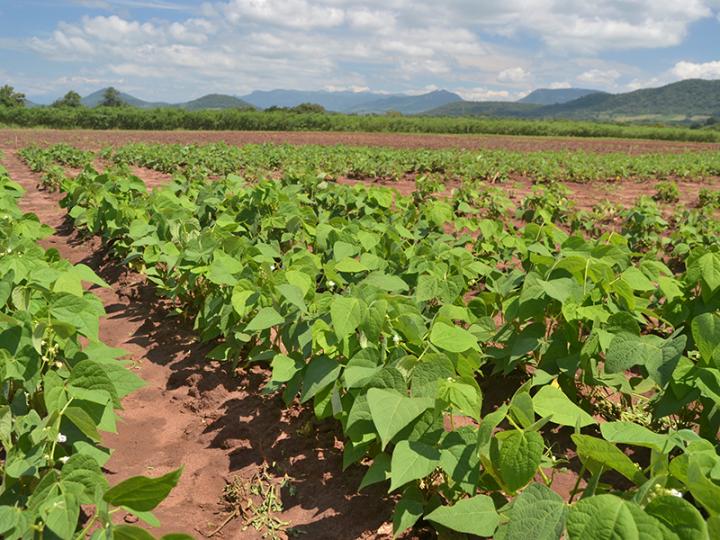
Credit: James Burridge
Roots play a vital role in crop plants. They take up water and nutrients for the plant and keep it help firmly in the ground. But not all roots are the same.
Different plants have different kinds of roots that help them survive in their environment. Two well-known examples are carrots and cactus. Carrots have a long taproot that penetrates deep into the soil. Cacti usually have shallow roots. These allow them to quickly soak up the little rainfall they receive in the desert.
Can studying roots lead to better crops? It’s a question that researchers from Pennsylvania State University set out to answer, focusing on beans. They know that crops like beans are critical for feeding a rapidly growing population.
“Grain legumes are critical for global food security, but achieve low yields in most areas,” says Jonathan P. Lynch, a professor at Pennsylvania State University. “This is especially true in areas of the developing world that experience drought, heat, and low soil fertility.”
Breeding is a way to improve how crops perform in different environments. However, looking at the roots for beneficial characteristics for breeding is rarely done.
“Optimizing how plants get resources from the soil in stressful environments is important for increasing food production, but specific breeding objectives are ill defined,” Lynch says. “We sought to test hypotheses about the link between root system architecture and life strategy in order to generate breeding targets.”
In their study, they analyzed the root systems of several kinds of beans and other legumes, like chickpeas. This allowed them to see tradeoffs and to determine what kind of root characteristics would perform better in certain environments. This can help plant breeders devise better plants.
Roots explore both the topsoil and subsoil. Nutrients like phosphorus and potassium are more present in the topsoil, while water and nitrogen are usually deeper in the soil. They observed that many crops focus on one or the other of these soil layers, which results in a tradeoff.
“Root architecture is an important component of crop adaptation to environments where water and nutrients are lacking,” Lynch says. “We suggest that root phenotypes capable of balancing topsoil and subsoil exploration would be useful.”
The researchers say that breeding programs could use trait-based selection on root characteristics they are interested in. They could then use various techniques to get well-adapted plants with stronger primary roots or longer root hairs, for example.
“Everyone knows that roots are important for crops, especially in poor soils and in dry conditions,” Lynch adds. “However, very few crop breeders actively select for these root characteristics because it can be difficult. This paper is one of a growing number by our team and others showing how specific root characteristics are associated with crop resilience under stress.”
Lynch says his personal goal is to improve food security in developing nations. 850 million people are chronically malnourished around the world and with the human population expanding, the problem will only increase.
Grain legumes have the potential to help address this problem because they are good for the soil and for humans. They take nitrogen from the air and make it usable in the soil and are rich in nutrients humans need like protein, iron, and zinc.
“It is important for us all to recognize the magnitude of the challenge represented by assuring food security for 10 billion people in a degraded global environment,” Lynch says. “We must do what we can to help the next generation of agricultural scientists meet this challenge.”
###
Read more about this research in Crop Science, a publication of the Crop Science Society of America. This work was supported by the Howard G. Buffet Foundation, the United States Agency for International Development, and the U.S. Department of Agriculture’s National Institute of Food and Agriculture.
Media Contact
Rachel Schutte
[email protected]
Related Journal Article
http://dx.