Cells communicate with one another in the language of chemistry, but those from different kingdoms, such as bacteria and yeast, speak dialects virtually unintelligible to the other. By learning how microbes “talk,” researchers hope to one day manipulate their behavior to protect against disease, for example. Efforts like this are in their infancy, but in a new study in ACS’ Nano Letters, researchers describe the first system that enables two unrelated organisms to communicate.
Credit: Adapted from Nano Letters 2022, DOI: 10.1021/acs.nanolett.1c02435
Cells communicate with one another in the language of chemistry, but those from different kingdoms, such as bacteria and yeast, speak dialects virtually unintelligible to the other. By learning how microbes “talk,” researchers hope to one day manipulate their behavior to protect against disease, for example. Efforts like this are in their infancy, but in a new study in ACS’ Nano Letters, researchers describe the first system that enables two unrelated organisms to communicate.
In nature, many cells send and receive chemical signals. This strategy allows bacteria to regulate their behavior, fungi to mate and human cells to notify each other of threats. This type of chemical communication has inspired researchers to devise their own means to join these conversations so they can give cells instructions. While some studies have examined micro- or nano-scale particles that communicate with one type of cell, the use of particles to enable communication between two different types of cells has not been explored. Antoni Llopis-Lorente, Martínez-Máñez and colleagues wanted to create a nano-scale translating device so they could send a chemical signal between members of two different kingdoms of life — something that rarely happens in the natural world.
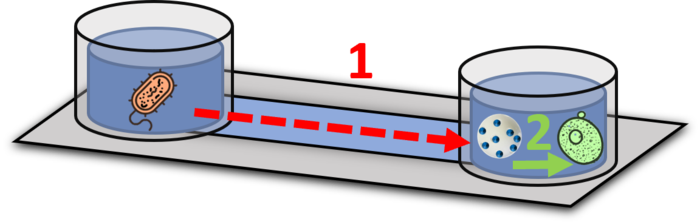
The team built the nanotranslator from silica nanoparticles loaded with two molecules: one that reacts with glucose, and another molecule called phleomycin. The signalling system they constructed had two steps, which they tested independently then put together. First, the researchers initiated a signal by exposing E. coli to lactose. The bacteria converted the lactose into glucose, which reacted with the nano-translator. Next, this device released phleomycin, another messenger compound. The yeast Saccharomyces cerevisiae detected the phleomycin and responded by fluorescing, something they had been genetically engineered to do. The researchers envision many possible applications for similar nanotranslator-based communication systems. For example, these devices could be used to tell cells to turn off certain processes and to switch on others, or to alter the activity of human immune cells to treat disease, the researchers say.
The authors acknowledge funding from the Spanish Government and the Generalitat Valenciana.
For more of the latest research news, register for our upcoming meeting, ACS Spring 2022. Journalists and public information officers are encouraged to apply for complimentary press registration by emailing us at [email protected].
The American Chemical Society (ACS) is a nonprofit organization chartered by the U.S. Congress. ACS’ mission is to advance the broader chemistry enterprise and its practitioners for the benefit of Earth and all its people. The Society is a global leader in promoting excellence in science education and providing access to chemistry-related information and research through its multiple research solutions, peer-reviewed journals, scientific conferences, eBooks and weekly news periodical Chemical & Engineering News. ACS journals are among the most cited, most trusted and most read within the scientific literature; however, ACS itself does not conduct chemical research. As a leader in scientific information solutions, its CAS division partners with global innovators to accelerate breakthroughs by curating, connecting and analyzing the world’s scientific knowledge. ACS’ main offices are in Washington, D.C., and Columbus, Ohio.
To automatically receive news releases from the American Chemical Society, contact [email protected].
Follow us: Twitter | Facebook | LinkedIn | Instagram
Journal
Nano Letters
DOI
10.1021/acs.nanolett.1c02435
Article Title
“Nanoprogrammed Cross-Kingdom Communication Between Living Microorganisms”
Article Publication Date
16-Feb-2022