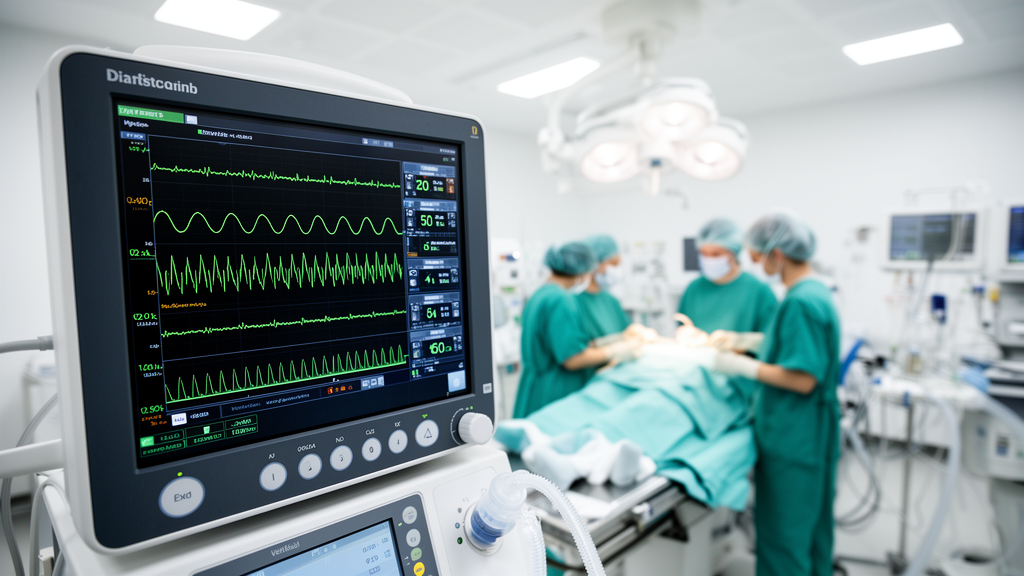
A nationwide prospective cross-sectional assessment of intraoperative ventilation settings in Germany has demonstrated that the vast majority of practicing anesthesiologists routinely adhere to established lung-protective ventilation strategies and low fresh gas flow standards. Conducted by researchers from the NO-HARM Study Group and the German Society of Anesthesiology and Intensive Care Trials Group, the investigation sampled routine surgical cases across hundreds of clinical departments to determine how international clinical recommendations translate into daily operating room workflows. Across the initial national assessment, ventilated surgical patients received a mean tidal volume of 7.4 milliliters per kilogram of ideal body weight, while inhalational anesthesia cases exhibited a median fresh gas flow of 0.60 liters per minute during the maintenance phase. Because the clinical cohort as a whole was already operating well within recommended physiological and ecological boundaries prior to any intervention, a subsequent nationwide educational campaign utilizing standardized pocket cards did not induce significant systemic shifts across the entire national cohort, though it was associated with notable improvements among departmental practices that initially recorded the highest ventilation and gas flow parameters.
The study protocol was established to evaluate two core endpoints reflecting distinct clinical and ecological priorities: a patient-centred primary endpoint defined as tidal volume scaled to ideal body weight, and an environment-centred primary endpoint defined as fresh gas flow during the maintenance phase of volatile inhalational anesthesia. Despite broad professional consensus surrounding these dual imperatives, prior observational literature indicated that translation into regular practice often lagged, leaving uncertainty regarding whether contemporary German anesthesiology teams were systematically applying protective physiological volumes or continued to rely on excessive tidal deliveries and liberal carrier gas volumes during everyday maintenance anesthesia.
To obtain an authentic snapshot of national practice without modifying standard clinical behavior, the coordinating research team designed a pragmatic prospective observational survey encompassing two separate cross-sectional audit dates spaced three months apart, on 15 March 2023 and 16 June 2023. Recruitment began by screening the German Hospital Directory, through which the authors identified and contacted department heads across 1,148 hospital institutions possessing dedicated anesthesiology divisions. Participating facilities agreed to record real-time operational parameters for every active operating room staffed by an anesthesiologist at exactly 9:00 a.m. on each designated collection morning, a standardized time point chosen because most surgical schedules would place patients stably in the maintenance phase of general anesthesia. Anesthesiologists in charge of individual operating rooms documented parameters anonymously on coded, paper-based case report forms, deliberately collecting only objective parameters readily displayed on anesthesia monitors and standard records to prevent observer bias and avoid unmanageable administrative burdens on participating community hospitals.
Departmental participation proved exceptionally robust and representative of Germany’s clinical landscape, with 246 of the 1,148 invited hospital departments participating in the baseline March cross-sectional assessment, and 242 of those departments completing the follow-up assessment in June, reflecting an outstanding institutional retention rate of 98 percent. The geographic distribution of participating centers closely matched national population demographics, with North-Rhine Westphalia accounting for the largest share at 71 departments, or 29 percent of the total sample. Participating hospitals spanned all organizational tiers: 88 departments represented community hospitals with 300 beds or fewer, 87 departments represented intermediate facilities with 301 to 600 beds, and large tertiary institutions with more than 900 beds provided the single largest share of surgical cases at 1,957 operating encounters. Participating anesthesiologists exhibited balanced workforce demographics, with female clinicians making up 46 percent of the surveyed providers in the initial phase and 45 percent in the follow-up audit, and both cohorts reflecting a median anesthesia clinical experience of six years.
Across the two scheduled survey dates, 4,479 surgical operating suites were running concurrently at the designated morning observation hour, and complete observational records were successfully captured from 4,304 of those rooms, yielding a comprehensive collection efficiency of 96 percent. The primary patient-centred ventilation analysis evaluated 3,554 qualifying patients receiving mechanical ventilation via volume-controlled, pressure-controlled, or pressure-support modes, excluding surgical encounters requiring cardiopulmonary bypass or deliberate one-lung ventilation. Pressure-controlled ventilation emerged as the predominant delivery mode, utilized in 2,104 patients or 59 percent of the cohort, followed by volume-controlled ventilation in 1,316 patients representing 37 percent, and pressure-support ventilation in 134 patients comprising 4 percent. Baseline physiological ventilation was remarkably well controlled, presenting a cohort-wide mean tidal volume of 7.4 milliliters per kilogram of ideal body weight with a standard deviation of 1.4 milliliters, shifting marginally to 7.3 milliliters per kilogram with a standard deviation of 1.3 milliliters in the secondary assessment.
Between the two cross-sectional assessments, the research leadership deployed an educational intervention designed to reinforce optimal intraoperative practices through concise clinical recommendations. Rather than imposing prescriptive institutional policies, the authors developed a hard-copy pocket card synthesized through a rigorous three-round remote Delphi consensus process involving eight recognized clinical experts representing German professional anesthesiology societies. The resulting guidance cards delivered explicit recommendations for lung-protective mechanical ventilation settings and minimal-flow anesthesia management, distributed to participating departmental leads after the baseline assessment for voluntary dissemination among local operating room staff. Follow-up measurements collected three months later allowed the investigators to apply an exploratory multilevel linear regression model, adjusting for predefined hospital and patient-level predictors while accommodating clustered institutional variables.
Multilevel regression modeling revealed several clinical and patient factors significantly associated with variations in delivered tidal volume per kilogram of ideal body weight. Potentially injurious ventilation with tidal volumes exceeding 10 milliliters per kilogram of ideal body weight remained uncommon across the German cohort, occurring in only 4 percent of patients at baseline and 3 percent during follow-up, though subgroup analyses noted that 12.8 percent of pediatric cases received volumes above this threshold compared to just 2.6 percent of adult patients.
Parallel analyses evaluating the environmental footprint of volatile inhalational anesthesia identified 2,360 patients receiving volatile agents out of 3,833 general anesthesia cases, with 1,927 stable maintenance encounters qualifying for formal fresh gas flow evaluation. In the baseline assessment, clinicians managed inhalational maintenance with a median fresh gas flow rate of 0.60 liters per minute and an interquartile range of 0.50 to 0.85 liters per minute, which adjusted slightly to a median of 0.50 liters per minute with an interquartile range of 0.45 to 0.75 liters per minute during the post-intervention audit. Multilevel modeling calculated an estimated baseline median flow of 0.6 liters per minute, demonstrating no statistically significant change following the intervention across the aggregate national cohort, with an estimated relative difference of 0.97.
Beyond the primary ventilation and carrier gas endpoints, the cross-sectional audit captured crucial patterns concerning adjunct anesthetic techniques, gas selections, and compliance with national monitoring standards. Furthermore, highly greenhouse-potent desflurane had already been heavily restricted across participating hospitals, and nitrous oxide was administered in only eight surgical cases across the entire multi-institution sample. Conversely, carrier gas flows during the initial anesthesia induction phase remained high, recording an estimated median flow of 2.00 liters per minute at baseline that decreased modestly to 1.50 liters per minute post-intervention. Notable monitoring omissions were also documented: clinicians omitted core body temperature monitoring in one-third of general anesthesia encounters despite explicit professional guidelines, and half of all patients receiving neuromuscular blocking agents lacked quantitative neuromuscular transmission monitoring.
The study authors acknowledged important methodological considerations, emphasizing that observational before-and-after evaluations cannot establish definitive causal relationships between educational pocket cards and subtle adjustments in clinical delivery. The modest aggregate effect of the intervention largely reflected a ceiling effect, as baseline German practice already conformed closely to modern recommendations, leaving minimal room for dramatic cohort-wide reductions. In addition, the self-reported nature of the survey and voluntary departmental enrollment introduced potential selection bias toward research-engaged and teaching hospitals, while post hoc quintile improvements must be interpreted cautiously due to potential regression to the mean. Nevertheless, capturing verified parameters across 4,304 operating suites confirms that protective ventilation is entrenched in German operating rooms, while highlighting targeted educational opportunities in wash-in induction gas flows, objective physiological monitoring adherence, and specialized pediatric ventilator management.
Subject of Research: Intraoperative ventilation parameters and fresh gas flow practices in German anesthesiology departments
Article Title: Intraoperative ventilation settings in Germany: an observational multicentre cross-sectional study
Article References: Grüßer, L., Keszei, A., Rossaint, R., Zingraf, B., Wallqvist, J., Goldmann, S., Coburn, M., Güldner, A., Hachenberg, T., Hönemann, C., Koch, T., Mierke, B., Schuster, M., Wrigge, H., Schuler, J., Larmann, J., Kowark, A., NO-HARM Study Group, Wittkowski, U., … Wittmann, M. (2026). Intraoperative ventilation settings in Germany: an observational multicentre cross-sectional study. Canadian Journal of Anesthesia/Journal canadien d'anesthésie, 73(9), 866-879. https://doi.org/10.1007/s12630-026-03172-w
Image Credits: AI Generated
DOI: 10.1007/s12630-026-03172-w
Keywords: mechanical ventilation, intraoperative ventilation, lung-protective ventilation, tidal volume, fresh gas flow, inhalational anesthesia, volatile anesthetics, positive end-expiratory pressure, educational intervention, Delphi technique, multicentre cross-sectional study, anesthesiology departments, ideal body weight, operating room practices, neuromuscular monitoring, temperature monitoring, closed-loop systems, driving pressure
News Source: Ophelia Keating. (November 23, 2026). German Operating Rooms Demonstrate Broad Adherence to Lung Protective Ventilation Guidelines. Scienmag.