


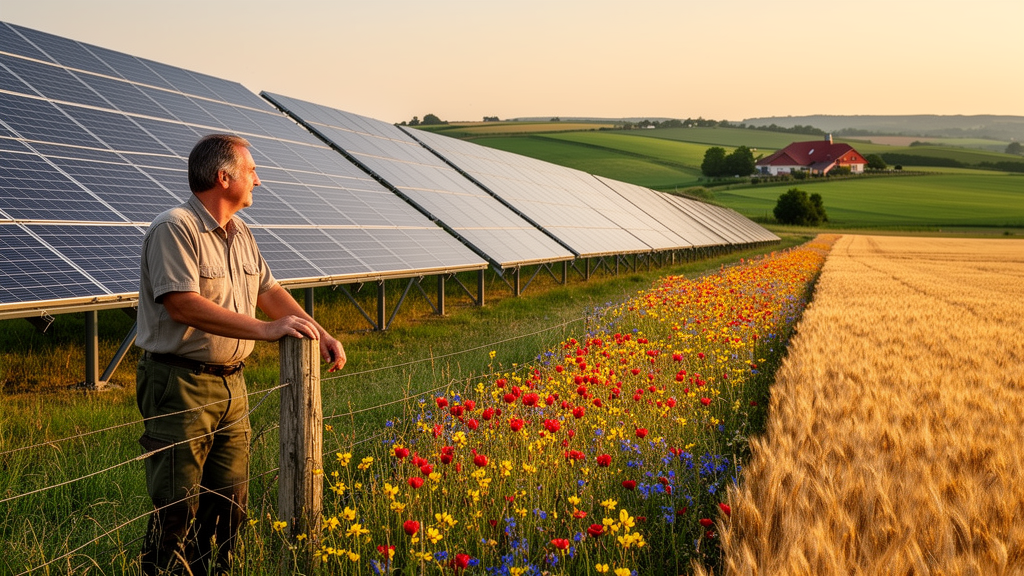
German farmers are broadly enthusiastic about generating renewable energy on their land, but they are deeply sceptical about one of the most talked-about ideas for combining energy production with nature conservation: installing photovoltaic panels on flowering strips. That is the central picture emerging from a case study in northwest Lower Saxony, Germany, published in the journal Energy, Sustainability and Society, which combined an online survey of 51 farmers with five in-depth narrative interviews conducted on their farms.
The study area, the Weser-Ems region of Lower Saxony, encompasses 14,986 square kilometres, of which 9,119 square kilometres are agriculturally used. Across Lower Saxony as a whole, 2.6 million hectares are under arable cultivation, and around 30 percent of farms already use photovoltaic systems, mostly on rooftops, to generate additional income.
The survey revealed that renewable energy installations are already widespread among respondents. Seventy-nine percent of farms had established renewable energy systems, 5 percent were planning additional systems, and 19 percent planned to obtain them for the first time. Of the farms with existing installations, 64 percent had photovoltaics, while 21 percent ran wind, biogas or other systems only. Among the farms planning new installations, every single one chose photovoltaics, with a small share also aiming for wind energy. The average farmer in the survey was 44.6 years old, 79 percent were male, and the average farm covered 70.4 hectares, of which 66.3 hectares were arable land.
When asked why they had installed renewable energy systems, the farmers’ answers were strikingly pragmatic. Income generation was the main motivation for 66 percent, followed by the wish to be energetically independent at 29 percent. Contributing to climate and nature conservation came in last, cited by just 5 percent. The authors note that this aligns with findings from Swedish farmers and with research showing that climate mitigation measures are often appreciated for offering farm-beneficial functions other than climate change mitigation itself. In the interviews, self-determination emerged as a powerful theme: one farmer spoke of wanting his own energy sources to be more self-sufficient, while another described generating electricity, self-sufficiency and participation as motivations, adding that she deliberately took no subsidies because she could do better on her own without extensive specifications.
Flowering strips told a different motivational story. Just over half of the surveyed farmers, 52 percent, had established flowering strips on their farms, covering an average of 2.3 hectares per farm, or about 1.4 percent of those farms’ total area. Among farmers who had established them, the top motivation was a personal contribution to biodiversity, cited by 56 percent, with funding a distant second at 25 percent. Among those who had not established them, the main reasons were seeing no benefit, cited by 42 percent, an expected increase in workload at 31 percent, and too much bureaucracy at 12 percent. The interviews suggested that for many farmers, biodiversity and sustainability were simply seen as a natural part of the job rather than a distinct project, with one interviewee remarking that using resources sparingly was how farmers had always thought.
The most consequential finding concerned the hypothetical dual-use scenario in which photovoltaic systems would be installed on flowering strips. Under the current remuneration system, 95 percent of participating farmers said they would not, or would probably not, install such a combination. The main disadvantage, seen by 53 percent of farmers, was the withdrawal of land from agricultural production for a longer period, followed by increased maintenance effort. More than a third, 35 percent, could see no advantage in the combined use at all, and 27 percent saw economic profit as the top advantage, but only on the condition that both the photovoltaic system and the flowering strip would be financially supported. Notably, 46 percent of farmers said they did not feel qualified to assess the effect of photovoltaic systems on the biodiversity of flowering strips, 28 percent assumed a negative effect, 26 percent assumed no effect, and none assumed a positive effect.
The interviews also laid bare the bureaucratic and legal obstacles that discourage farmers from adopting renewable energy. All five interview participants mentioned the immense administrative effort required, and several described frustrating encounters with local authorities. One farmer had his application for a small photovoltaic system on unused land rejected outright because the district feared a flood of similar applications. Another, who operates a biogas plant, was sued by the district because the plant’s performance differed from its registered performance, and described feeling anxious and unfairly treated despite doing what everyone talks about in terms of environmental protection and sustainability. The authors conclude that clear and simple workflow structures and designated contact persons at district level could meaningfully improve support for farmers.
The study’s authors argue that successful adoption of dual-use systems combining photovoltaics with flowering strips would require reducing bureaucratic obstacles, designing landscape-integrated solutions, and respecting fertile land, while also taking farmers’ emotions and observations into account. Farmers in the survey preferred high-mounted or medium-high photovoltaic systems beneath which agricultural management could continue, indicating an effort to mitigate land-use conflicts. Aesthetic considerations also played a role: 26 percent of farmers thought the combination would be detrimental to the landscape’s aesthetic value, and one interviewee expressed a clear preference for small-scale energy systems over large parks that dominate the landscape, describing the barren areas created under large panel arrays as bad for both landscape and biodiversity.
Looking ahead, the researchers propose several policy directions, including amending national laws to better consider the intersection of energy law and environmental law, creating a single main contact point for renewable energy and biodiversity issues, developing a practical guide for farmers covering legal, tax and inheritance aspects, and exploring whether state agencies could lease land from farmers to set up renewable energy combined with biodiversity measures. They stress that understanding the different motivations of farmers is essential for developing future policies that support rural transformation processes in economic, environmental, social and aesthetic terms, since farmers shape rural areas economically, ecologically, socially and aesthetically and are therefore central to any transformation process.
The authors caution that their findings come from a single case study region in northwest Germany with a modest sample size, so the results should be read as a detailed portrait of one farming community rather than a nationally representative picture. Nevertheless, the study offers a rare combined quantitative and qualitative view of how farmers weigh income, independence, bureaucracy, land stewardship and landscape aesthetics when deciding what to do with their fields. As Germany pursues targets of 400 gigawatts of photovoltaic capacity, an expansion estimated to require some 280,000 hectares of agricultural land by 2040, the attitudes of the farmers who work that land may prove decisive for whether energy and biodiversity goals can be reconciled in the countryside.
Subject of Research: Farmers' attitudes towards renewable energy, biodiversity and combining photovoltaics with flowering strips in northwest Germany
Article Title: German farmers’ attitudes towards renewable energies, biodiversity, and a combination of both – a case study based on results from an online survey and in-depth interviews
Article References: Baumann, K., Scheffler, M., Aka, C., & Kayser, M. (2026). German farmers’ attitudes towards renewable energies, biodiversity, and a combination of both – a case study based on results from an online survey and in-depth interviews. Energy, Sustainability and Society, 16(1), Article 50. https://doi.org/10.1186/s13705-026-00613-8
Image Credits: AI Generated
DOI: 10.1186/s13705-026-00613-8
Keywords: renewable energy, photovoltaics, biodiversity, flowering strips, farmers, Germany, Lower Saxony, agriculture, dual land use, online survey, in-depth interviews, energy policy
News Source: Faith Mcneil. (October 28, 2026). German farmers weigh solar power, flower strips and the future of their land. Scienmag.



