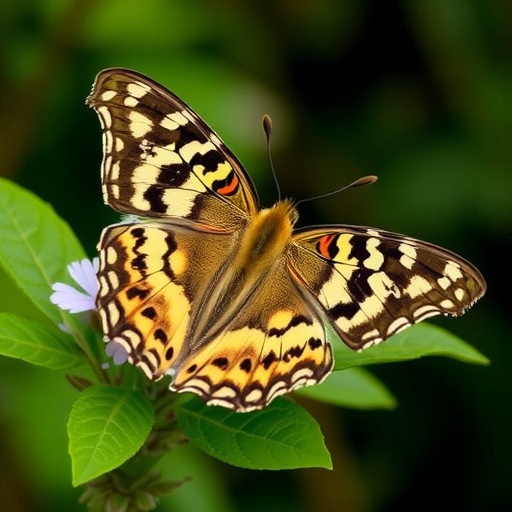
In the dense, vibrant rainforests stretching across South and Central America, a remarkable evolutionary marvel is unfolding in the form of a tropical butterfly genus that defies traditional biological limits on lifespan. According to a groundbreaking study led by researchers at the University of Bristol, as published recently in Nature Communications, Heliconius butterflies have evolved a sophisticated anti-aging mechanism that dramatically extends their lifespans compared to their close relatives. This discovery not only challenges existing paradigms surrounding insect longevity but also opens a new frontier in understanding the molecular and physiological bases of aging in natural populations.
Heliconius butterflies, widely distributed throughout neotropical ecosystems, have long intrigued biologists due to their exceptional longevity. Unlike most butterfly species, which complete their adult phase within a few weeks, Heliconius butterflies exhibit lifespans that soar to nearly a full year, with median lifespans averaging around three times those of closely related species. Specifically, Heliconius hewitsoni can live up to 348 days in the wild, a staggering contrast to the mere 14 days observed in its relative Dione juno. This magnified difference—in terms of maximum lifespan—exceeds a 25-fold disparity, presenting a natural laboratory to investigate the factors that contribute to longevity.
Delving into the evolutionary dynamics behind this phenomenon, the research team employed an integrative methodology that combined field observations, controlled insectary experiments, and mark-release-recapture studies across multiple Heliconiini tribe species. This multifaceted approach allowed the scientists to quantify not only lifespan but also the patterns of physiological aging, including metrics such as physical performance decline via grip-strength assessments. Intriguingly, in some Heliconius species like Heliconius hecale, the expected decline in physical capabilities that accompanies aging in most organisms was virtually absent, underscoring an evolved resistance to senescence.
The research highlights a unique ecological adaptation: adult pollen feeding. Heliconius butterflies are one of the few lepidopteran groups capable of digesting pollen throughout their adult lives, contrasting with the nectar-reliant feeding habits of most butterflies. This dietary specialization appears intricately linked to their extended healthspan and longevity. Pollen is a rich source of proteins and amino acids, which are hypothesized to support enhanced somatic maintenance and cellular repair mechanisms, potentially underpinning slower rates of aging and sustained physiological function.
To rigorously test the relationship between diet and aging, the study contrasted Heliconius hecale with its non-pollen-feeding relative Dryas iulia under controlled conditions that varied access to pollen. Remarkably, while Heliconius hecale individuals sustained their muscular function and body mass longer and evaded typical age-related deterioration, even those deprived of pollen retained a longevity advantage relative to Dryas. This finding implies that while pollen feeding contributes nutritionally, intrinsic genetic or epigenetic adaptations also play a critical role in extending lifespan, suggesting a complex interplay between evolved traits and ecological factors.
From an evolutionary biology perspective, the divergence in longevity and aging rates within the Heliconiini tribe exemplifies natural selection’s power in shaping life-history traits in response to ecological niches and resource utilization. The accelerated lifespan and delayed senescence in Heliconius suggest that adaptive shifts—such as adult pollen feeding—can drive profound modifications in physiology and perhaps modulate molecular pathways linked to aging, including oxidative stress resistance, protein homeostasis, and metabolic regulation.
The implications of this research extend beyond the entomological sphere, offering a promising model for the biology of aging and lifespan extension. Insects have already revealed fundamental insights into genetic regulation and cellular processes, and the Heliconius genus introduces a new dimension by combining extraordinary longevity with ecological and evolutionary relevance. Decoding the molecular mechanisms enabling Heliconius butterflies to circumvent typical aging processes could illuminate targets for biomedical research into human healthspan and age-related diseases.
Jessica Foley, the study’s lead author, emphasized the significance of these findings within the broader context of longevity research. Highlighting the vast interspecies disparity in lifespan—from ephemeral mayflies surviving mere days to ant and termite castes living decades—she notes that Heliconius butterflies offer a naturally evolved system to decode the underlying biology that governs such diversity. Their relatively recent evolutionary divergence from short-lived relatives strengthens the value of this natural comparative experiment.
Furthermore, the study underscores the utility of integrating ecological, physiological, and evolutionary data to unravel complex biological phenomena. By blending fieldwork with laboratory precision, the researchers were able to identify robust patterns of aging and performance that are rarely accessible in wild insect populations. This holistic approach models a pathway forward for future studies aimed at dissecting the multifactorial influences on longevity and healthspan.
In conclusion, the revelation that Heliconius butterflies not only live exceptionally long lives but also maintain functional integrity well into old age represents a profound breakthrough in understanding natural aging mechanisms. Their case underscores how dietary innovations and evolutionary pressures can collectively sculpt lifespan, challenging the limits traditionally imposed by physiology. As research progresses, the Heliconius genus is poised to emerge as a vital model system, shedding light on the deep evolutionary roots of ageing and longevity and potentially inspiring novel therapeutic approaches for age-associated conditions in humans.
Subject of Research: Animals
Article Title: Evolution of increased longevity and slowed ageing in a genus of tropical butterfly
News Publication Date: 16-Jun-2026
Web References: 10.1038/s41467-026-73635-7
Image Credits: Louise Bestea
Keywords: Insects, Lepidoptera, Rainforests, Tropical forests, Evolutionary biology
Tags: anti-aging mechanisms in insectsbutterfly longevity researchevolutionary adaptations in insectsevolutionary biology of butterfliesHeliconius butterfly lifespanHeliconius hewitsoni lifespaninsect lifespan comparisonmolecular basis of aging in insectsneotropical butterfly speciesphysiological aging in butterfliesrainforest butterfly speciestropical butterfly longevity